



The Hidden Costs of Ignoring Automation: How Industrial Firms Lose Profit, Jobs, and Flexibility
Every economic cycle forces industrial leaders to ask the same hard questions: Where should we invest next? When will demand rise? How can we attract top talent while staying profitable? What strategic risks loom?
Growth in manufacturing often gets reduced to three headline variables: overall demand, input costs (labor and raw materials), and the adoption of new processes or technology that boosts competitiveness and profitability.
In many sectors the third factor—technology—is treated as a wild card. While demand and input prices are predictable, the impact of automation is harder to forecast, which in turn discourages firms from pursuing projects that could deliver substantial returns.

Automation is not a replacement for human labor; it is a multiplier of productivity. By streamlining repetitive tasks, automation reduces material waste, offsets labor cost volatility, and gives firms the flexibility to scale operations in response to demand swings—particularly when market prices are low.
Amplifying Labor Productivity
The myth that automation eliminates jobs is outdated. Since the Industrial Revolution, automation has created more jobs than it has displaced, with lower inequality and higher wages. It is economic downturns, not automation itself, that drive labor cuts.
When workers lack the right tools, productivity stalls. Automation can bridge that gap, turning repetitive, hazardous tasks into high‑precision, low‑risk operations that free human talent for more value‑added roles.
Statistics Canada’s 20‑year study shows that firms using robotics employ 15% more people than comparable firms that do not, and those workers enjoy greater autonomy and equity in goal setting. This evidence suggests that automation, when used to augment existing talent, can grow a business while creating jobs.
Saving on Materials
Material cost overruns—often driven by rework and waste—are a top driver of industrial inefficiency. Global raw‑material prices have been above the 100‑point index benchmark for most of the past decade, a trend that traces back to the 2008–2009 recession.

Regulatory pressure for environmental stewardship can spur “induced innovation,” pushing firms to adopt cleaner, more efficient processes. Automation—particularly robotics—can deliver 20–30% savings in consumables, reducing material costs per unit and improving overall profitability.
Flexibility in Response to Demand
Effective automation reduces incremental costs, enabling firms to launch short‑run production runs that remain profitable even as demand fluctuates. Low fixed costs are a proven driver of resilience, allowing companies to respond swiftly to market peaks and troughs.

By automating routine tasks, firms can lower both fixed labor and energy costs. Autonomous solutions—where machines operate on pre‑programmed instructions—further reduce fixed labor expenses, freeing capital to hire additional staff during high‑demand periods.
In the U.S., unit labor costs have risen sharply since 2008‑09, constraining job growth and flexibility. Automation that augments labor is the most viable path to restoring balance.
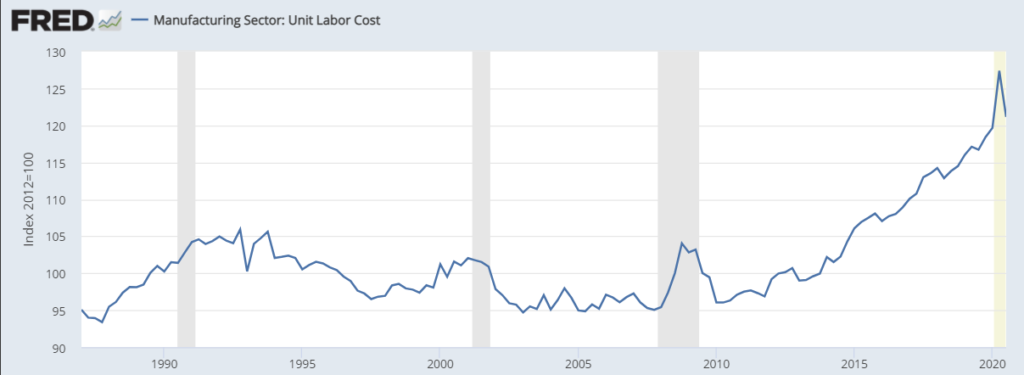
Reducing fixed costs by even 10% can significantly boost profits at the peak of a cycle while mitigating downside risk, given that fixed costs can represent 30–40% of total costs during growth periods.
Industrial Automation Is About Autonomy
High‑mix manufacturers often see automation as an energy burden because each new part requires re‑programming. Autonomous manufacturing systems overcome this by using 3D vision and AI to plan and execute operations without manual coding.
Omnirobotic’s Autonomous Robotics Technology for Spray Processes exemplifies this shift. Robots can see parts, autonomously plan motion, and perform coating and finishing tasks—enabling high‑mix production with zero manual programming.
See what kind of payback you can get from it here.
Industrial robot
- Understanding the NOT Gate (Inverter) in TTL Circuits
- Cutting 3D Printing Material Costs: Unlocking ROI and Sustainability
- Justifying Factory Automation: Expert Insights on ROI, Implementation, and Best Practices
- Navigating the COVID-19 Recession: Automation’s Role in Manufacturing Resilience
- Opinion: Automation Enhances, Not Replaces, Human Workforce
- Why Delaying Automation Costs You More: The Hidden Opportunity Cost
- Automation: Empowering Tomorrow’s Workforce, Not Fear
- The True Cost of Crane Downtime: Reducing Hidden Losses
- Leveraging Robot Automation for Efficiency in the Paper Industry
- Revolutionizing Manufacturing: The Power of Industrial Automation