



Software Testing Techniques: Types, Benefits, and Drawbacks
Software testing techniques are systematic methods used by quality assurance professionals to assess whether a system or component meets its specified requirements. By rigorously applying these best‑practice techniques, teams uncover gaps, defects, and unmet requirements early, safeguarding product quality, performance, security, and user experience.
What Are Testing Techniques?
In the seminal work “Testing Techniques” by Kaner, Bach, and Pettichord, testing is framed as a five‑fold system that guides every test effort:
- Testers – the individuals who execute the tests
- Coverage – the components or functionalities that are examined
- Potential Problems – the defects or issues the test seeks to uncover
- Activities – the methods or approaches employed during testing
- Evaluation – the comparison of results against expectations to determine success
All testing activities revolve around these dimensions, and selecting the right technique allows teams to focus on the most relevant aspects of a project.
Types of Testing Techniques
Choosing the appropriate technique depends on the software’s requirements and the stage of development. Below are the two primary families of techniques that most teams rely on.
Black‑Box Testing
Black‑box testing validates functionality without any knowledge of the internal code structure. It is often called specifications‑based testing because it treats the system as a “black box” that only exposes inputs and outputs.
Typical black‑box methods include:
- Equivalence Partitioning – divides input data into valid and invalid partitions and tests each once.
- Boundary Value Analysis – focuses on values at the edges of input ranges, where defects frequently occur.
- Cause‑Effect Graphing – models relationships between inputs (causes) and outputs (effects) using a visual graph.
- Error Guessing – leverages tester experience to anticipate and probe for likely faults.
- All‑Pairs Testing – a combinatorial approach that covers every pair of parameter values.
White‑Box Testing
White‑box testing examines the internal structure of the application, such as code paths, branches, and logic. It is also known as structural or clear‑box testing and is typically applied at unit, integration, and system levels.
Key white‑box coverage metrics include:
- Statement Coverage – ensures every executable statement is executed at least once.
- Branch Coverage – verifies that every possible branch in decision points is taken.
- Path Coverage – tests all possible execution paths through the code.
Types of Software Testing Techniques
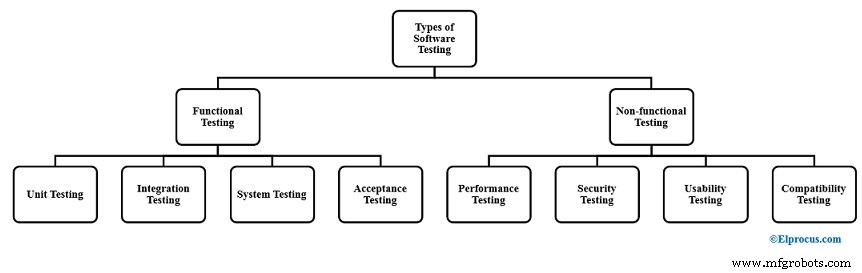
Software testing can be broadly divided into functional and non‑functional categories, each with its own sub‑techniques and goals.
Functional Testing
Functional testing verifies that every feature behaves as expected. It is subdivided into four main phases:
Unit Testing
Each isolated module or function is tested against its design specifications, focusing on logic, data structures, and boundary conditions.
Integration Testing
Individual units are combined and exercised together to detect interface and interaction defects.
System Testing
All hardware and software components are integrated and tested as a complete system to ensure overall compliance with requirements.
Acceptance Testing
Confirms that the finished product is ready for delivery. Alpha testing occurs within the development environment, while beta testing involves real users outside the organization.
Non‑Functional Testing
Non‑functional testing assesses attributes that affect user experience and system performance. Common categories include:
Performance Testing
Measures how the application behaves under load. Sub‑types include load, stress, endurance, and spike testing.
Security Testing
Identifies vulnerabilities and verifies that data protection measures are effective.
Usability Testing
Ensures the product is intuitive and user‑friendly for its target audience.
Compatibility Testing
Validates that the software operates correctly across different operating systems, browsers, and devices.
Advantages and Disadvantages of Testing Techniques
When executed effectively, testing yields numerous benefits:
- Enhanced efficiency and defect detection early in the lifecycle.
- Improved product quality and customer satisfaction.
- Higher revenue potential through reliable releases.
- Optimized user experience and brand reputation.
- Alignment with business objectives and risk mitigation.
However, challenges remain:
- Requires clear communication and coordination among stakeholders.
- Competition among service providers can drive up costs.
- Shortage of seasoned testing professionals.
- Difficulty selecting the right testing partner.
FAQs
1) Statement coverage and branch coverage are which type of testing techniques?
White‑box testing.
2) What is unit testing?
Testing each component or unit of software individually.
3) Boundary value analysis can be found in which type of testing?
Black‑box testing.
4) Which type of testing combines individual units for testing?
Integration testing.
5) Testing attributes such as performance, usability, security, reliability, and quality falls under which type?
Non‑functional testing.
6) What is beta testing?
External acceptance testing performed by end users.
7) Load testing is a type of testing technique?
Performance testing.
8) What is system testing?
Testing the integrated hardware and software components of a system as a whole.
In summary, mastering software testing techniques—black‑box, white‑box, and the broader functional/non‑functional categories—empowers teams to deliver defect‑free, high‑quality products that meet business goals and delight users.
Embedded
- Debugging in Embedded Systems: Types, Techniques, and Tools for Reliable Software
- Virtual Machines Explained: Types, Architecture, and Key Advantages
- Pigment Printing: Benefits, Drawbacks, and Applications in Textile Manufacturing
- Benefits of Aluminum Castings: Speed, Precision, and Value for Modern Manufacturing
- Understanding Casting Patterns: Types, Materials, and Their Impact on Quality
- Forging Process: Types, Operations, Applications, Benefits & Drawbacks Explained
- Process Planning Explained: Steps, Types & Key Benefits
- Horizontal Machining Centers: Key Benefits, Drawbacks, and Their Impact on Production Efficiency
- Exploring the 7 Core Types of Technology
- Explore the 4 Key Types of Hydraulic Motors and Their Applications