



The Road Ahead: How Long Will the Shift to Autonomous Vehicles Take?
I recently attended the inaugural AutoSens Conference in the United States, a gathering that not only showcased cutting‑edge technology but also offered a memorable experience. Detroit, the birthplace of the automotive assembly line, served as the venue, positioning the city at the forefront of the next mobility revolution: mass‑produced autonomous vehicles.
A standout highlight was the M1 Concourse race track, a country‑club‑style venue featuring private garages and a state‑of‑the‑art 1.5‑mile performance circuit. The conference included autonomous test drives by Dataspeed, a specialist in driverless technology.
After the day’s sessions, we dined at the Henry Ford Greenfield Village, a historic tribute to pioneers such as Ford, Edison, and the Wright brothers. Sharing the space with a live Dataspeed self‑driving car was a genuine 1917 Ford Model T, the first assembly‑line automobile that transformed personal transport. Seeing these two vehicles side by side prompted reflections on the challenges and similarities between the horse‑carriage era and today’s autonomous transition.
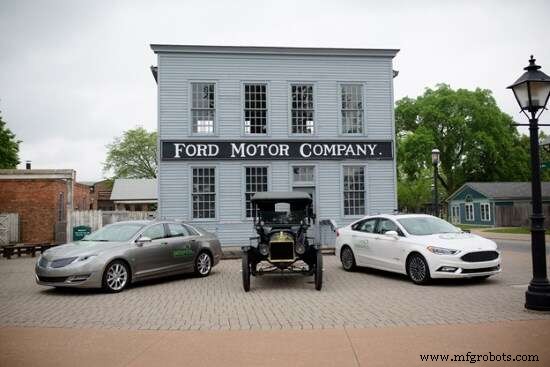
The juxtaposition of a Ford Model T (circa 1917) with a pair of 2017 self‑driving cars powered by Dataspeed (Source: OpenBoxPhoto.com, courtesy of Dataspeed)
The Earth‑Shattering Revolution of the Automobile
A century ago, horse‑drawn carriages dominated roads, and the idea of a car without a horse seemed radical. Like many inventions, early automobiles faced skepticism—they were deemed dangerous, imposing, and a nuisance to the equine transport that had long prevailed. The transition from horse to car was gradual and fraught with obstacles, as illustrated by a now‑infamous law requiring drivers to dismount and announce themselves at every intersection with a loud noise—sometimes even a firearm or other explosive.
Investors were equally cautious. According to AmericanAutoHistory.com, in 1903 the president of the Michigan Savings Bank warned against investing in Ford Motor Co., arguing that "The horse is here to stay but the automobile is only a novelty—a fad." Today we can view that skepticism in hindsight, yet it mirrors the cautious stance many take toward autonomous vehicles today.
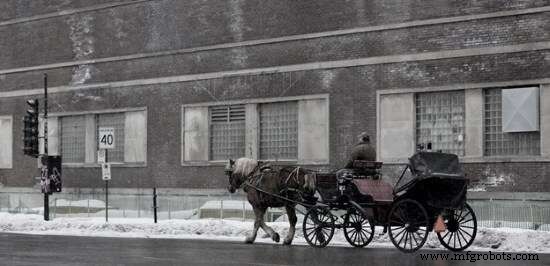
"The horse is here to stay but the automobile is only a novelty—a fad." – Michigan Savings Bank President, 1903 (Source: Unsplash.com)
From a future perspective, the initial reluctance to embrace motor vehicles was not dissimilar to today’s hesitancy toward autonomous systems. As history suggests, gradual adoption ultimately leads to dominance—hence the expectation that autonomous vehicles will soon become the primary form of personal transport, especially in urban and densely populated areas.
We may anticipate the near‑complete phase‑out of manual cars within about thirty years, reserving them mainly for hobby or leisure—much like horses today. As my colleague Gunn noted, even racing could eventually be overtaken by autonomous technology.
Self‑Driving Cars Are the Next Big Change; Mass Production Is Key
Prior to the Model T, automobiles were luxury items inaccessible to the masses. The assembly line, perfected by Ford, increased production, necessitating new infrastructure—roads, traffic regulations, and safety standards. To ignite the next revolution, autonomous vehicles must also achieve mass production and competitive pricing. As the cost of self‑driving systems decreases, their accessibility and appeal will expand.
Can You Trust Artificial Intelligence to Drive You Around?
Historical skepticism of the automobile finds a modern counterpart in doubts about AI. Concerns about reliability, failure modes, and reaction times echo those that once plagued early drivers. Today, however, data shows that human‑driven cars are less safe than many modern autonomous prototypes—yet widespread public trust has grown through experience, infrastructure, and regulation.
Deep learning and related AI technologies have advanced rapidly, outperforming humans in games like Go, image recognition, and increasingly in complex decision‑making tasks. These advances underpin the safety and reliability of future autonomous vehicles.
The Assembly Line Made Car Manufacturing Efficient; DSPs Are Making AI Efficient
A major hurdle for autonomous vehicles is embedding powerful AI in compact, low‑power systems. Traditional AI workloads require large servers, but automotive applications demand smaller, energy‑efficient solutions. Digital Signal Processors (DSPs) and specialized vision processors like the CEVA‑XM6 enable ultra‑low‑power, high‑precision computer vision, while development is streamlined via tools such as the CDNN deep‑learning toolkit.
Learn more about these technologies by watching our on‑demand webinar: Challenges of Vision‑Based Autonomous Driving & Facilitation of an Embedded Neural Network Platform.
Embedded
- How 5G is Transforming Smart Factories into High‑Performance Powerhouses
- The Birth of NASCAR: From Moonshine Racers to Modern Motorsports
- Ethernet: The Backbone of Autonomous Vehicle Reliability
- Why Autonomous Operator Maintenance Drives Efficiency and Workforce Empowerment
- Revolutionizing Cars: How 3D Printing Is Transforming Automotive Design and Production
- Electric Vehicle Surge: How Growing Demand Shapes the Global Supply Chain
- Why the United States Is Poised to Lead Global Manufacturing
- How Long Does It Take to Charge a 3D Pen? Expert Guide to Safe Charging Times
- How Industry 4.0 Will Transform Manufacturing: Key Impacts & Opportunities
- The Future of Autonomous Vehicles: Technology, Challenges, and Innovations