



Digital Car Keys: Beyond Unlocking to Secure Authentication
Automakers, smartphone makers and chip suppliers have been refining “digital car keys” for years. Thanks to the Car Connectivity Consortium (CCC), a cross‑industry body, the industry has converged on a single standard for unlocking vehicles, as Rainer Lutz, NXP Semiconductors’ director of digital key and NFC segments, explained.
Once a key is digital, its potential far exceeds simple lock and unlock. Automakers envision starting engines via smartphones, authenticating drivers, sharing keys with authorized users, and revoking access instantly.
NXP Semiconductors has just launched an “automotive digital key solution” that lets smartphones, key fobs and other mobile devices communicate securely with vehicles. Importantly, these keys authenticate users, configure driving rights and attach entitlements. The architecture is built on the CCC’s Standardization Release 2.
NXP’s secure element family, the NCJ38A, is an automotive‑qualified microcontroller featuring advanced cryptographic accelerators and resistance to physical and electrical attacks. Built on an Arm SecureCore SC300 processor, it stores security applications and confidential data.
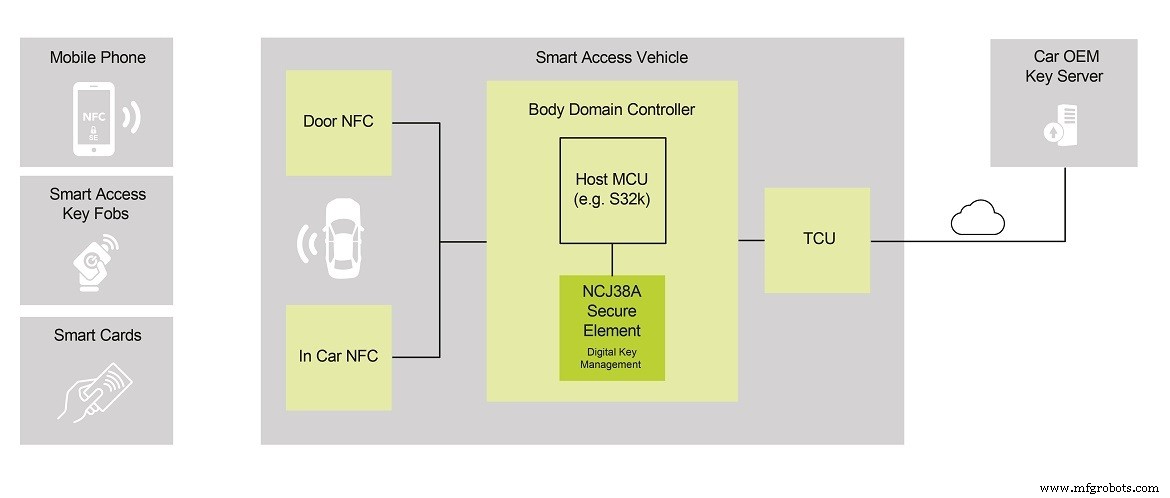
NXP Secure Element Application Block Diagram (Source: NXP)
Who benefits?
Digital car keys do not render traditional keys obsolete; instead, they allow smartphones or key fobs to double as keys. If you lose a physical key, you can still enter and start the car with your phone.
Sharing becomes seamless. Because the key is digital, a single key can be granted to family members, friends, or rental services without the need for multiple physical copies. “You can even start an Air B&B business,” Lutz noted.
Equally important is the ability for owners or OEM services to remotely suspend or terminate a key if a vehicle is stolen or misused.
For all this to work, the digital key must communicate securely and authenticate the user reliably. NXP is confident it can deliver, leveraging its automotive‑qualified Secure Element and NFC chipsets while complying with the CCC’s Standardization Release 2.
Secure container
Lutz highlighted that, beyond secure chips, NXP offers a “container” for secure applets. This container can store multiple keys—private, company, rental—or even a one‑time key for delivery services, giving drivers granular control.
Because NXP has supplied these secure elements and NFC chipsets to phones and key fobs for years, it has a head start: all chips have been rigorously tested for interoperability on both cars and smartphones.
Adhering to the CCC’s Digital Key Release 2, which is supported by 107 member companies—including Volkswagen, Toyota, BMW, GM and Honda—adds credibility. The standard guarantees that the solution is car‑ and device‑agnostic and fully interoperable.
Release 2 stands out for two reasons. First, it relies on NFC, which creates a secure link between a mobile device and a vehicle. Because NFC operates independently of the phone’s OS, it works even when the battery is low.
BLE and UWB add an extra security layer
Automakers are now integrating Bluetooth Low Energy (BLE) and Ultra‑Wide Band (UWB) to enhance security. These technologies will be defined in CCC Release 3.
According to the CCC, “Digital Key Release 3.0 will build on Release 2.0 by adding passive, location‑aware keyless access.”
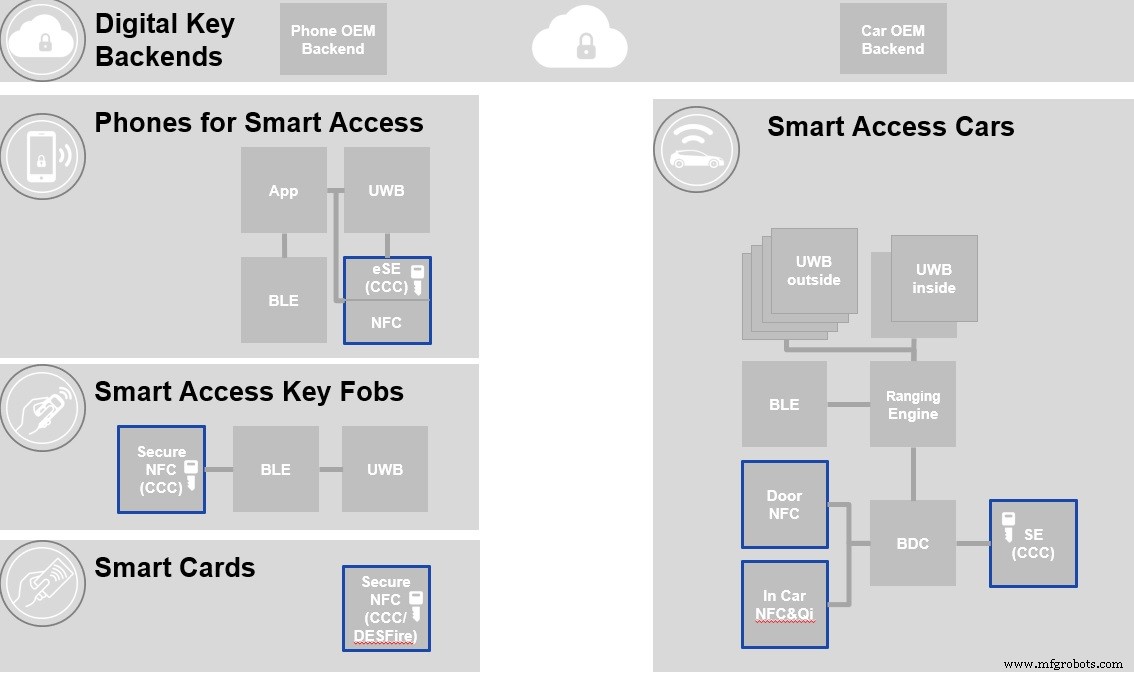
The Smart Car Access Ecosystem (Source: NXP)
Consumers will no longer need to pull out their phones to unlock a vehicle. Instead, a phone can stay in a bag or pocket, and when it comes within a two‑meter range, the car can detect the driver’s proximity via BLE and UWB and enable passive keyless access.
BLE initiates the connection, while UWB provides precise location data. NXP plans to incorporate BLE and UWB ICs into future digital key solutions following the CCC’s Release 3 specifications, though it has not yet disclosed a timeline.
Embedded
- Allen Keys Explained: How to Use and Maintain Hexagonal Socket Fasteners
- Embedded Vision Drives Innovation Across Industries
- Microcontrollers Power the Next Wave of Edge AI
- Five Essential Steps to Respond Quickly and Safely to a Data Breach
- Digital Transformation: Updated Technology Forecasts Post-2020
- Harnessing Digital Twins: The Cornerstone of Electricity Sector 4.0
- Stainless Steel: The Sustainable Material Driving a Greener Future
- Repairing a Broken Car Key: Quick Fixes & Expert Tips
- Engine Oil Change Time: What You Need to Know
- Master the Siemens Sinumerik 808D Operator Panel: Features & Functions