



Li‑Fi Networking Advances Toward Commercial Viability
Light Fidelity (Li‑Fi) is an indoor wireless networking technology that uses high‑power LEDs, photodetectors, and microcontrollers to deliver fast Internet for home offices and other high‑bandwidth applications.
Advocates believe that as costs drop, Li‑Fi will expand into commercial and industrial sectors.
According to Global Market Insights, Li‑Fi is expected to grow at a 50% CAGR over the next decade. The market reached $70 million in 2023, buoyed by smartphone adoption and rising data demands.
If current trajectories persist, the global Li‑Fi market could surpass $8 billion by 2030.
Li‑Fi’s advantage lies in its capacity to transmit large data volumes with minimal interference, leveraging existing radio spectrum. Nevertheless, high component costs and the complex LED‑based architecture make deployment more expensive and configuration less straightforward than traditional routers or Wi‑Fi boosters.
Industry players are actively working to lower component prices to spur commercialization. Key participants include established firms such as Fujitsu, GE, and Panasonic, as well as newer entrants like Lightbee, LumEfficient Lighting, and Oledcomm.
Renesas Electronics and Qualcomm Technologies also contribute their chip‑scaling expertise, aiming to cut LED and photodetector costs.
The LED industry is the primary driver, projected to dominate Li‑Fi sales with roughly $600 million in 2025 revenue. While LEDs are still pricey for networking, their low power draw, high light output, and durability help offset costs.
These benefits are fueling the widespread adoption of LED arrays in Li‑Fi infrastructure, according to the market tracker.
Retailers are exploring Li‑Fi for location‑based services that guide shoppers to specific products via their smartphones. While this enhances customer experience, it also generates rich data on shopping behavior, often leading to targeted online offers.
Vehicle‑to‑Vehicle (V2V) communication represents another promising application. Li‑Fi links could enable rapid data exchange between connected cars, advancing autonomous driving capabilities.
Global Market Insights notes that Li‑Fi can “further enhance autonomous vehicles’ decision‑making.” The growing integration of advanced tech in modern cars is expected to drive Li‑Fi adoption in the automotive sector.
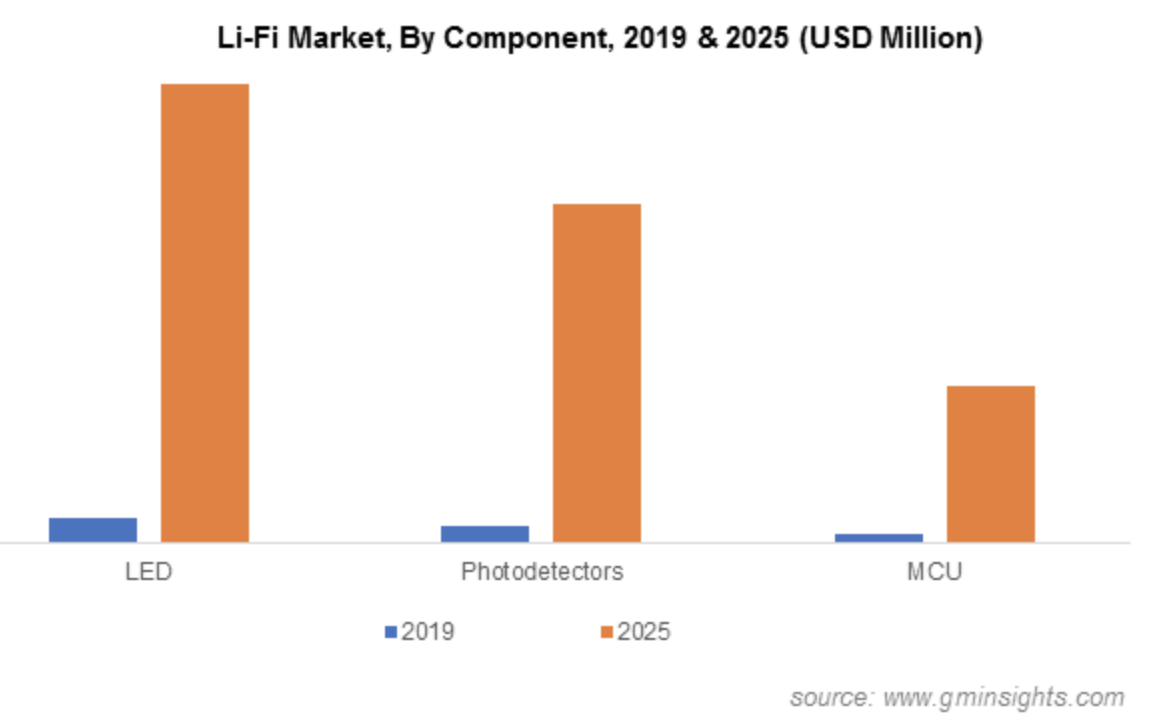
Source: Global Market Insights
With more component vendors emerging, Li‑Fi trials are underway. In 2018, UK telecom operator O2 partnered with PureLiFi to launch a trial using Li‑Fi‑enabled LEDs. By varying bulb intensity, the team demonstrated high‑speed, bidirectional data exchange, according to industry analysts.
Since then, Li‑Fi transceivers have entered the market, offering speeds up to 150 Mbps.
At present, the home‑office environment remains the most promising use case for LED‑based networking.
>> This article was originally published on our sister site, EE Times.
Embedded
- G Suite Gains Enterprise Momentum as IT Teams Embrace the Cloud
- Cisco Tops Industrial Networking Market Share for Second Consecutive Year
- Ground‑to‑Ground Radio Propagation: Understanding the Impact on Wireless Links
- RSL10 Mesh Development Kit Empowers Ultra‑Low‑Power BLE Networks
- Kaiserwetter’s Aristoteles IoT Platform Accelerates Global Green Energy Transition
- Color Masterbatch Market: Growth Drivers and Industry Applications
- Samsung Announces $22 Billion Investment in 5G and AI to Capture 20% Network Equipment Share by 2020
- Premium Ground Engaging Tools & Supplies – Long Island Heavy Equipment
- High-Temperature Tungsten Ground Rod for Superior Stability
- High-Performance Molybdenum Ground Rods for Industrial Applications