



Ground‑to‑Ground Radio Propagation: Understanding the Impact on Wireless Links
When estimating the performance of a wireless link, the free‑space model—where path loss grows with the square of distance—is often the starting point. However, this model falls short when one or both antennas operate close to the earth’s surface. In such cases, radio waves bounce off the ground, leading to significant signal degradation that can either reinforce or weaken the received signal, depending on antenna height and separation.
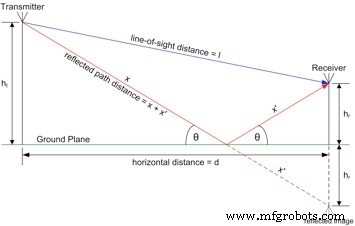
For links where both antennas sit within a few meters of the ground, the effective path‑loss exponent rises from 2 to 4. This means the received power falls off with the fourth power of distance. In a practical scenario—both antennas approximately 1.5 m (5 ft) above the ground—the following graph illustrates the steep drop in signal strength over distance.
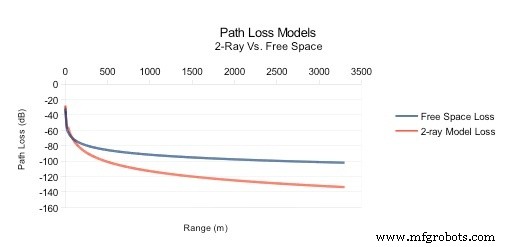
At a range of one mile (1.6 km), the extra loss introduced by the ground reflection is roughly 25 dB—equivalent to a 20‑fold reduction in usable range compared to the free‑space prediction.
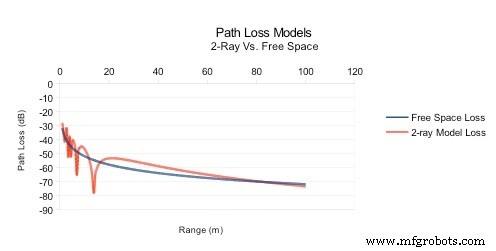
Another consequence of ground‑reflected waves is a rapid sequence of constructive and destructive interference, producing “peaks” and “valleys” in signal strength. When both antennas are only 5 ft above the ground, this fading becomes noticeable at distances shorter than 20 m.
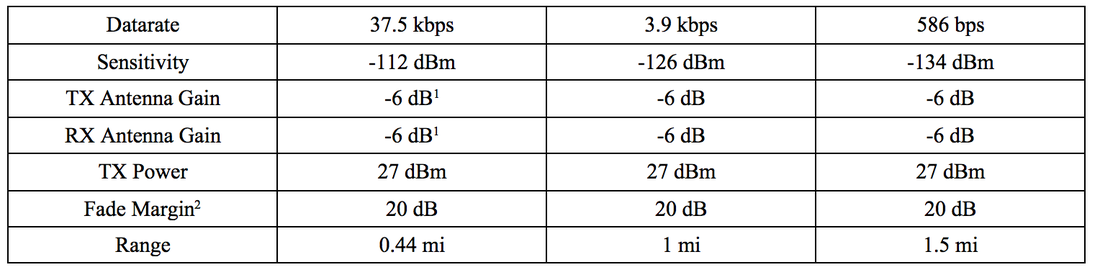
These effects make ground‑to‑ground propagation exceptionally challenging. To maintain a reliable link under such conditions, a receiver must be highly sensitive. Our long‑range transceivers are engineered to meet these demanding requirements. Below are sample link budgets demonstrating achievable ranges when both antennas are 5 ft above the ground.

Internet of Things Technology
- Customizing Resistance Ranges with Rheostats and Series‑Parallel Resistor Networks
- Crystal and Transistor Radio Circuits: From Basic Detectors to Integrated AM/FM Receivers
- The Evolution and Engineering of Radio Technology
- Mastering Wireless Communication Range: How Power, Data Rate, and Interference Shape Connectivity
- 6LoWPAN Wireless Range – Practical Calculations for Obstacle Course Applications
- Build a Reliable FM Radio with SparkFun & Arduino Components
- Why Radio Waves Are Preferred for Short‑Range Communication
- Premium Ground Engaging Tools & Supplies – Long Island Heavy Equipment
- High-Temperature Tungsten Ground Rod for Superior Stability
- High-Performance Molybdenum Ground Rods for Industrial Applications