



Enhancing Cold Chain Tracking with Advanced Hardware Solutions
The COVID‑19 pandemic underscored the critical need for precise cold chain management. Some vaccines demand storage below –70 °C, with tolerances so tight that any deviation can compromise efficacy.
In the pharmaceutical, chemical, and food industries, the term cold chain refers to the end‑to‑end logistics that must keep products within stringent temperature ranges. Maintaining this chain without interruption requires an automated, error‑free tracking system.

Asset tracking with a barcode scanner
Asset tracking
Asset tracking traces a product from its point of origin to the end‑user, enabling real‑time location visibility. The most common method assigns a unique barcode to each asset, which is scanned whenever the item moves. All events are logged in a centralized database for audit and analysis.
Advances in electronics now allow low‑power sensors—measuring temperature, humidity, vibration, and contaminants—paired with GPS for real‑time geolocation. Central to this system are data loggers, which capture sensor data, process it, and store it on non‑volatile memory. These devices run on batteries and communicate intermittently, reducing network dependency.
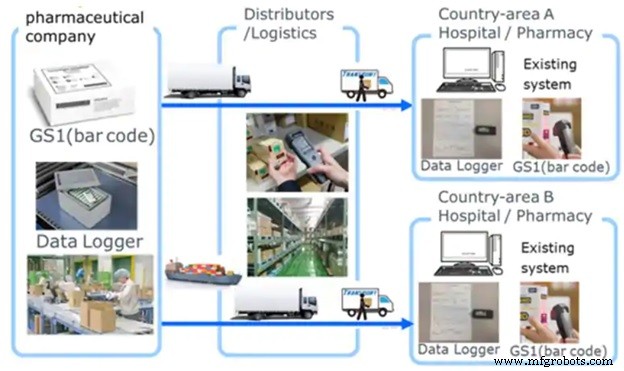
Typical asset tracking architecture using data loggers
Data loggers are indispensable in cold chain systems because they record temperature at regular intervals, a requirement mandated by the U.S. Food and Drug Administration (FDA) for food, drugs, and cosmetics.
These loggers rely on a low‑power microcontroller that drives sensor acquisition, data logging, and communication. A prime example is the ML630Q466/Q464 from Lapis Technology (Rohm Group). This 32‑bit ARM Cortex‑M0+ MCU offers 64 KB or 128 KB flash, built‑in LCD drivers, an RC‑ADC for accurate temperature readings, USB 2.0 full‑speed, and multiple serial ports for sensor interfacing—all while consuming minimal power.
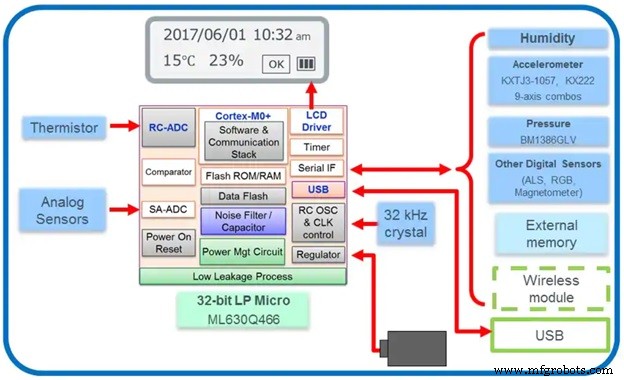
A 32‑bit low‑power MCU suited for cold‑chain tracking
Compatible sensors span a wide range: accelerometers (e.g., KXTJ3‑1057 for motion wake‑up and impact detection), ambient light and RGB sensors for environment monitoring, barometric pressure sensors for altitude and indoor navigation, Hall ICs for door status, and magnetometers for e‑compass functionality.
Beyond USB, integrating wireless modules—Bluetooth Low Energy, Wi‑Fi, or specialized IoT protocols—enables real‑time data sharing and remote monitoring. In an IoT ecosystem, asset trackers can broadcast their data to nearby nodes, providing a richer context of the environment the asset experiences.
» This article was originally published on our sister site, EE Times.
Related Contents:
- Satellite connectivity bridges gap to underserved IoT markets
- Renesas and Altran develop wearable chipset using 3db Access UWB
- Lack of expertise and interoperability still hinder IoT in connected factory
- Technology choices for social distancing in retail applications
- LoRa platform simplifies design, reduces BOM
- Temperature sensors feature high accuracy, low power consumption
For more Embedded, subscribe to Embedded’s weekly email newsletter.
Embedded
- Cold Chain Asset Tracking: Lapis Technology’s Low‑Power Data Logging Solution
- Why Asset Tracking Systems are Essential for Logistics Efficiency
- Asset Tracking: A Proven Solution to 2021 Supply Chain Shortages
- 2021 Asset Tracking Trends: Visibility, Condition Monitoring, and Cloud Integration
- How Asset Tracking Hardware Enhances Commercial Shipping & Logistics
- Link Labs: The First Leader in Enterprise Asset Tracking
- How Modern Asset Tracking Technologies Drive Business Efficiency
- How IoT Asset Tracking Is Revolutionizing Manufacturing Efficiency
- Optimizing Cold Chain Integrity with Advanced Sensor Infrastructure
- M2M Asset Tracking: Unlocking Efficiency, Security, and Peace of Mind