



AI at the Edge: From Consumer Innovations to Enterprise‑Grade Solutions
Data‑driven experiences promise depth, immediacy, and immersion—but they also demand instant, massive data flows that can’t tolerate cloud latency.
Consider drone‑delivered pizza, traffic‑monitoring cameras that capture accidents on the fly, or freight trucks that pre‑empt system failures in real time.
Such rapid, data‑intensive tasks require on‑site processing. Sending all data to the cloud introduces delays that can compromise safety and performance. Edge computing keeps the computation close to the data source, eliminating round‑trip latency.
“An autonomous vehicle cannot wait even a tenth of a second to activate emergency braking when the AI predicts a collision,” explains Northwestern University professor Mohanbir Sawhney in Why Apple and Microsoft Are Moving to the Edge. “In these scenarios, AI must reside at the edge, where decisions are made instantly without relying on network connectivity or moving vast amounts of data over a network.”
“AI edge processors enable the device itself or a nearby server to handle the workload, rather than offloading everything to the cloud,” says Aditya Kaul, research director at Omdia.
AI at the Edge: Enterprise vs. Consumer Adoption
Recent advances in AI chips—especially GPUs delivering over 10 teraflops (10 trillion floating‑point operations per second)—have transformed smartphones, cameras, and drones into capable AI workhorses. Few years ago, such on‑device inference was unheard of; today, edge devices routinely handle complex workloads.
Deep‑learning chipsets, including GPUs and custom ASICs, have spurred a rapid market surge. The Deloitte report Bringing AI to the Device forecasts that edge AI chips will generate more than $2.5 billion in new revenue in 2020, growing at a 20% annual rate over the next few years. 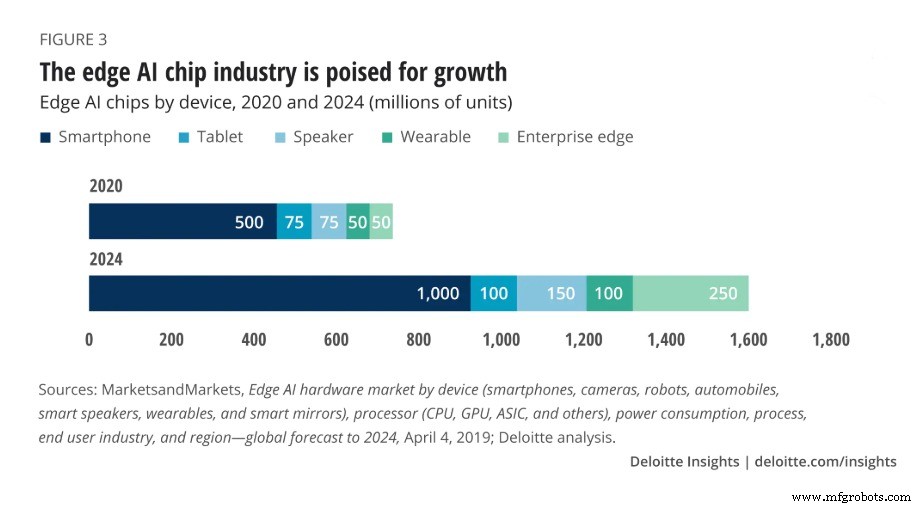
Tractica’s Deep Learning Chipsets report projects the AI chipset market to reach $72.6 billion by 2025.
Consumer electronics currently dominate the edge AI chip landscape, representing roughly 90% of units sold and dollar value in 2020. Smartphones alone account for 40%–50% of the market.
Kaul notes that enterprise adoption is accelerating, especially in industrial IoT, retail, healthcare, and manufacturing—what he calls “enterprise‑grade AI edge.”
Clear, high‑impact use cases drive this shift. Machine vision, for instance, automates product inspection and process control on factory floors, improving quality and efficiency. Industries now use deep learning to spot defects in automotive assembly lines, detect spoilage in produce, and shape biscuit production lines.
Retail benefits from edge AI through camera‑based shopper analytics, identifying product dwell times and engagement patterns.
AI at the Edge Works Hand‑In‑Hand with Cloud Computing
The resurgence of edge computing underscores a renewed focus on hardware. As McKinsey’s Artificial Intelligence: The Time To Act Is Now report notes, hardware has regained prominence after years dominated by software innovation.
Edge architectures offer low latency and enhanced data security by keeping sensitive information on‑premises. “Decisions should happen locally, not over a third‑party cloud, for both speed and security,” Kaul explains.
Ultimately, edge AI complements, rather than replaces, cloud AI. Sawhney illustrates this with Tesla’s vehicles: real‑time edge AI manages braking, steering, and lane changes, while nighttime data uploads refine models in the cloud.
Expectations of Continued Growth in AI at the Edge
Advances in chip performance, coupled with evolving industrial attitudes toward AI, underpin sustained growth. Traditional manufacturing sectors, once cautious about AI integration, now view edge AI as a key ROI driver, embedding big‑data analytics and continuously training models for higher accuracy.
“Accurate models hinge on high‑quality training data,” Kaul asserts. “Where two years ago training data was a novelty, today it’s a standard practice across sectors.”
Tractica forecasts an inflection point in 2021–2022, with a rapid transition to AI accelerators and ASIC chips. While innovation has historically lagged in many markets, the current wave is already evident in industrial vision, medical imaging, and retail—though the full momentum is still building.
Internet of Things Technology
- Defining the Edge: Where Edge Computing Truly Happens
- Bridging the Gap: Making Machine Learning Accessible at the Edge
- Edge Computing: The Architecture Driving Tomorrow’s Intelligent Networks
- Bridging the Skills Gap in the IoT Market: Challenges and Solutions
- Move the Cloud to the Edge: Accelerating IoT Decision-Making
- Navigating Digital Transformation: Expert Insights from The Evolving Enterprise
- Private 5G Networks: Driving the Future of Industrial IoT
- Edge Computing: The New Heartbeat of the Cloud Era
- Driving Innovation: How Edge Computing Is Transforming the Automotive Industry
- Edge Computing & 5G: Powering Enterprise Transformation