



Move the Cloud to the Edge: Accelerating IoT Decision-Making
 Adi Hirschtein of Iguazio
In today’s IoT landscape, enterprises must make split‑second decisions. Adi Hirschtein, Iguazio’s product director, explains that sending data to a distant cloud—and back—creates latency that hampers both efficiency and cost‑effectiveness.
Edge computing offers a compelling answer: by processing data at the source, enterprises can sidestep cloud latency and unlock the full potential of IoT.
The U.S. edge‑computing market, valued at $80 million in 2017, is expected to exceed $1 billion by 2025 as companies across industries adopt its advantages. Business Insider projects that 5.6 billion enterprise and public‑sector IoT devices will rely on edge computing by 2020—a nine‑fold jump from 2015.
The cloud remains essential. Hybrid platforms let firms use edge computing for real‑time decisions and bandwidth savings, while still tapping public clouds for historical storage and scalable compute. In this model, cloud‑trained machine‑learning models are automatically pushed to edge nodes, delivering peak performance where it matters most.
A critical need
Consider a few illustrative use cases in which the time‑consuming process of sending data back and forth to a centralised cloud could jeopardise companies’ performance and public safety.
Should localised intelligence at an industrial plant predict or detect an equipment failure in industrial IoT (IIoT), factories must cease operations and trigger auto‑healing actuators as soon as possible to avoid further destroying machinery, and more importantly with heavy‑duty industrial equipment in motion – to avoid endangering employees’ lives.
The pressing need for edge computing solutions in industrial settings helps explain why manufacturing is slated to represent the largest slice of the U.S. edge computing market in 2025, at $306 million (€266.04 million).
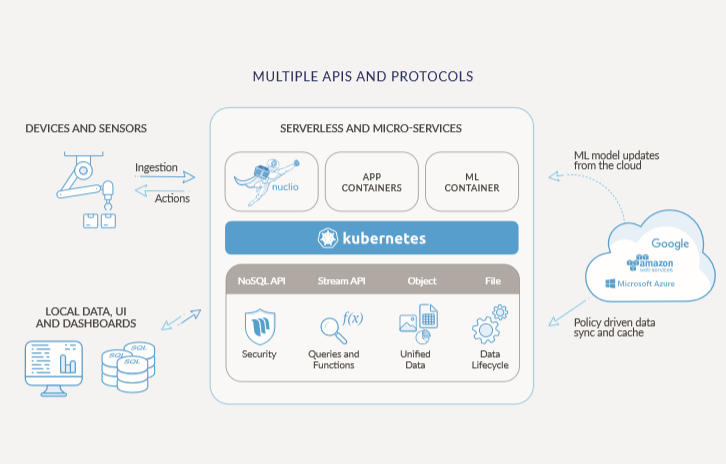
In telecommunications, edge computing serves as a vital tool for monitoring and predicting network health in real time. This can only be achieved by processing high message throughput from multiple streams, correlated with historical data at the edge. Without edge computing’s ability to process and act upon distinct data streams in real time, the analytics process would be much more inefficient and time consuming, increasing the likelihood of major cell network outages dramatically.
These outages, if caused by natural occurrences or cyberattacks, have the capability to kneecap the affected region, compounding the importance of a telco’s ability to detect and resolve outages rapidly. With regard to public safety, efficiency and time are key to crime solving. All the technology that law enforcement has at their disposal – intended to make case resolution faster – goes to waste when cloud processing seriously delays data analysis.
In extreme cases it is exactly those extra three minutes that make or break law enforcement’s ability to keep the public secure. Only an edge solution can quickly correlate data from multiple unstructured and structured data sources to pave the path for police to detect and prevent criminal activity. As with other highly sensitive use cases in which decision makers need rapid access to actionable analytics, hyper‑localised data processing is the only answer.
Rethinking data management
Amid the infusion of IoT into virtually every aspect of business, companies have generated unprecedented demand for access to and analysis of vast amounts of data. In this climate, companies have two choices: They can either send all their data for processing to the cloud or they can opt to have their most critical, time‑sensitive data processed and analysed locally while utilising the cloud for machine learning model training and elasticity.
The former causes enterprises to be vulnerable to delays of all kinds and imposes significant costs and risks. The latter provides businesses with the edge they need to boost response times. All of this raises an important question: Instead of sending all data to the cloud and back, why not move that cloud to the edge itself? Businesses seem to be asking themselves this and agreeing.
According to a Gartner analysis, by 2022, three quarters of enterprises’ data will be processed and analysed away from centralised data centres, compared to less than 10% in 2017. As more businesses adopt the intelligent edge approach, it will mean greater simplicity, performance, and security – bringing the benefits of IoT to more enterprises and governments, without incurring unnecessary costs in time and money.
Edge analytics are not only allowing companies to be more competitive in their respective industries, but to effectively perform their tasks in real‑time, something that is essential in our interconnected reality.
The author of this blog is Adi Hirschtein, director of product at Iguazio
Internet of Things Technology
- Why Cloud Data Security Is Becoming Programmable
- Secure and Real‑Time Machine Data Logging with IXON Cloud
- Why Data Is the Cornerstone of Reliability Engineering
- From Edge to Cloud: Mastering IoT Data Pipelines
- Why the Cloud Is Not the Only Solution for IoT Success
- Three Powerful Ways Cloud Computing Enhances IoT Deployments
- Unlocking Real-Time Value: Why Your Business Must Embrace IoT
- Harnessing Cloud Power for IoT: Unlocking Seamless Connectivity & Data Insights
- Edge Computing: The New Heartbeat of the Cloud Era
- Driving Innovation: How Edge Computing Is Transforming the Automotive Industry