



Bridging the Gap: Making Machine Learning Accessible at the Edge
Edge intelligence is now within reach of designers without formal data‑science training, thanks to emerging hardware platforms.
Connected devices and the Internet of Things (IoT) have woven themselves into the fabric of our daily lives—whether inside homes, vehicles, or workplaces. While most of these devices rely on cloud services for heavy lifting, a new paradigm, “edge intelligence,” is reshaping how we build intelligent systems.
In this article we compare cloud‑based intelligence with edge intelligence, illustrate real‑world use cases, and show how NXP’s hardware and eIQ software ecosystem empower designers of all skill levels to deploy machine learning (ML) on the edge.
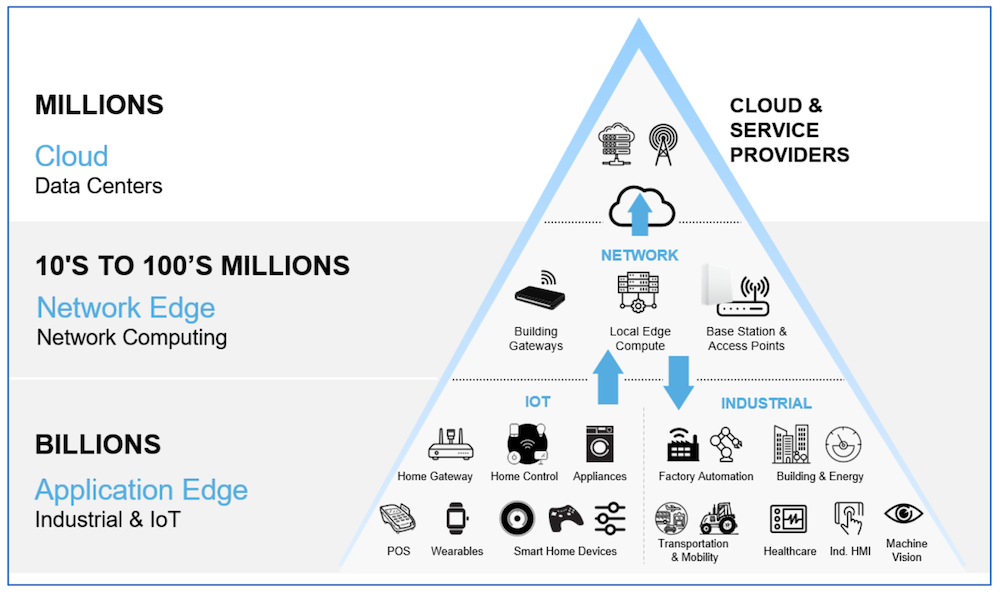
Figure 1. Moving from cloud computing to edge computing unlocks billions of ML‑enabled devices. Image courtesy of NXP.
Key Machine‑Learning Terms
Cloud Computing
Cloud computing delivers remote computing resources on demand. Service providers maintain the hardware and guarantee availability, allowing customers to pay only for what they use. For most enterprises, cloud services remain the go‑to solution for large‑scale analytics and training.
Edge Computing
Edge computing places processing closer to the data source—between the end‑user and the cloud. Edge nodes handle filtering, buffering, and privacy‑enhancing tasks, reducing latency and bandwidth usage while cutting costs. Modern edge devices now embed AI accelerators that decide which data is worth sending upstream for deeper analysis.
Machine Learning (ML)
At its core, ML trains algorithms to recognize patterns. Neural networks—especially convolutional architectures like MobileNet—have democratized ML by running efficiently on devices with limited resources. The result is high‑accuracy image classification, speech recognition, and more, all on the edge.
ML Beyond the Data‑Science Realm
Historically, building ML systems required deep expertise in data science. Today, the landscape has shifted dramatically. Forecasts project that by 2025, 98 % of edge devices will embed ML, translating to roughly 18‑25 billion smart devices worldwide. This explosion opens possibilities across computer vision, speech analysis, video processing, and sequence analysis.
Concrete examples include smart door locks that use camera feeds to recognize authorized users, or fleet‑management dashboards that detect driver distraction in real time. The key is that these capabilities are no longer limited to specialists; they can be assembled by designers with modest ML knowledge.
Hardware Platforms That Make Edge ML Practical
Optimized neural‑network algorithms, combined with powerful microcontrollers, enable sophisticated ML workloads on the edge. The i.MX RT1170, for instance, offers a dual‑core architecture—1 GHz Arm Cortex‑M7 plus 400 MHz Cortex‑M4—allowing real‑time inference and concurrent model execution. Its built‑in crypto engines, graphics, and multimedia support make it ideal for driver‑distraction detection, smart lighting, intelligent locks, and fleet‑management systems.

Figure 2. Block diagram of the i.MX RT1170 crossover MCU. Image courtesy of NXP.
The i.MX 8M Plus targets higher‑performance applications such as computer vision and industrial automation. With a dedicated NPU delivering up to 2.3 TOPS, four Arm Cortex‑A53 cores, and optional 4K or dual‑HD camera support, it can handle facial‑recognition, object detection, and advanced multimedia tasks. An additional low‑power Cortex‑M7 core handles real‑time networking functions, including CAN FD and TSN‑capable Gigabit Ethernet.
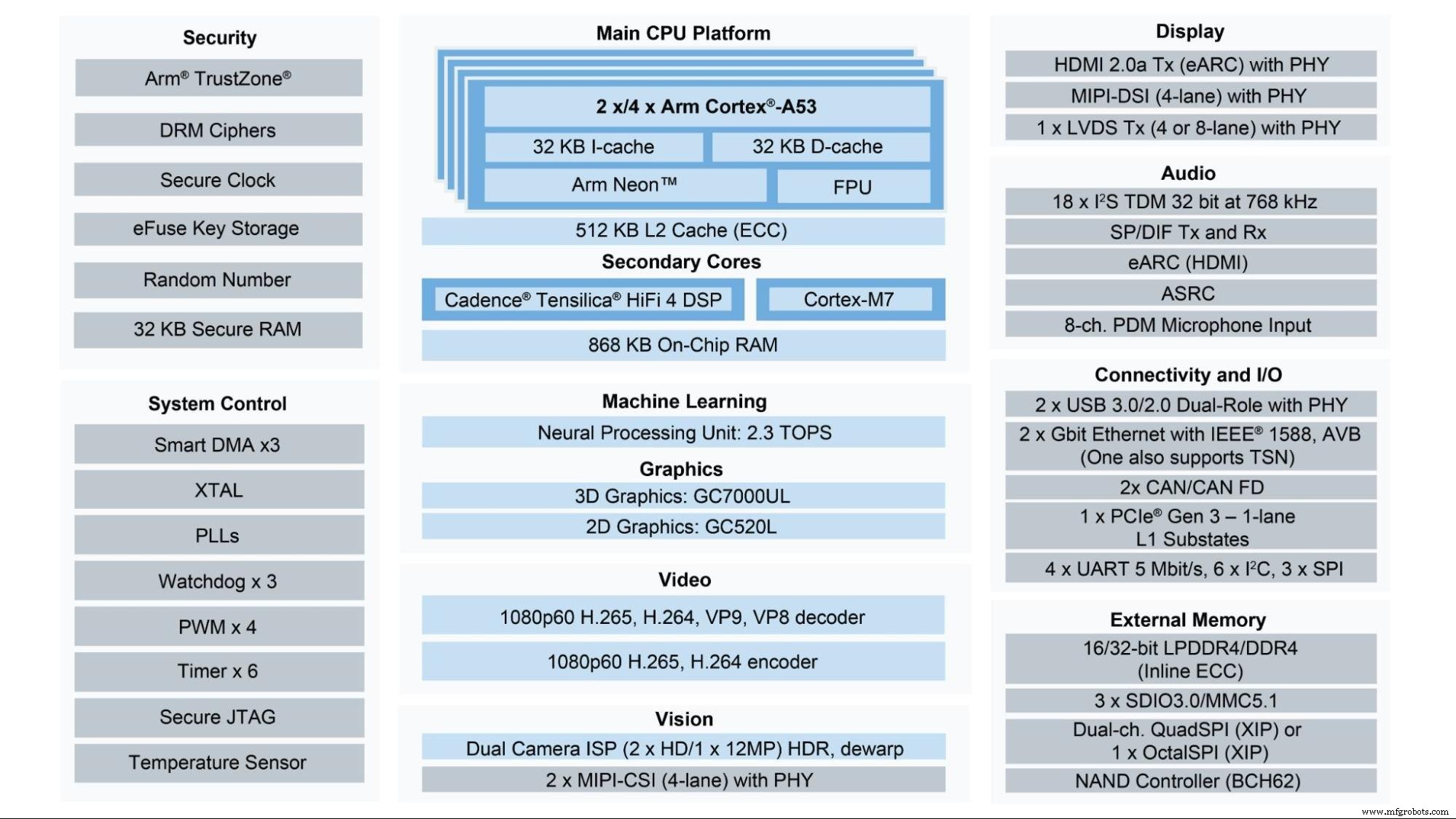
Figure 3. Block diagram of the i.MX 8M Plus. Image courtesy of NXP.
The eIQ Toolset: From Model to Deployment
NXP’s eIQ ML ecosystem turns these powerful devices into user‑friendly platforms. The suite includes inference engines, neural‑network compilers, and optimized libraries that integrate with the MCUXpresso IDE and Yocto BSP. Upcoming releases add a graphical eIQ Toolkit and eIQ Portal, supporting both “bring your own model” (BYOM) and “bring your own data” (BYOD) workflows.
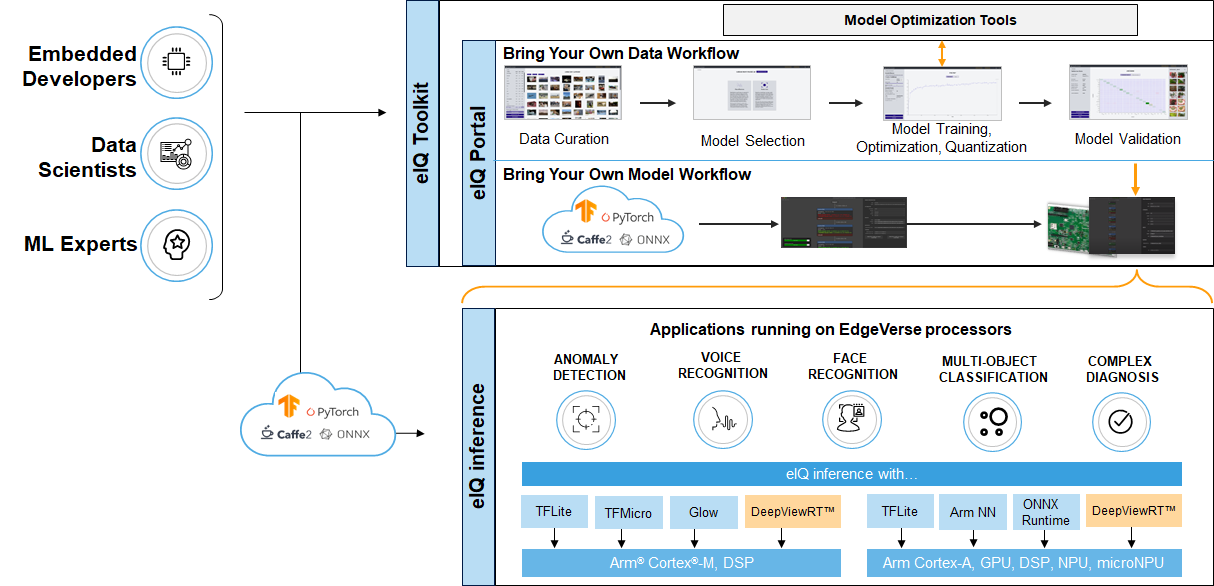
Figure 4. eIQ Toolkit and eIQ Portal with BYOD/BYOM workflows and selectable inference engines. Image courtesy of NXP.
With BYOM, developers can train models in the cloud and import them into the eIQ environment, then choose the optimal inference engine. With BYOD, the same tools curate datasets, train models, and package them—all within the same graphical interface.
Edge ML: Accessible, Secure, and Scalable
Edge computing keeps sensitive data local, reduces bandwidth costs, and cuts latency—benefits that are amplified when combined with ML. Whether it’s real‑time driver‑distraction alerts or automated access control, ML at the edge is reshaping how devices interact with the world.
By pairing NXP’s cost‑effective hardware with a developer‑friendly software stack, designers at all experience levels can create robust, future‑proof ML solutions. Whether you’re building a single prototype or deploying a fleet of billions of devices, the tools and platforms are now within reach.
Industry Articles are a form of content that allows industry partners to share useful news, messages, and technology with All About Circuits readers in a way editorial content is not well suited to. All Industry Articles are subject to strict editorial guidelines with the intention of offering readers useful news, technical expertise, or stories. The viewpoints and opinions expressed in Industry Articles are those of the partner and not necessarily those of All About Circuits or its writers.
Internet of Things Technology
- Harnessing Machine Learning to Optimize MRO Supply Chain Management
- Harnessing Machine Learning to Transform Additive Manufacturing
- Defining the Edge: Where Edge Computing Truly Happens
- Leveraging DSPs for Real‑Time Audio AI at the Edge
- Accelerating Industrial Edge Vision with NXP’s i.MX 8M Plus Processor
- NXP Accelerates Edge AI with eIQ Toolkit
- AI, ML, and Deep Learning Explained: Key Differences and How They Work
- Deep Learning vs. Machine Learning: Understanding the Key Differences
- Machine Learning Accelerates Pipeline Safety: Real-Time Fault Detection Saves $10M
- Driving the Machine-Centric Internet: The Edge Revolution