



Bringing Precision Analytics to AgTech: Challenges and Opportunities
At first glance, agtech feels paradoxical. Growing crops demands patience—planting in the right season, securing sunlight, water, soil nutrients, and time. In contrast, technology thrives on speed, rapid prototyping, and swift deployment.
Yet, agtech is becoming the dynamic intersection where traditional agriculture meets next‑generation connectivity and analytics.
See also: Platagon partners with Dubai university to create urban agriculture center
While rooted in generational farming practices, the industry is rapidly embracing advances in machinery, robotics, analytics, and software. Arable Labs—led by CEO Dr. Adam Wolf—stands at the forefront of this transformation. Their multidisciplinary team of product engineers, biologists, and mathematicians tackles one of the most pressing challenges in the food supply chain: accurate forecasting.
During a recent conversation with Dr. Wolf, I learned about Arable’s momentum over the past year. The company earned runner‑up honors at the water‑innovation accelerator Imagine H₂O, and has previously partnered with Zambia’s Meteorological Service to enhance weather monitoring and with the New York City Parks Service to support storm‑management weather tracking—demonstrating the breadth of their technology’s applicability.
Arable’s latest milestone is a $4.25 million Series A round, led by Middleland Capital’s agriculture‑technology fund and S2G Ventures. The capital will fuel expansion of data‑science capabilities and the mass production of the Arable Mark IoT device (formerly PulsePod) slated for release later this year.
“We have outstanding investors who truly understand the sector,” says Wolf. “They’re well connected, knowing key players in growing, processing, and retailing. In food and agriculture, the pain points are hidden in a secret world; our investors help us bring them to light.”
Arable focuses on supply‑chain risk—how producers, processors, and retailers are interlinked, how contracts are structured, and where failure can occur. “For example, if a restaurant chain orders a large quantity of cilantro and the farmer delivers only half, the ripple effect is immediate,” Wolf explains. “Bringing all stakeholders into a conversation is powerful, and our investors empower us to do that.”
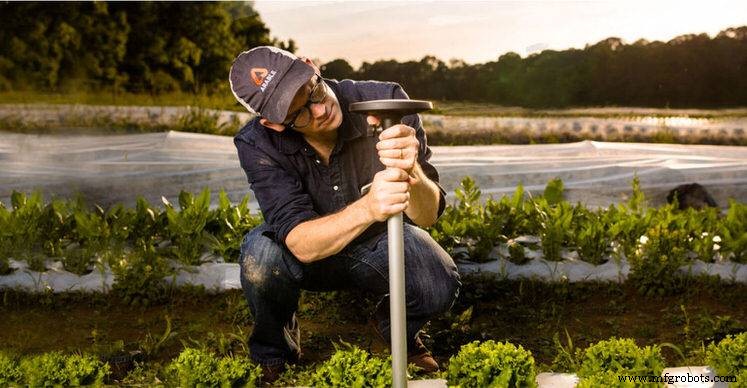
The Arable Mark delivers unprecedented plant‑health data. It captures over 40 environmental streams, offering higher spatial resolution than any weather model or station network, and more plant attributes than any satellite or aircraft. In short, it’s the most data‑rich IoT device available today.
Its launch coincides with the brand‑new, cloud‑based Arable Insights platform. Designed for crop consultants, farmers, large‑scale producers, and food processors, Insights enables real‑time, field‑level data sharing among trusted partners. Managers can benchmark crop performance across hundreds of fields, drill into growth or weather events, and predict timing, quality, perishability, and yield—all derived from the synthesis of weather and crop data.
“Our business model is hardware‑enabled software‑as‑a‑service,” notes Wolf. “The data harvested in the field is a well from which many stakeholders can draw.”
Automation’s Role in Modern Farming
Public perception often romanticizes farmers as stoic, technology‑averse pioneers. In reality, farmers are hacking tractors, deploying drones for crop surveying, and consulting data platforms—often before almanacs—before sowing. Wolf highlights one of the company’s core values: customer service.
“Our initial vision was to treat farmers with respect—through thoughtful design and fair pricing—and the benefits will follow,” Wolf says.
A 2012 Agriculture Census showed that, over the past 30 years, the average age of U.S. farmers rose by nearly eight years, from 50.5 to 58.3. Does this signal a robotic takeover? Wolf counters: “Someone growing 35,000 acres of leafy greens for restaurants must be exceptionally skilled. They’ve mastered scale and delivery of safe, affordable food.”
“Young talent often seeks software engineering over low‑paid farm jobs,” he continues. “With year‑round production, many Latino families’ children attend college. Farms must preserve institutional knowledge while managing an expanding workforce. Automation can’t replace people; it empowers them.”
“By automating data collection, we enable better jobs, prioritization, and planning,” Wolf adds. “People can focus on what truly matters.”
Arable will begin shipping the Mark this spring, expanding availability through distributors later in the year.
Internet of Things Technology
- Avoiding Common Pitfalls in Data Analytics Projects – A Practical Guide
- Launching a Data Analytics Project in Manufacturing: A Practical Guide
- Transitioning to Wireless SCADA: Proven Methods, Key Differences, and Reliable Tech Options
- Data Harvest Fuels Agriculture 4.0
- IoT Data Drives Precision Agriculture: Boosting Yields and Cutting Costs
- Elevating Industry 4.0: Harnessing Edge Analytics for Smarter, Faster Manufacturing
- Leading Cloud‑Based IoT Analytics Platforms for 2026
- Data Science Drives COVID-19 Response: Insights and Strategies
- Building Trust in IoT: How Blockchain Enhances Security and Transparency
- Leveraging AI to Contextualize Data Analytics for Business Insight