



Why Bluetooth Low Energy Drives Cost‑Effective Asset Tracking
At Link Labs, our flagship solution, AirFinder, tackles the challenge of tracking assets and personnel while keeping costs down. In an era where resources are finite, enterprises must prioritize solutions that deliver clear ROI.

From the outset, we built AirFinder around three cost pillars:
- Tag cost: The largest fixed expense in any tracking system. Lower tag prices mean a faster break‑even.
- Infrastructure cost: Reader units, installation, maintenance, and network connectivity add to the bill.
- Labor cost: Training, change management, and ongoing support can erode savings if not carefully managed.
Why Bluetooth Low Energy (LE)?
Because it keeps tags inexpensive. Bluetooth LE tags benefit from mass production, integrated Bluetooth LE System‑in‑Package (SIP) or System‑on‑Chip (SoC) units that cost roughly $2, and highly efficient batteries that extend battery life.
- Mass‑produced components drive down unit cost.
- Integrated $2 Bluetooth LE SIPs/SoCs keep silicon expenses minimal.
- Efficient power consumption allows simple, low‑cost batteries.
However, the trade‑off is a limited link budget—typically a range of about 100 ft—to maintain long battery life. This means that readers must be strategically placed within that distance to capture transmissions.
AirFinder mitigates infrastructure costs by using Symphony Link (LoRa) access points (SLAPs). These receivers collect Bluetooth LE messages and forward them to a central gateway via cellular or Ethernet, dramatically reducing per‑SIM cellular fees and avoiding the high cost of dense reader deployments.
Why Cellular?
Enterprise networks demand stringent security and compliance. Gaining permission to plug a Bluetooth LE reader into a customer’s internal network can take months of paperwork and security reviews. A stand‑alone IoT network—leveraging cellular backhaul—provides a clean, secure path without entangling the customer’s core infrastructure.
What are the Alternatives to Bluetooth?
Check out this chart.
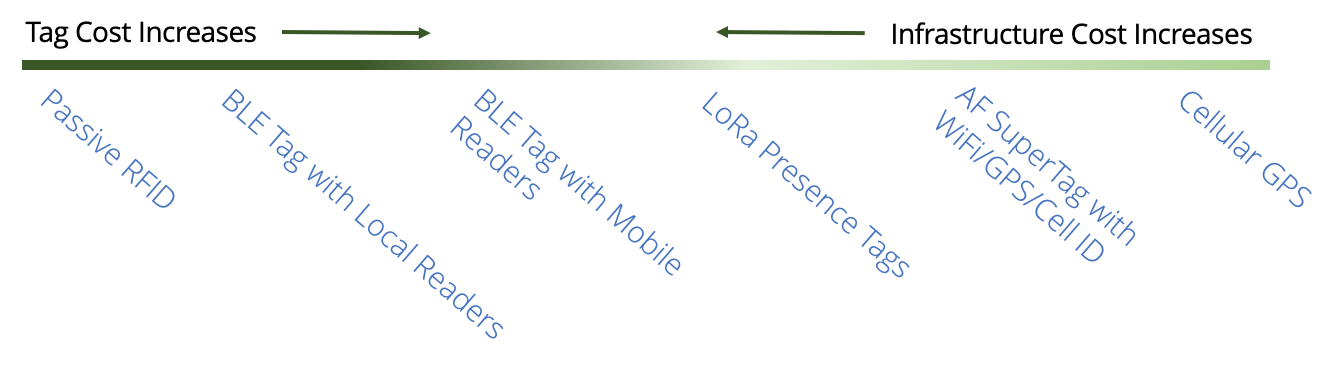
For most enterprise, industrial, and manufacturing scenarios, the main alternative is Ultra‑Wideband (UWB). UWB offers 3–5× higher precision but at the cost of more expensive tags and a far larger, more complex infrastructure. Many use cases only require high precision in specific zones, where we can supplement AirFinder with targeted reference beacons.
Not All Bluetooth Tracking Is Created Equal
AirFinder’s approach differs from typical Bluetooth LE systems. Our tags “listen” to reference‑point beacons, localizing themselves before sending a precise location report to the network. This strategy reduces infrastructure requirements while maintaining accuracy, and it enables low‑data‑rate backhaul via LoRa.
Have questions? Drop a comment below and I’ll get back to you!
Internet of Things Technology
- 5 Essential Insights into Bluetooth Low Energy for Asset Tracking
- XLE: The Future of Bluetooth Low Energy Asset Tracking
- Choosing the Right IoT Connectivity: XLE vs Bluetooth Low Energy for Enterprise Asset Tracking
- Why Bluetooth LE is the Best Choice for Industrial Indoor Asset Tracking
- How Bluetooth LE Range Shapes Industrial Asset Tracking – Facts & Solutions
- Bluetooth LE vs. XLE: Maximizing Range and Accuracy for Commercial Asset Tracking
- AirFinder Bluetooth LE & XLE: Top IoT Solutions for Industrial Asset Tracking
- Bluetooth LE Outperforms UWB for Indoor Asset Tracking: Cost, Battery Life & Accuracy
- AirFinder vs Apple AirTags: Why AirFinder Leads Commercial Asset Tracking
- Why GPS Asset Tracking Often Falls Short – Understanding Its Limitations