



Data Diodes: Securing Industry 4.0 Networks Against Modern Cyber Threats
The internet of things and Industry 4.0 networks demand reliable, secure data links. Yet, even the most robust traditional defenses can be breached by modern cyber‑attacks. A data diode – a hardware and software solution – forces data to flow only outbound, preventing any reverse transmission to the internal network.
The BSI study (German Federal Office for Information Security) shows that malware – including Trojans, ransomware and trickbots – surged to 117 billion incidents between June 2019 and May 2020, underscoring the critical need for hardened network protection.

Genua’s Steve Schoner
“Even with conventional security tools, a residual risk remains,” says Steve Schoner, strategic product marketing manager at Genua GmbH, a subsidiary of Bundesdruckerei (German Federal Printing Office). “The cyber‑diode closes that gap.” Genua, founded in 1992, has a long record protecting classified information and is a leading specialist in securing industrial and critical infrastructure networks.
As IT and OT converge, many plants abandon the benefits of internet connectivity to avoid exposure. Yet, Industry 4.0 thrives on real‑time data exchange for predictive maintenance, analytics and flexible manufacturing down to lot size 1. The risk of sabotage and espionage grows with every connected device.
Maximized cybersecurity
“Existing solutions are either proprietary or prohibitively expensive,” Schoner explains. “Our industrial cyber‑diode offers secure, reliable, manufacturer‑ and platform‑independent communication. It is the only certified confidential data diode available worldwide.” The device supports OPC UA, the open standard for machine‑to‑machine data, and can transmit encrypted data via IPSec VPN. When IPSec is enabled, external clients can only communicate through the diode’s built‑in firewall, ensuring data reaches the cloud or any external system securely.
Cyber‑diode in detail
The hardware is protected by an I/O memory‑management unit (IOMMU) that isolates compartments. The left compartment houses the transmitter (e.g., an OPC UA client), the central patented One‑Way‑Task enforces unidirectional flow, and the right compartment is VPN‑ready, sending data through the NIC to the external target. An additional Update compartment on top permits secure firmware upgrades – new features can be uploaded, but the core configuration remains immutable. The design fits DIN rails or 19‑inch rack housings and includes UEFI and Secure Boot. Optional LTE or WLAN interfaces extend connectivity.
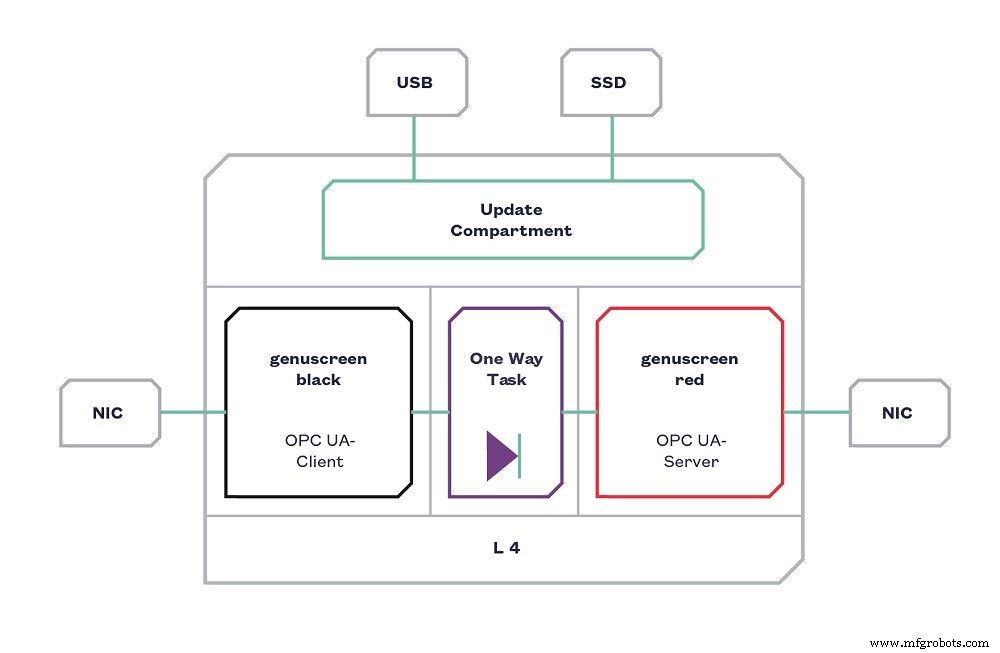
Block diagram of a cyber‑diode (Image source: Genua)
The software stack is built on a minimalist hardened microkernel and OpenBSD, containing only a few lines of code to reduce attack surfaces. “Such an architecture is extremely difficult to compromise,” Schoner notes. Even OS vulnerabilities do not affect the patented One‑Way function. Only Genua’s firmware runs on the device. The lifetime license bundles hardware, software and support – including a hotline and full system management.
Improving security functions
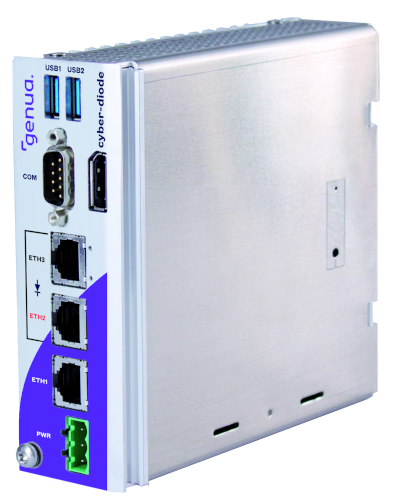
Cyber‑diodes enable secure data transfer in Industry 4.0 networks
Compared with air gaps, firewalls or optical fiber, cyber‑diodes provide a decisive advantage. Air gaps isolate IT from OT but block the essential data exchange required for Industry 4.0; manual transfer via USB is inefficient and can introduce malware. Firewalls can enforce one‑way rules but are complex to configure and may inadvertently change over time. Fiber diodes block reverse traffic but need a separate channel for acknowledgment; our cyber‑diode confirms successful transfer with a single bit, improving reliability and ease of integration.
>>> This article was originally published on our sister site, EE Times Europe.
Internet of Things Technology
- Understanding Network Protocols: From Physical Layer to Advanced Arbitration
- Monetizing Mobile Network Data Drives Operational Efficiency
- Securing Legacy Infrastructure for IoT Success
- How Data Connectivity Will Propel the Energy Industry Forward in 2019
- Navigating Security Challenges in Next‑Generation 5G and IPv6 Networks
- Elevating Industry 4.0: Harnessing Edge Analytics for Smarter, Faster Manufacturing
- Why Data is Critical for Industry 4.0 Success
- Robust Long‑Range Wireless Sensor Networks for Remote Data Monitoring
- Bringing Legacy Systems into Industry 4.0: Overcoming Multi-Protocol Challenges
- Understanding the Security Industry: Products, Services, and Global Impact