



Why Smart Buildings Struggle: The Missing Standards That Hold Them Back
From an engineering standpoint, creating smart buildings is technically straightforward—processors and software already exist. A $3 MCU can be embedded in light switches, sockets, motorized window covers, and water pumps, and these tiny nodes can be networked together. Large appliances, thermostats, temperature sensors, occupancy detectors, and fire alarms could coordinate to control central HVAC, manage solar‑heated water tanks, circulate 60 °F underground water via heat pumps, and adjust lighting in real time.
So what’s the problem?
- There is no industry‑wide communication protocol that guarantees ≥ 99.999 % reliability (a “five nines” standard). In practice, wireless and power‑line solutions fail 1 %–10 % of the time due to dead zones, spectrum congestion, low SNR, and interference.
- There is no common operating system for building devices. While PCs run Windows, phones run iOS or Android, building actuators and sensors lack a unified OS, making plug‑and‑play integration difficult.
Ensuring Reliability
When occupants flip a wall switch, the communication between that switch and the ceiling bulb must work at least 99.999 % of the time. Any downtime in everyday infrastructure is unacceptable. Power‑line data is particularly fragile, as signals must traverse the fuse box and contend with voltage spikes, leading to frequent errors.
Engineers can employ a data bus that mirrors automotive CAN bus—a robust, fault‑tolerant network that protects the data line even if it’s accidentally tapped to a power cable. The network topology should resemble a tree: a single cable branches to multiple devices, matching building geometry and allowing for scalable, low‑cost wiring.
Light vs. Heavy Loads
Smart‑building devices fall into two power categories. Light devices (<20 W) include LED bulbs, switches, thermostats, sensors, motors for blinds, and radiator valves. Heavy devices (>20 W) cover HVAC units, large appliances, and high‑power outlets. For example, a 10‑W LED draws 0.1 A at 110 V AC—only 1/200th of a 20‑A fuse. By routing light loads on 48 V DC over 18‑AWG wire, engineers can reduce cable costs and comply with fewer building code restrictions, freeing budget for additional networked devices.
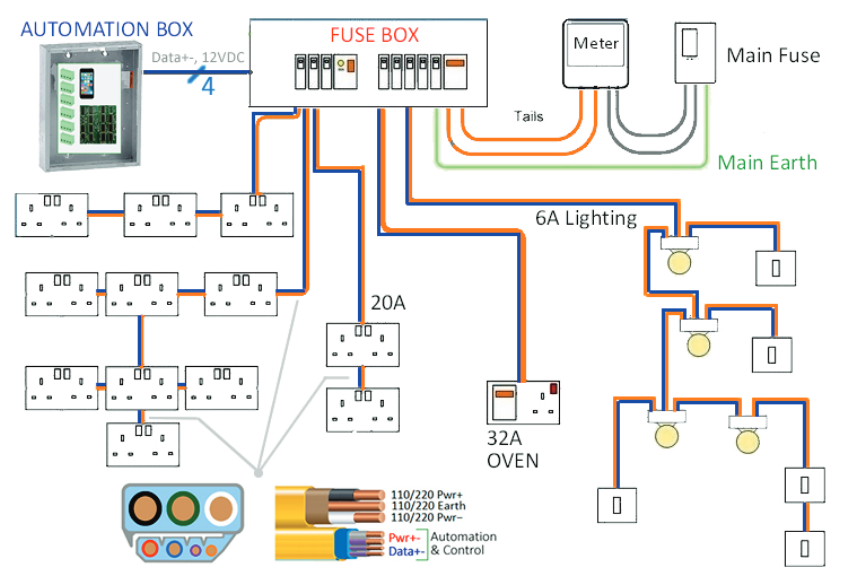
An automation network connects from a central location throughout the building. Source: Manhattan 2
Unified Software for All Devices
Low cost and high reliability hinge on deploying the same software stack across every device. Open, free, and well‑documented code ensures widespread adoption and rapid iteration. While many networking protocols exist, none provide a complete operating system for building automation.
Researchers at UMass Amherst and other institutions are developing BuildingBus, a free, open‑source smart‑building OS. BuildingBus allows any device to send messages, read/write ports, exchange device libraries, monitor sensors in pseudo‑real‑time, and issue commands—all with fault tolerance and plug‑and‑play support.
Adopting a common OS and a reliable communication backbone can dramatically lower the cost of building intelligence while boosting energy efficiency. Multiple initiatives are underway, and the next few years will likely see several mature solutions emerge.
>> This article was originally published on our sister site, EDN.
Internet of Things Technology
- 5 Key Wireless Standards Powering IoT Connectivity
- Connected LED Streetlights: The Next Step Toward Smart City IoT
- Mastering IEC Power Standards for Smart Home Appliance Design
- Wi‑Fi: The Cornerstone of Smart Everything
- Building the Foundation for Enterprise IoT Success
- Rethinking Smart Manufacturing for the New Normal: Data‑Driven Strategies for Resilience
- How 5G Adoption Enhances IoT Security: What You Need to Know
- Matter: Revolutionizing Smart Home Connectivity
- Revolutionizing Hospitality: Enseo & Catapult Tech Introduce IoT Smart Rooms at Fiesta Americana Viaducto Aeropuerto Hotel
- Fortifying Smart Devices for the Future of Work