



Redpine Signals Unveils RS9116N‑DBT: An All‑in‑One IoT SoC with Dual‑Band Wi‑Fi, Bluetooth 5, Thread, and Built‑In AI Engine
Leading semiconductor companies such as Qualcomm, Cypress, and Texas Instruments are finding the smart‑home IoT market a tough chase.
The fragmented smart‑home IoT landscape presents numerous challenges.
First, the smart‑home segment encompasses a wide range of devices—from doorbells and door locks to smoke detectors, smart speakers, and refrigerators. Second, it offers an overwhelming array of connectivity options, including Wi‑Fi, Bluetooth, BLE, ZigBee, Z‑Wave, and Thread. Third, many devices lack interoperability at the application layer, relying on proprietary ecosystems such as Apple HomeKit or Samsung SmartThings. Fourth, security gaps in IoT chips remain a serious concern. Above all, battery life continues to limit device functionality; when power runs out, a device becomes neither connected nor 'smart.'
Redpine Signals has introduced the RS9116N‑DBT, a comprehensive IoT SoC that combines dual‑band Wi‑Fi, Bluetooth 5, 802.15.4, and Thread, powered by an ARM Cortex‑M4 MCU with robust security features. The company asserts that the chip matches and surpasses competitors.
CEO Venkat Mattela highlights four key advantages: 1) simultaneous multi‑protocol wireless connectivity, 2) high‑level security, 3) built‑in edge intelligence powered by Redpine’s proprietary AI engine, and 4) whole‑home coverage.
Always‑on sensor with Wi‑Fi
The RS9116N‑DBT consumes less than 90 µA in Wi‑Fi connected mode, according to tests by Tolly Enterprises commissioned by Redpine. This power draw is one‑fifth to one‑fifteenth that of rival chipsets currently on the market.
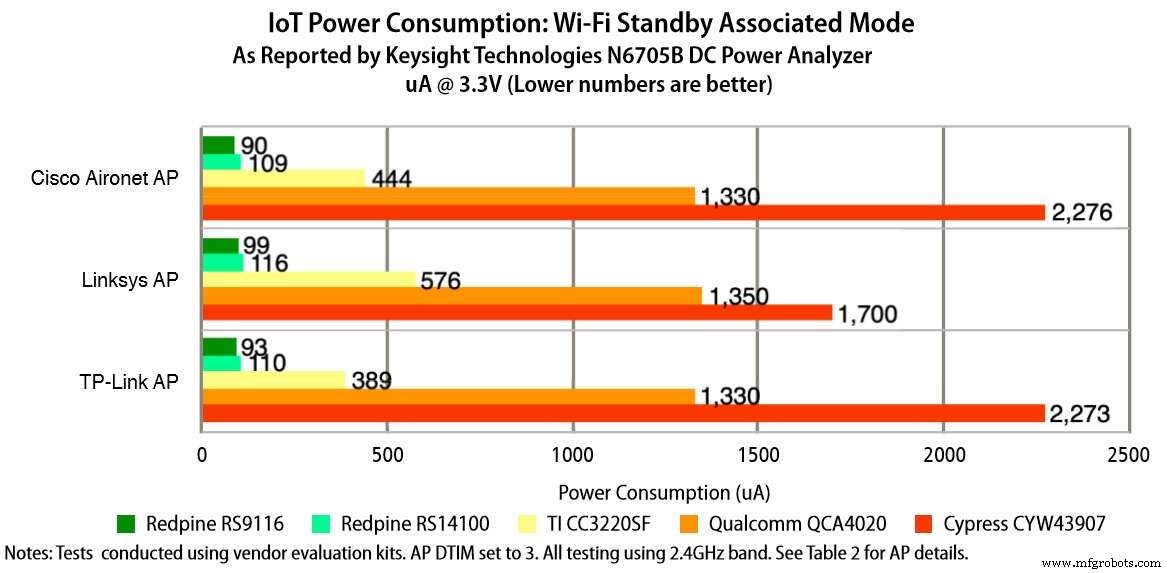
Click here for larger image IoT Power Consumption: Wi‑Fi Standby Associated Mode (Source: Tolly Enterprises)
Why integrate Wi‑Fi in a smart‑home IoT chip? In traditional setups, Wi‑Fi is often paired with ZigBee mesh devices, but Mattela argues that Wi‑Fi is the only native IP‑supported technology, essential for interoperable access across all devices. Despite its higher power and cost, Redpine’s Wi‑Fi stack delivers the lowest power consumption of any wireless technology, overcoming resistance to Wi‑Fi adoption.
One‑size‑fits‑all IoT chip?
The prevailing view in the industry is that a single IoT chip cannot satisfy the distinct needs of wearables, security cameras, or smart speakers. Mattela disagrees, noting that OEMs prefer a unified software environment over managing multiple teams for different devices, a costly approach.
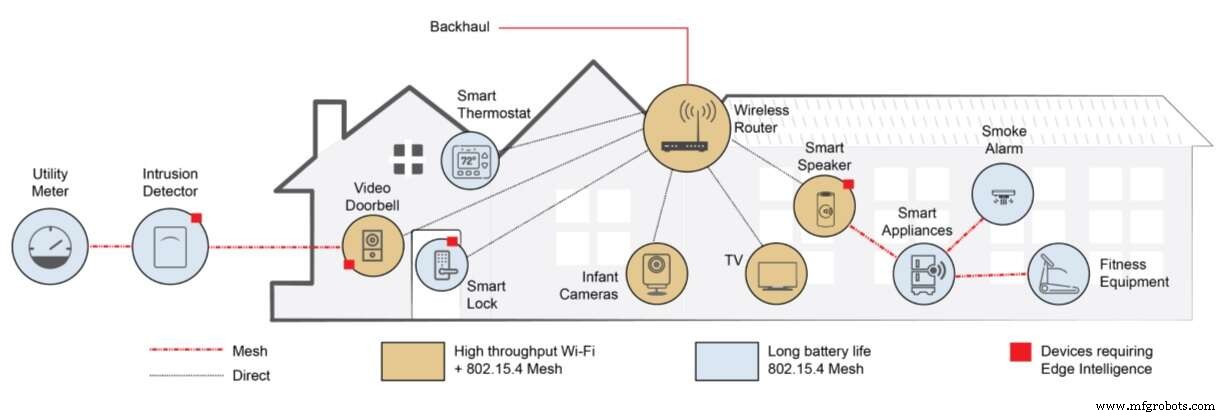
Redpine promotes the RS9116N‑DBT as a one‑chip solution that eliminates the need for separate wireless modules in devices such as video doorbells and routers.
AI functions on the edge
The chip’s edge intelligence enables a surveillance camera to perform face recognition, motion‑based break‑in detection, or a smart speaker to recognize a homeowner’s voice—preventing unauthorized control of lights or other appliances.
The RS9116N‑DBT offers power‑efficient, hardware‑assisted machine‑learning functions that maintain low latency and power consumption. Instead of licensing off‑the‑shelf AI cores, Redpine developed its own AI engine and neural networks.
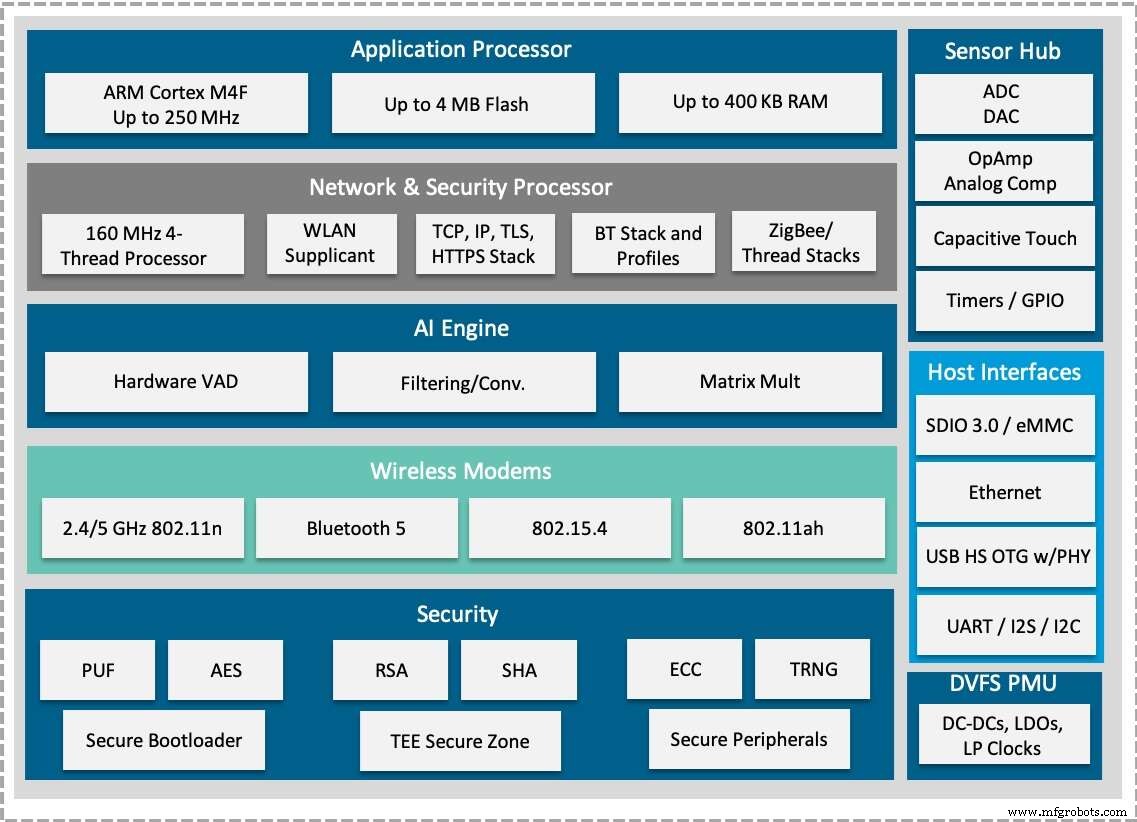
Click here for larger image Block diagram for RS9116N‑DBT, Redpine’s IoT SoC (Source: Redpine Signals)
The RS9116N‑DBT is a single chip that integrates all functions, including an AI engine. A 5 GHz RF transceiver is provided on a separate die. The BGA package contains two dies: one with the full stack and another dedicated to the 5 GHz RF.
The chip is fabricated using a 40 nm LP process at GlobalFoundries.
Internet of Things Technology
- Choosing the Right IoT Wireless Technology: Avoiding the New‑Tech Traps
- Scaling IoT Provisioning: Secure, Efficient Strategies for Device Onboarding
- Seamless Wireless Commissioning for Smart Homes: From Unboxing to Secure Remote Setup
- Understanding How IoT Devices Work: A Practical Guide for Product Managers
- Everactive Launches Battery‑Free IoT Sensors Powered by Light and Heat
- Everactive’s Self‑Powering IoT Sensors Eliminate Batteries with Solar, Thermal, and Vibration Energy
- Cut Factory Valve Monitoring Costs by 90% with Wireless IoT Sensors
- Transforming Maintenance with IoT Sensors: Predictive Excellence
- Underwater IoT: Transforming Water Management with Real‑Time Insights
- Efficient IoT Sensor Provisioning: Secure Connectivity & Credential Management