



Understanding How IoT Devices Work: A Practical Guide for Product Managers
Hardware choices influence cost, user experience, functionality, and more. Yet only about 20% of IoT Product Managers have hands‑on hardware experience, while 76% are software‑savvy.
After surveying hundreds of PMs across industries, I found that a small minority have direct hardware expertise. The gap between hardware and software management is why building IoT devices can feel daunting—even for seasoned professionals.
If you come from a software background, this post equips you with the knowledge you need to engage confidently with hardware teams and navigate hardware‑related challenges.
In my IoT Decision Framework, hardware sits within the Technology Decision Area, placing you right at the intersection of product vision and engineering reality.
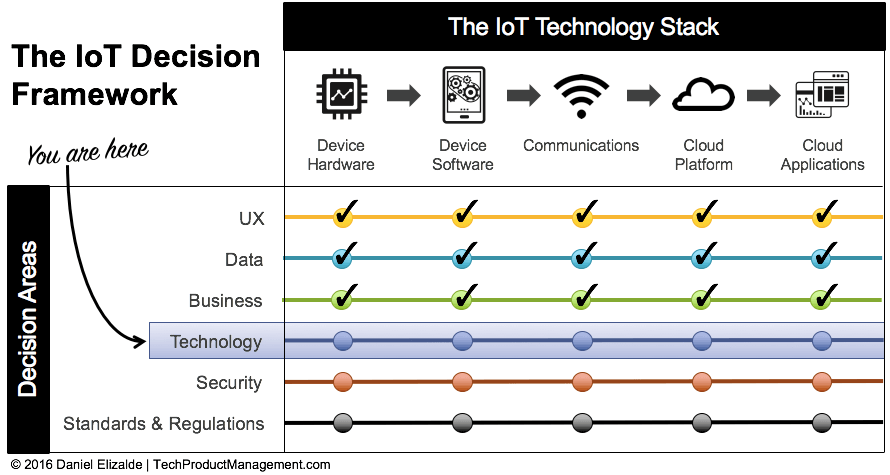
Recommended article: A Product Management Framework for the Internet of Things.
Why Do I Need to Understand the Hardware Inside My IoT Device?
Engineers design and implement the hardware, but product managers steer those choices to align with market needs. Hardware decisions shape cost, performance, user experience, and future scalability.
By grasping the fundamentals of IoT hardware, you can lead more effective conversations with engineering teams and make informed trade‑offs.
The Four Building Blocks of IoT Device Hardware
While every IoT application has its unique nuances, most devices share four core hardware components. Understanding these blocks helps you map product requirements to technical solutions.

Building Block 1: The Thing
The "thing" is the asset you aim to control or monitor. In many consumer products—such as smart water pumps or autonomous vehicles—the thing is fully integrated into the device. In industrial settings, existing equipment (e.g., wind turbines, jet engines, conveyor belts) often become “smart” through an attached gateway.
Choosing between a fully integrated device and a smart‑enabler model—known as brownfield versus greenfield—affects your value proposition, target market, and hardware architecture.
Illustrations:


Building Block 2: Data Acquisition Module
This module gathers physical signals from the thing—temperature, motion, light, vibration, etc.—and converts them into digital data for processing.
Key design questions:
- Which physical signals must be captured?
- How many sensors of each type are required?
- What sample rate ensures accurate monitoring?
- What resolution is necessary for your application?
Answers to these questions dictate sensor selection, signal conditioning, and the data volume your device will generate.
Recommended article: Data Acquisition: A Primer for IoT Product Managers
Building Block 3: Data Processing Module
The processing module is the device’s on‑board computer. It performs edge analytics, stores data locally, and may run real‑time control loops.
As a PM, focus on:
- Processing power—how much edge computation is needed?
- Local storage—how much data must be retained before transmission?
Considerations include:
- Number of sensors and their data rates.
- Need for real‑time control or advanced analytics.
- Future software upgrades that may raise processing demands.
- Physical size constraints that limit processor selection.
Determining Processing Power
Identify all tasks the device must perform. The more complex the workload—especially real‑time control or edge analytics—the higher the required CPU or microcontroller performance.
Assessing Local Storage Needs
Local storage is dictated by data retention policies and offline operation windows. For intermittent connectivity, the device must buffer data until it can transmit without loss.
Building Block 4: Communications Module
The communications module enables data exchange with the cloud and other systems. It can be integrated or external (gateway).
Common interfaces include USB, serial (RS‑232/485), CAN, Modbus, and wireless radios such as Wi‑Fi, LoRa, Zigbee, 3G, 4G, or 5G.
Gateway architectures aggregate multiple sensors into a single communication pathway, simplifying connectivity and reducing cost.
The Bottom Line
While deep expertise in every hardware layer isn’t required, a solid grasp of these four building blocks empowers you to make strategic product decisions and communicate effectively with engineering teams.
Stay tuned for deeper dives into the remaining layers of the IoT Technology Stack—subscribe to my newsletter to keep the learning flowing.
Internet of Things Technology
- How Electromagnets Work: Principles, Operation, and Practical Advantages
- Electrical Grounding Explained: Safeguarding Systems from Arcing and Fires
- How Water‑Jet Cutting Works: A Heat‑Free, Precision‑Cutting Technology
- How a Car Radiator Works: Inside the Cooling System
- Embedded Hardware Hacking for IoT Devices: Tools, Techniques, and Business Implications
- Understanding Overrunning Clutches: How They Operate and Why They Matter
- Understanding Turret Punching: How It Works and When to Use It
- How 3D Printers Operate: A Comprehensive Technical Overview
- How a 3D Pen Works: From Filament to Finished Model
- How a Two-Stage Pump Delivers Reliable Water Pressure