



HaLow: A Game‑Changing Low‑Power Wireless Standard for Large‑Scale IoT
In today’s rapidly evolving technology landscape, keeping up with wireless communication standards can feel daunting—even for seasoned professionals. The sheer variety of protocols and the specific use‑case requirements they address often blur the lines between necessity and innovation.
Most people are familiar with Wi‑Fi and Bluetooth—they’re ubiquitous in homes, offices, and mobile devices. Even if you haven’t built a low‑power mesh network, the names Zigbee, SigFox, LoRa, LTE‑M, and NB‑IoT will trigger recognition.
Yet those familiar words only scratch the surface. Different IoT scenarios demand distinct performance profiles. Some applications need low data rates, infrequent transmissions, but must reach distances of 15–50 km. Others require higher bandwidth but operate within a kilometer of an Internet gateway.
The Internet of Things has moved from a buzzword to a daily reality, and we’re just beginning to see its full potential.
Current wireless standards fall short of the ideal mix of long‑range, ultra‑low power, low cost, sufficient bandwidth, and robust security. No single protocol satisfies all these criteria, limiting the scalability of many promising IoT deployments.
Enter HaLow—pronounced “HEY‑Low”—the newest entrant in the Wi‑Fi family, based on the IEEE 802.11ah standard. HaLow delivers power consumption comparable to Bluetooth while offering higher data rates, a coverage radius exceeding 1 km, and the ability to support over 8,000 devices per access point.
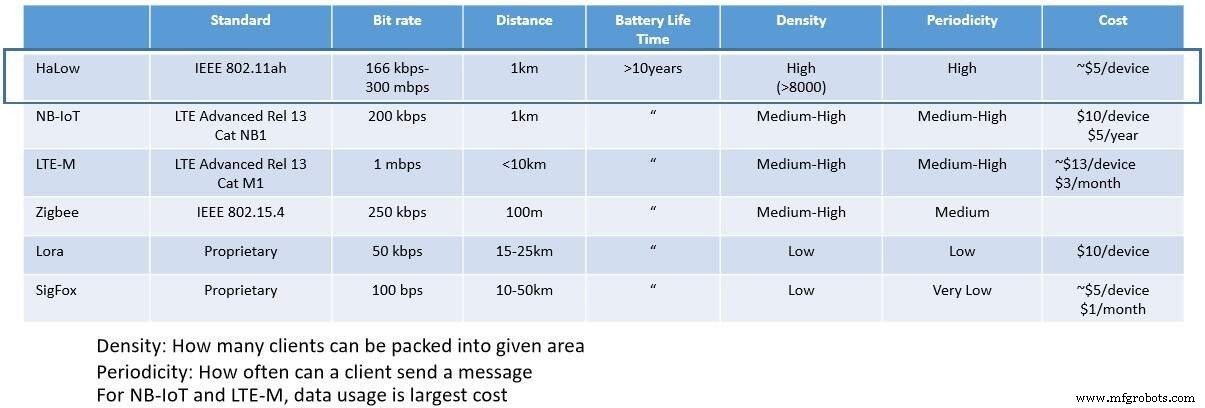
Operating in the sub‑GHz, license‑free ISM bands, HaLow extends range beyond 1 km while drawing less power than conventional Wi‑Fi, even from a coin‑cell battery. The standard also offers superior building penetration, support for up to 8,191 stations per access point, and WPA3 authentication—key features that make large‑scale IoT deployments feasible.
For developers looking to experiment with HaLow, Adapt has launched a comprehensive development platform. The HDP‑100 and HDP‑200 boards ship with full hardware and software support, enabling rapid prototyping across sectors such as agriculture, construction, logistics, retail, security, smart home, and transportation.
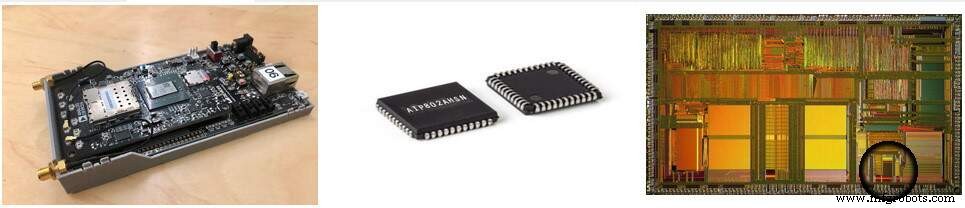
Adapt HaLow products: Development platforms (left), integrated circuits (middle), and IP for SoCs (right). (Source: Adapt)
The FPGA‑based HDP package, priced at $50,000, comes with hardware‑and‑software integration services, making it ideal for early adopters who need a turnkey solution for prototyping HaLow networks.
Adapt is also developing a HaLow SoC that integrates the radio, baseband, MAC, processor, memory, and sensor interfaces into a single chip. With tape‑out scheduled for Q4 2019 and full production planned for Q4 2020, it will be one of the first certified HaLow SoCs available to next‑generation IoT platform creators.
>> This article was originally published on our sister site, EEWeb: “New HaLow Wireless Protocol for Large-Scale IoT Deployments.”
Internet of Things Technology
- Robust Cloud‑Based Software Updates for IoT Devices
- 5 Key Wireless Standards Powering IoT Connectivity
- 5 Proven Principles for Designing Reliable Wireless IoT Products
- Cellular IoT: Unlocking the Advantages of CIoT Connectivity
- Designing IoT Devices for LTE and NB‑IoT: Expert Insights on Antenna Integration and Certification
- How IoT Is Slashing Healthcare Costs and Boosting Outcomes
- IoT Connectivity Revolution: New MVNO Models Threaten Traditional Operators
- IoT: Driving the High Street’s Digital Renaissance
- Operational Brain: The Next‑Gen Data Management Paradigm for Industrial IoT
- Volvo Drives Innovation: Leveraging IoT & AI to Revolutionize Vehicle Connectivity and Maintenance