



Wearables Get a Boost: Accurate Heart‑Rate Sensors Drive Shift to Proactive Health Monitoring
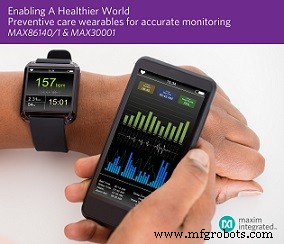
Continuous monitoring technology is redefining consumer expectations, moving from reactive check‑ups to proactive, real‑time health insights. As Jeremy Cowan reports, this trend is reshaping the wearable market.
“Consumers no longer wait for annual doctor visits to learn their blood pressure or heart rate,” says Sui Shieh, Vice President of the Industrial and Healthcare Business Unit at Maxim Integrated. “They want immediate, accurate data that helps them prevent illness before it starts.”
To meet this demand, the industry is increasingly focused on devices that are small, low‑power, and clinically reliable. Shieh notes that as continuous monitoring and preventive care become mainstream, both technology providers and healthcare professionals must adapt to remain competitive.
Global healthcare spending now represents 10% of GDP—approximately $9 trillion in the United States—yet the market for wearable health tech remains stagnant, largely because most fitness apps offer limited, non‑clinical data. The market, however, is growing fast: according to Berg Insight, the user base expanded from six million in 2016 to 50 million in 2021.
Maxim Integrated claims it can now deliver the performance consumers expect. Leveraging compact, low‑power solutions, the company has launched a new line of sensors that accurately track vital signs for fitness and early disease detection.
Maxim’s sensor portfolio supports a wide range of applications while prioritizing low power and small form factor. The MAX86140 and MAX86141 are optical pulse oximeter/heart‑rate sensors that capture PPG signals on the wrist, finger, or ear, enabling measurement of heart rate, heart‑rate variability, and pulse oximetry. The MAX30001 is an electrocardiogram (ECG) and bioimpedance (BioZ) analog front‑end that monitors heart rate, respiration, and arrhythmias from chest or wrist placements.
Compared with competitors, the MAX86140/41 consume less than half the power and are roughly one‑third the size, while the MAX30001 uses about half the power in almost half the space. By providing beat‑to‑beat data, these sensors help users recognize early symptoms and take action before conditions worsen. The MAX30001 also meets IEC 60601‑2‑47 clinical ECG standards, reinforcing its suitability for medical‑grade applications.
“The convergence of clinical‑grade diagnostics in form factors small enough for everyday wearables is impressive,” says Adrian Straka, Director of Hardware and Manufacturing at SKIIN. “The ultra‑compact MAX30001 powers SKIIN’s bio‑sensing underwear, enabling 24/7 health monitoring in low‑power mode.”
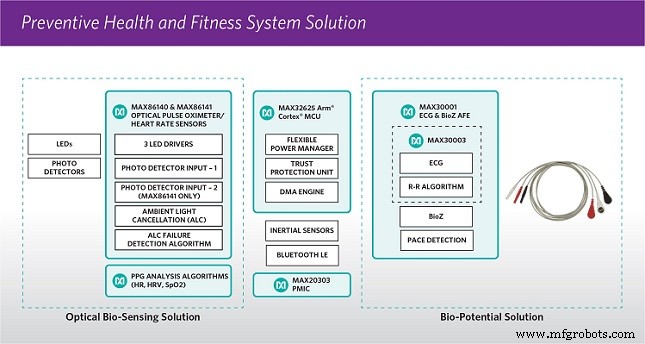
Maxim Integrated Products, Inc. (NASDAQ: MXIM) now offers the MAX86140, MAX86141, and MAX30001 for continuous monitoring in wearable health and fitness applications.
The MAX86140 and MAX86141 are available in a 20‑pin WLP package (2.048 mm × 1.848 mm) and operate from –40 °C to +85 °C. The MAX30001 is offered in a 28‑pin TQFN and 30‑bump WLP package (2.7 mm × 2.9 mm) and operates from 0 °C to 70 °C.
The author is Jeremy Cowan, editorial director & publisher of IoT Now.
Internet of Things Technology
- Ensuring Continuous Health of Your IIoT Systems
- Remote Heart Rate Monitoring System with AWS IoT Alerts
- Global Condition Monitoring Market to Hit $3.9 B by 2025, Fueled by Predictive Maintenance
- 2020 Marks a Turning Point for eSIM Adoption: Implications for Connectivity Providers
- Printed Sensors to Hit $4.5 bn by 2030, IDTechEx Forecasts Rapid Growth
- IoT Sensors Revolutionize Air Pollution Monitoring and Public Health
- Real-Time Heart Rate Monitoring System with Arduino & Infrared Sensors
- Robotic Sensor Market Forecast to Surpass $4 Billion by 2026
- Integrated Heart‑Rate Sensors in Smart Clothing: Reliable Wearable Monitoring
- Advanced Self‑Heating Wearable Gas Sensor for Precise Health and Environmental Monitoring