



Printed Sensors to Hit $4.5 bn by 2030, IDTechEx Forecasts Rapid Growth

Matthew Dyson, technology analyst at IDTechEx, shares insights from the latest report, “Printed and Flexible Sensors 2020‑2030: Technologies, Players, Forecasts.”
The printed‑sensor market currently exceeds US$3.6 bn (€3.1 bn) and is projected to reach US$4.5 bn (€3.9 bn) by 2030. This growth is driven by diverse applications and a nuanced technology landscape.
Rather than broad generalities, the report offers a granular view—examining 25 distinct forecast lines across 120 companies and organizations. It covers a wide array of sensor types, from organic and hybrid image sensors to piezoresistive/piezoelectric pressure sensors, stretchable strain sensors, temperature sensors, and more.
Figure below illustrates adoption readiness across the spectrum of printed sensor technologies and applications. Each color represents a specific technology or application, highlighting the varied maturity stages.
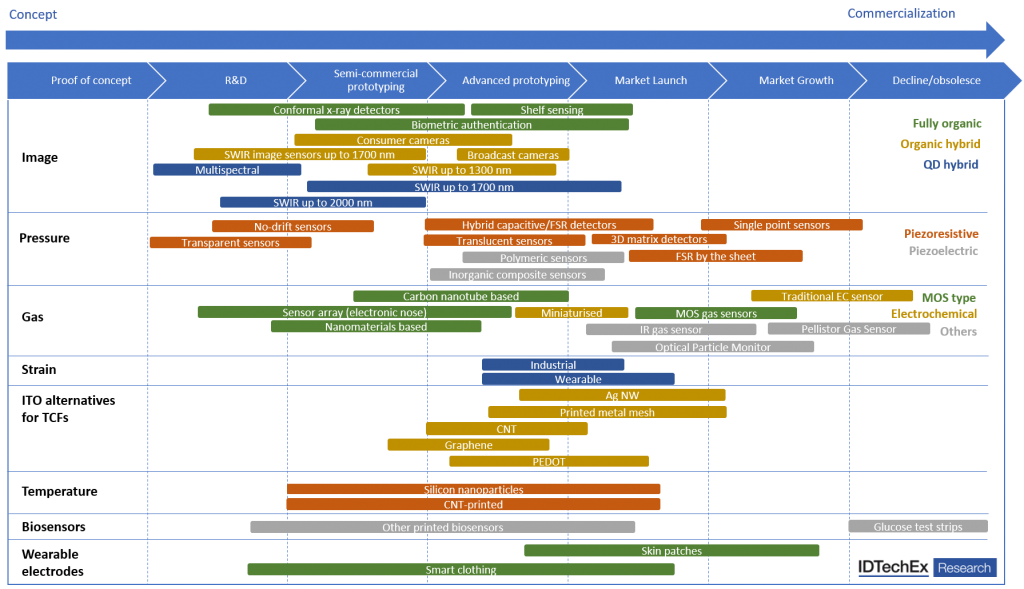
Hybrid image sensors—combining thin organic or quantum‑dot layers with CMOS read‑out—stand out, projected to rise from under US$1 m to approximately US$800 m by 2030. These sensors enable short‑wave infrared (SWIR) imaging, crucial for industrial inspection, driver assistance, and autonomous vehicles, while leveraging existing CMOS manufacturing lines.
Three Image‑Sensing Paradigms
1. Fully Organic Photodetectors (OPDs) rely on sequential printing of organic semiconductors onto flexible substrates. While attractive for biometric authentication and large‑area X‑ray imaging, market adoption is limited by competition from amorphous silicon and the existing presence of integrated fingerprint sensors.
2. Organic‑on‑CMOS Hybrids integrate organic semiconductors with standard CMOS circuitry, offering cost‑effective pathways for advanced imaging. These are poised for broadcast‑camera integration, delivering spatially variable sensitivity without compromising resolution.
3. Quantum‑dot‑on‑CMOS Hybrids provide extended wavelength sensitivity beyond 1000 nm, enabling cost‑effective SWIR imaging that traditionally required expensive InGaAs detectors.
Pressure Sensing: Targeting High‑Value Applications
Piezoresistive sensors dominate mature markets such as automotive occupancy detection and musical instruments. To differentiate, manufacturers are exploring 3D‑touch pads, hybrid piezoresistive/capacitive sensors, and transparent detectors—applications that demand additional functionality and justify higher costs.
Printable piezoelectric sensors, whether polymer‑based or ceramic‑composite, are still early in adoption. They excel in high‑frequency vibration sensing and actuator roles rather than competing directly with piezoresistive devices.
Transparent Conductors Beyond ITO
Indium tin oxide (ITO) brittleness limits its use in flexible displays. Alternatives such as silver nanowires, hybrid metal mesh, and fully printed metal mesh are maturing, while carbon nanotube and graphene films remain early‑stage, battling for a clear value proposition.
Wearable Electrodes for Continuous Health Monitoring
Continuous monitoring of physiological parameters—heart rate, ECG, muscle activity—requires flexible electrodes. Printed electrodes simplify integration with flexible circuits, reduce manufacturing complexity, and enable fully hybrid flexible electronics (FHE).
Forecasts predict the wearable‑electrode segment to exceed US$3 bn (€2 bn) by 2030, with medical skin patches leading adoption before smart clothing, due to higher regulatory scrutiny and clear clinical benefits.
The Full Landscape
Understanding printed‑sensor prospects requires dissecting each technology’s market need, barriers, and value proposition. IDTechEx’s 2020‑2030 report offers a comprehensive view, profiling over 50 companies and delivering revenue and printed‑area forecasts across 30 applications.
With a decade of expertise, IDTechEx provides unrivaled insight—conducting interviews, site visits, and hosting global events to track the evolving printed‑electronics ecosystem.
For full details, download the IDTechEx report or email [email protected].
Dr. Matthew Dyson will discuss these findings in a webinar on 6 August, “Opportunities and New Technologies in Printed Sensors.” Register now for one of our three sessions.
Author: Dr. Matthew Dyson, technology analyst at IDTechEx.
Internet of Things Technology
- Key Automotive Sensors: How Modern Cars Use Advanced Technology
- Digital Magnetic Hall Sensors: Fundamentals, Design, and Automotive Applications
- Global Condition Monitoring Market to Hit $3.9 B by 2025, Fueled by Predictive Maintenance
- 3D‑Printed Sensor Enclosure for Tablet‑Counting Systems: A Practical Use Case
- Tiny Yet Powerful: NevadaNano Unveils 0.9‑sq‑in Combustible Gas Sensor for IoT
- Robotic Sensor Market Forecast to Surpass $4 Billion by 2026
- Digital Sensors in Industrial Machinery: Function, Types, and Best Practices
- NASA-Developed Inductive Non-Contact Position Sensor for Precise Motion Control
- New Wearable Hologram Sensor Provides Instant Gas Leak Alerts
- Distance Sensors Explained: Types, Uses, and How to Choose the Right One