



Autonomous Vehicles: Telecom Operators’ New Frontier in Passenger Entertainment
While autonomous vehicles capture headlines across industries, the telecom sector’s true opportunity lies beyond the vehicle’s own connectivity. After engaging with a broad spectrum of stakeholders and conducting a detailed analysis, Analysys Mason’s Tom Rebbeck, research director of Enterprise & IoT, argues that autonomous cars will have a modest direct impact on telecoms, but could unlock significant demand for passenger‑focused services.
From Driver to Passenger: A New Customer Base Emerges
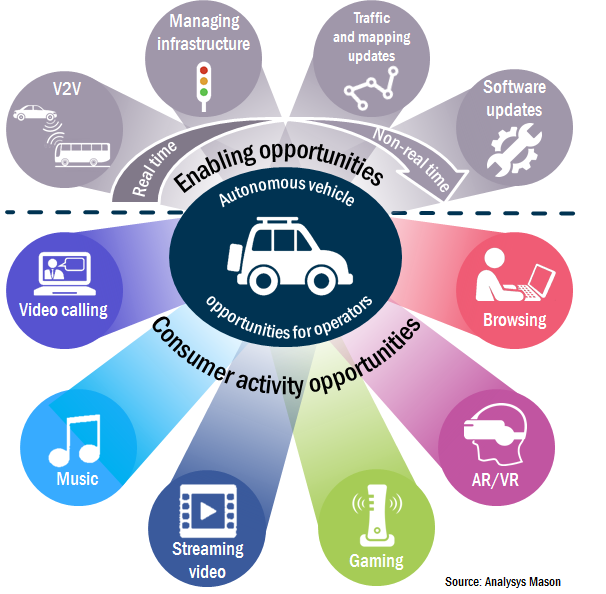
Self‑driving cars rely primarily on on‑board sensors—radar, lidar, cameras—to navigate. While 5G and other cellular links can provide real‑time data, they are not the core of vehicle operation. Instead, telecom networks will mainly handle non‑real‑time updates such as traffic feeds, map refreshes, and over‑the‑air software patches, all of which require relatively modest bandwidth.
However, as drivers transition to passengers, their consumption habits shift. Audio, video, gaming, and emerging augmented‑reality experiences become prime content streams for carriers. Although full‑autonomy is still years away—many analysts project widespread deployment only after 2030—the long horizon offers a growing market for high‑volume data services.
Wide‑Area Connectivity Is Supplementary, Not Essential
On‑board processing is the backbone of autonomous navigation. Cellular links act as a safety net, providing additional context such as the intentions of nearby vehicles via V2X (vehicle‑to‑everything) protocols. These protocols enhance traffic flow and enable coordinated maneuvers like platooning, but they do not replace local sensor data.
Data Volume Is Smaller Than Often Implied
Intel’s claim that autonomous cars could generate 4 TB of data per day is based on an extreme scenario—15 hours of operation daily, similar to a commercial Uber vehicle. For a typical private car that drives one hour a day, the amount of data needing cloud upload could be as low as 250 MB if only 0.1 % of processed data is transmitted. In practice, most locally processed information is discarded, with only anomalies sent to the network.
Entertainment Drives Higher Bandwidth Demand
The real upside for telecoms lies in passenger entertainment. Streaming video, high‑definition audio, and immersive AR games can consume well over 1 GB in a 30‑minute session. Solutions include upgrading a vehicle’s existing data plan, tethering smartphones, or deploying in‑car Wi‑Fi hotspots that connect through the OBD‑II port.

Long Development Timeline
Full autonomy is unlikely before the early 2030s. Even if autonomous vehicles replace conventional cars at a 7 % annual replacement rate, half of the fleet would not be autonomous until around 2035. Rapid acceleration could occur through retrofitting, regulatory incentives, or industry consolidation, but assuming widespread adoption before 2025 remains speculative.
By the time autonomous mobility reaches maturity, telecom operators may already be transitioning to 6G, positioning them to capitalize on the passenger‑entertainment wave.
Author: Tom Rebbeck, Research Director, Enterprise & IoT, Analysys Mason.
Internet of Things Technology
- From Prototype to Production: Building Tomorrow’s Autonomous Vehicles
- Why RTI Connext DDS Is the Go‑to Middleware for Autonomous Vehicles
- Ethernet: The Backbone of Autonomous Vehicle Reliability
- The Internet of Things and 5G: Driving the Future of Connected Vehicles
- Top 4 Challenges Facing the Industrial Internet of Things (IIoT)
- Augmented Reality: The Future of HR and Workplace Innovation
- How eSIMs are Transforming Mobile Operators: Growth Opportunities & Revenue Models
- Sustainability: The Next Priority for Wireless Technology
- Big Data Lingo Explained: Essential Terms Every Data Enthusiast Should Know
- The Future of Autonomous Vehicles: Technology, Challenges, and Innovations