



AI Takes Center Stage at Economist Innovation Summit – Leaders Call for Augmenting, Not Replacing, Human Skills
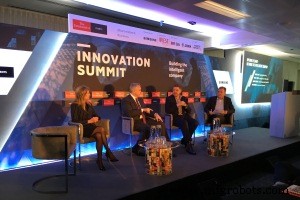 Panel (L-R): Nicole Eagan, Heath P. Terry, Michael Wignall & Tom Standage
Artificial intelligence dominated the opening session of today’s Economist Innovation Summit (#EconInnov). For attendees like me—Jeremy Cowan—who had viewed AI as a set of chatbots and pilots, the session served as a decisive wake‑up call.
Tom Standage, The Economist’s deputy editor, welcomed Nicole Eagan, CEO of Darktrace, a company that brands itself as an “Enterprise Immune System” for cybersecurity. Eagan announced that Darktrace’s AI platform is now active in more than 7,000 organisations worldwide.
(Nicole will be interviewed by IoT Now in the coming weeks to discuss the AI market and these deployments in greater detail. Ed.)
While it was unsurprising that banks use AI for fraud detection and predictive analytics, Eagan highlighted that most deployments can be completed in under an hour—a claim we will revisit in depth during her interview.
Standage raised a common concern: how can an AI system detect threats that already exist in the network? Eagan explained that the system may initially flag the current state as “normal” during its first few days of operation, but by analysing multiple data streams it quickly learns to spot anomalies.
Heavy but not slow‑moving
When asked which sectors are leading AI adoption beyond finance, Heath P. Terry, Managing Director of Goldman Sachs, delivered a surprising answer: heavy industry—including energy, oil, and manufacturing—is seeing significant gains. “A gas turbine can host up to 400 sensors,” Terry noted, “and AI can predict potential failures from five hours to five days ahead. Scheduling maintenance during low‑usage windows can be crucial for utilities that operate on 2–3% margins.”
Standage expressed genuine surprise, remarking, “These are the kinds of companies we don’t usually associate with rapid software adoption.” When asked about lagging industries, Terry clarified that it isn’t an entire sector but rather individual firms. “Retail is often slower, largely due to a massive talent shortage,” he said. “An eight‑figure AI expert is unlikely to choose a retail chain over Google or another tech giant.” The biggest obstacle, according to Terry, remains the availability of high‑quality data.
Michael Wignall, Microsoft UK’s CTO, shared how the company is embedding AI into productivity tools. “We’re making AI a standard part of everyday workflows,” he said. “Real‑time translation on Skype, for instance, now supports Chinese‑to‑English conversation. By lowering the barrier to AI, we’re democratising its use.” He also highlighted Microsoft’s role in enabling a Dixons Carphone chatbot and helping Rolls‑Royce launch an Engines‑as‑a‑Service model—examples that illustrate AI’s potential to transform business models, albeit with associated risks.
Build or buy, and other risks
Standage noted that tech giants like Google and Facebook can move from idea to product in as little as five months, a stark contrast to the decade‑long transition many companies experienced when adopting cloud email. Wignall agreed that AI, machine learning and deep learning will see a mix of overt development and stealth adoption. “Users will become aware of AI through its utility,” he said.
He added that for sectors such as financial services, organisations often build AI solutions in-house, whereas Microsoft and Google provide complex building blocks to avoid reinventing the wheel.
Eagan warned that expanding AI deployments can increase an organisation’s attack surface, especially given a talent shortage—over 2 million open cybersecurity roles globally. “A cyber‑attack can encrypt data faster than a security manager can get a coffee,” she said. “That’s why human oversight must be augmented with AI.”
People need time to trust AI
When asked whether engineers resist AI integration, Eagan replied that when AI is used to detect threats, staff are generally receptive. “We empower humans to decide the final action, and the machine neutralises threats,” she said. Darktrace’s deployment model starts with Recommendation Mode, then moves to Human Confirmation Mode, and finally to Active Mode where AI can take autonomous action. “Trust is built over time,” she added.
“Cyber experts are in a kind of hand‑to‑hand combat with hackers when the system is first deployed,” she explained. “Within a year, after trialing the technology, they enter a due‑diligence phase, benchmarking their cyber defence against peers.”
Concluding, Wignall stressed that AI is a productivity tool but also a catalyst for new business models. “While the Luddites of the 19th century feared job loss, railways and telegraphs ultimately created new employment opportunities,” he said.
The author is Jeremy Cowan, Editorial Director of IoT Now, IoT Global Network and VanillaPlus.
Internet of Things Technology
- How Open Source Drives Innovation in the Internet of Things
- Beyond the Buzz: 3 Core Pillars of the Internet of Things
- Bridging the Smart Home Skills Gap: Why Britain Lags Behind Europe
- Bridging the Skills Gap in the IoT Market: Challenges and Solutions
- Schneider Electric Ventures Launches €300‑500 M Fund to Accelerate Industrial IoT Startups
- AI at the Edge: From Consumer Innovations to Enterprise‑Grade Solutions
- Building Robots to Augment Humans, Not Replace Them
- Opinion: Automation Enhances, Not Replaces, Human Workforce
- Beat Automation: 5 Essential Skills for Manufacturers
- Human Innovation Meets Advanced Automation: Shaping the Future of Modern Manufacturing