



Why Scale Drives Profitability in NB‑IoT and LoRa Networks

Joe Madden, principal analyst at Mobile Experts, explains the key levers that drive the profitability of an IoT service.
Many businesses mistakenly focus on cloud providers, device subsidies, or spectrum costs, overlooking the most impactful variables.
Mobile Experts’ ROI studies distill the debate into a few decisive factors:
- The choice between NB‑IoT and LoRa is context‑dependent. If an operator can upgrade an existing LTE network via software, NB‑IoT is the most economical path. Otherwise, LoRa may reduce CAPEX for operators lacking LTE coverage, but NB‑IoT often wins on coverage and device cost.
- Cloud platforms—AWS, Google Cloud, Microsoft Azure—contribute a negligible share of the total cost of ownership; their impact on profitability is minimal.
- Leveraging an established tower infrastructure delivers substantial savings. Negotiating rights for thousands of new sites is prohibitively expensive, whereas adding NB‑IoT or LoRa radios to the existing 2G/3G/LTE sites is far more cost‑effective.
- The pricing of end‑user devices is the single most critical factor. When consumers pay $15–$20 (€13.08–€17.43) for a device, the business case remains viable. Subsidizing or giving away hardware makes it difficult to achieve a positive margin.
Deploying a new network—whether LoRa or NB‑IoT—requires significant capital. LoRa demands more sites and a fresh nationwide RF plan, whereas NB‑IoT base stations can be mounted on existing LTE sites but still carry substantial CAPEX. In either scenario, operators must reach roughly 20 million connected devices to break even on the upfront investment.
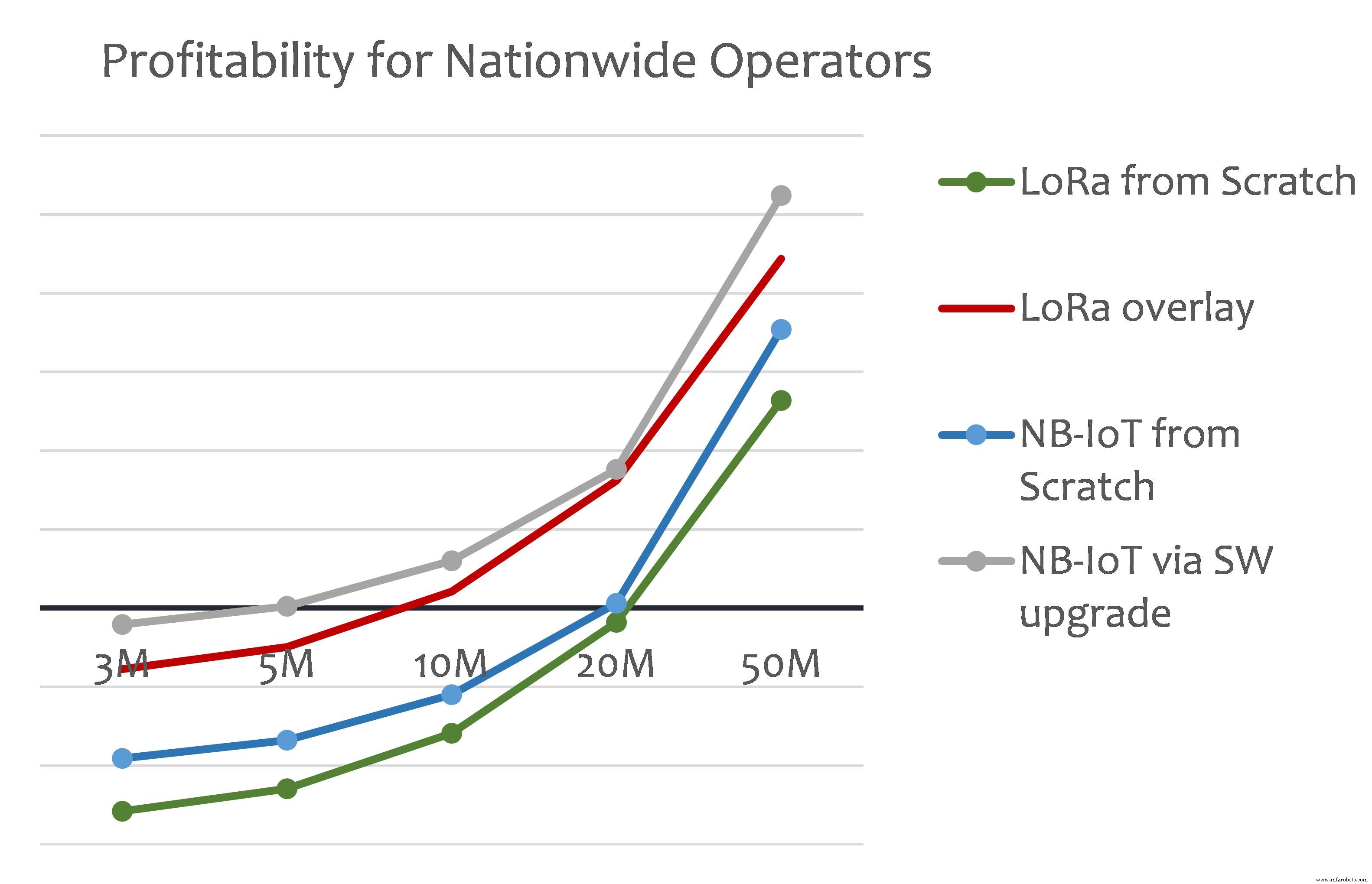
Our calculations incorporate the entire cost of ownership: network deployment CAPEX, device provisioning and subsidies, cloud fees, and ongoing OPEX over an eight‑year horizon.
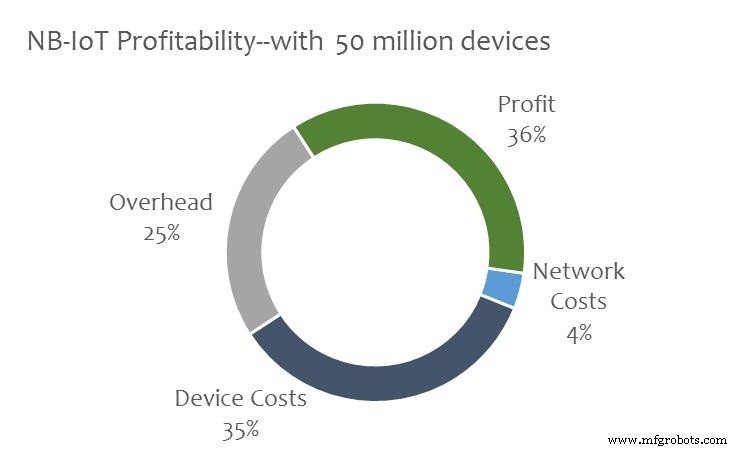
Despite recent complaints from NB‑IoT operators in China about thin margins, the economics of the IoT market are fundamentally tied to scale, not the specific technology stack. Adding devices incurs minimal incremental cost yet drives revenue growth.
When a large‑scale LPWAN reaches 50 million devices, it transitions into a sustainable business model. According to our forecasts, operators will reach this milestone sooner than many anticipate.
The author of this blog is Mobile Experts’ principal analyst, Joe Madden.
Internet of Things Technology
- From Sports Glory to Factory Excellence: How Team Chemistry Fuels Industrie 4.0
- NB‑IoT vs. LoRa vs. Sigfox: Selecting the Ideal LPWAN for Your IoT Deployment
- LoRa Breaks Distance Records by Bouncing a Message to the Moon and Back
- Smart Core Network Slicing for IoT and MVNOs: Unlocking 5G Potential in 3G/4G Networks
- Why Battery Life Matters for Real‑World IoT Applications
- 5G’s Top Five Challenges: Navigating Spectrum, Cost, Coverage, Devices, and Security
- Secure, On‑Demand Private LTE: IPX Network Innovation & Dynamic Bandwidth
- Procurement & HR: Driving Supply Chain Excellence Together
- Elevating Robotics & Automation with Precision Hydraulic Manifolds
- Edge Computing & 5G: Powering Enterprise Transformation