



Thermocouples Explained: Types, Ranges, and Performance Comparison
A thermocouple is a temperature sensor that consists of two dissimilar metal wires joined at one end to form a junction. When the junction experiences a temperature change, a small voltage is generated, which can be converted to a temperature reading using reference tables. Thermocouples are prized for their high‑temperature capability, low cost, durability, and wide operating range, making them ubiquitous in scientific research, OEM products, and industrial processes—from gas and oil pipelines to power plants, cement manufacturing, pharmaceuticals, biotechnology, and even household appliances like toasters and heaters.
Thermocouple Types and Their Operating Ranges
Thermocouples are grouped into several standard types—K, J, T, E, N, S, R, and B—each defined by the alloy composition of its positive and negative legs and tailored for specific temperature ranges and environmental conditions. A protective sheath or insulation surrounds each sensor, reducing corrosion and shielding it from harsh surroundings.
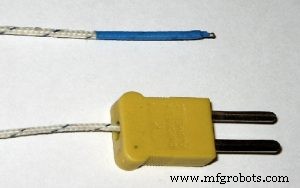
Below is an overview of each thermocouple type, its typical composition, temperature range, accuracy, and sensitivity.
J‑Type Thermocouple
Composition: Iron (+) / Constantan (–). J‑type sensors are often used in reducing, vacuum, oxidizing, and inert environments. They offer a temperature range of –210 °C to +1200 °C and an accuracy of ±2.2 °C (±0.75 %). Sensitivity is 50–60 µV/°C.
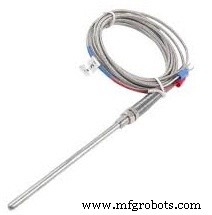
K‑Type Thermocouple
Composition: Chromel (+) / Alumel (–). The K‑type is the most widely used thermocouple, suitable for inert or oxidizing atmospheres up to 2300 °F (1260 °C). It is stable and accurate at high temperatures, with a sensitivity of 28–42 µV/°C and the same accuracy as J‑type.
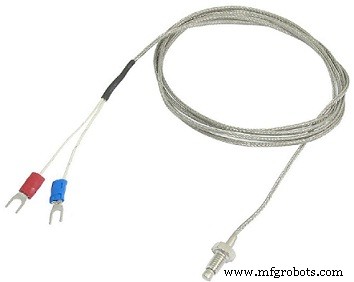
N‑Type Thermocouple
Composition: Nicrosil (+) / Nisil (–). N‑type sensors offer superior resistance to thermal cycling, hysteresis, and “green rot” compared with K‑type, but are more expensive. Operating range: –250 °C to +1300 °C; accuracy ±2.2 °C (±0.75 %); sensitivity 24–38 µV/°C.
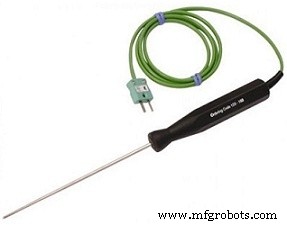
T‑Type Thermocouple
Composition: Copper (+) / Constantan (–). T‑type is ideal for sub‑zero temperatures and operates reliably in oxidizing, reducing, vacuum, and inert environments. Temperature range: –330 °F to 660 °F (–200 °C to 350 °C). Accuracy ±2.2 °C (±0.75 %); sensitivity 17–58 µV/°C.
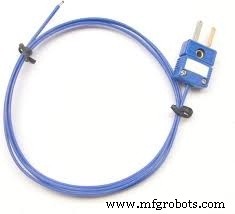
E‑Type Thermocouple
Composition: Chromel (+) / Constantan (–). E‑type sensors provide a high EMF per degree and are suitable for oxidizing atmospheres up to 1650 °F (900 °C). They require protection from sulfurous environments. Accuracy ±1.7 °C (±0.5 %); sensitivity 40–80 µV/°C.
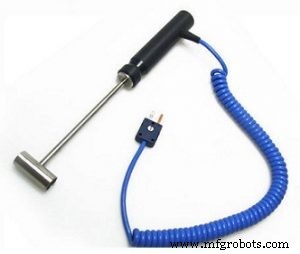
S‑Type Thermocouple
Composition: Platinum 10 % Rhodium (+) / Platinum (–). S‑type is designed for extreme high‑temperature processes in the pharmaceutical and biotech sectors and offers excellent stability and accuracy at high temperatures. Operating range: 1800 °F to 2640 °F (980 °C to 1450 °C). Accuracy ±1.5 °C (±0.25 %); sensitivity 8–12 µV/°C.
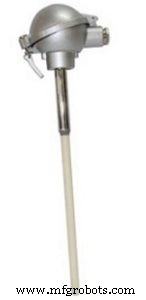
B‑Type Thermocouple
Composition: Platinum 30 % Rhodium (+) / Platinum 6 % Rhodium (–). B‑type sensors handle the highest temperature limits, from 2500 °F to 3100 °F (1370 °C to 1700 °C), while maintaining high precision and stability. Accuracy ±0.5 % (±0.25 %); sensitivity 5–10 µV/°C.
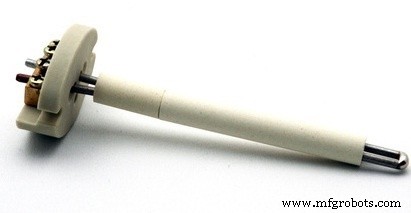
R‑Type Thermocouple
Composition: Platinum 30 % Rhodium (+) / Platinum (–). R‑type shares many characteristics with S‑type but uses less Rhodium, making it slightly cheaper. It operates from 1600 °F to 2640 °F (870 °C to 1450 °C). Accuracy ±1.5 °C (±0.25 %); sensitivity 8–14 µV/°C.
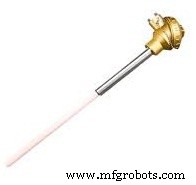
Thermocouple Performance Comparison
The table below summarizes the key specifications of each type for quick reference:
| Type | Composition | Temperature Range | Accuracy | Sensitivity |
|---|---|---|---|---|
| J | Fe / Constantan | –210 °C to +1200 °C | ±2.2 °C (±0.75 %) | 50–60 µV/°C |
| K | Chromel / Alumel | 95 °C to 1260 °C (200 °F–2300 °F) | ±2.2 °C (±0.75 %) | 28–42 µV/°C |
| N | Nicrosil / Nisil | –250 °C to +1300 °C | ±2.2 °C (±0.75 %) | 24–38 µV/°C |
| T | Copper / Constantan | –330 °F to 660 °F (–200 °C to 350 °C) | ±2.2 °C (±0.75 %) | 17–58 µV/°C |
| E | Chromel / Constantan | –200 °F to 1650 °F (–95 °C to 900 °C) | ±1.7 °C (±0.5 %) | 40–80 µV/°C |
| S | Pt‑10%Rh / Pt | 1800 °F to 2640 °F (980 °C to 1450 °C) | ±1.5 °C (±0.25 %) | 8–12 µV/°C |
| B | Pt‑30%Rh / Pt‑6%Rh | 2500 °F to 3100 °F (1370 °C to 1700 °C) | ±0.5 % (±0.25 %) | 5–10 µV/°C |
| R | Pt‑30%Rh / Pt | 1600 °F to 2640 °F (870 °C to 1450 °C) | ±1.5 °C (±0.25 %) | 8–14 µV/°C |
Whether you need a robust, cost‑effective solution for low‑temperature measurements or a high‑temperature, high‑accuracy sensor for advanced industrial processes, selecting the correct thermocouple type is critical. If you have any questions about which thermocouple best meets your application’s needs, feel free to leave a comment below.
Sensor
- Understanding Maintenance Types: A Practical Comparison for Industrial Success
- 8 Common Data Breach Types – Real-World Examples & Impact
- Comprehensive Guide to C# Data Types: Value, Reference, and Pointer
- Explore 8 Welding Helmets: Pros, Cons & the Best Fit for You
- A Comprehensive Guide to Shaper Machine Types
- Understanding Couplings: 13 Types Explained for Efficient Power Transmission
- Compare 8 Top Welding Helmets: Pros, Cons, and Expert Tips
- 11 Welding Processes Illustrated: A Comprehensive Guide
- Sheet Metal Operations Explained: Types, Techniques & Diagrams
- Steel Wind Turbine Towers: Types, Benefits, and Innovations