



Building the Hardware Foundations of the Metaverse
The metaverse has become a buzzword in tech circles, especially after high‑profile announcements from companies like Meta (formerly Facebook) and Nvidia. Yet what does the term actually mean, what hardware obstacles must be overcome, and which technologies are already on the path to realization? Analyst firm IDTechEx recently dissected key hardware domains—displays, image sensors, optics, haptics, AR/VR—and we distill that analysis here.
At its core, the metaverse envisions virtual worlds that coexist seamlessly with the physical world, enabling immersive interactions that reshape our sense of presence. While software is approaching maturity, the hardware still faces significant hurdles.
Without the right hardware, the metaverse remains a visionary concept. Current interactions will still rely on phones and laptops, but these devices are soon to become legacy. Full immersion demands dedicated VR headsets, and true integration of digital and physical environments requires AR glasses.
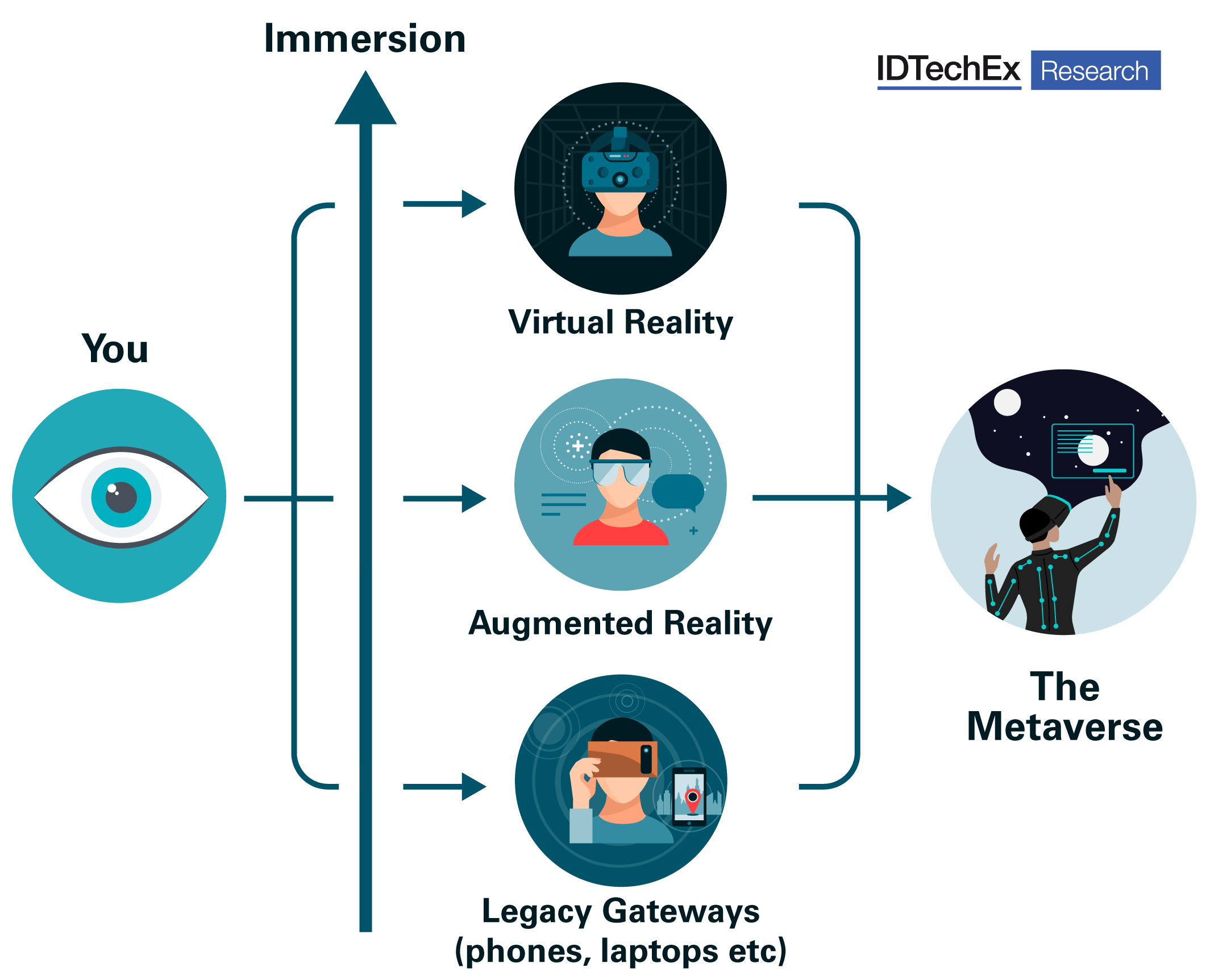
Social acceptability is the litmus test for AR/VR hardware. Even with multi‑billion dollar R&D budgets, genuine AR glasses that are both stylish and deliver IMAX‑level visuals are still years away. Meta unveiled its AR glasses concept alongside its rebrand, admitting the technology is not near viability. Some VR headsets are so bulky they resemble futuristic robots; only premium models begin to blur the line between virtual and real.
The long‑term vision is a lightweight, comfortable device that can be worn all day, switching fluidly between AR and VR while enabling natural interaction with other users. The hardware journey to that device is filled with exciting progress but also complex challenges.
MicroLED displays: a pivotal breakthrough
Placing a screen directly in front of the eye exposes pixel gaps—known as the screen‑door effect. The rule of thumb is 60 pixels per degree (ppd) of field of view to achieve a realistic look, driving extremely high resolution requirements. Optics must also focus and size the image correctly. In AR, inefficient optics require brightness levels in the millions of nits; for context, the iPhone 13 Pro Max peaks at 1,200 nits.
MicroLED technology offers several advantages for AR and VR: it avoids OLED burn‑in, can reach extraordinary brightness (JadeBird’s AR panel tops 3 million nits), and supports ultra‑small pixel pitches. Mojo Vision’s nanoLED claim a sub‑pixel pitch of 900 nm, small enough for a contact‑lens‑size display.
Challenges remain. MicroLEDs struggle with full‑color fidelity because blue emitters are far more efficient than red and green. Quantum‑dot color conversion is the industry’s preferred solution, converting blue light into the other colors. While this technique can be inkjet‑printed or lithographically patterned, concerns about long‑term durability under extreme brightness and the use of heavy metals persist. A detailed roadmap for microLED commercialization can be found in our full report.
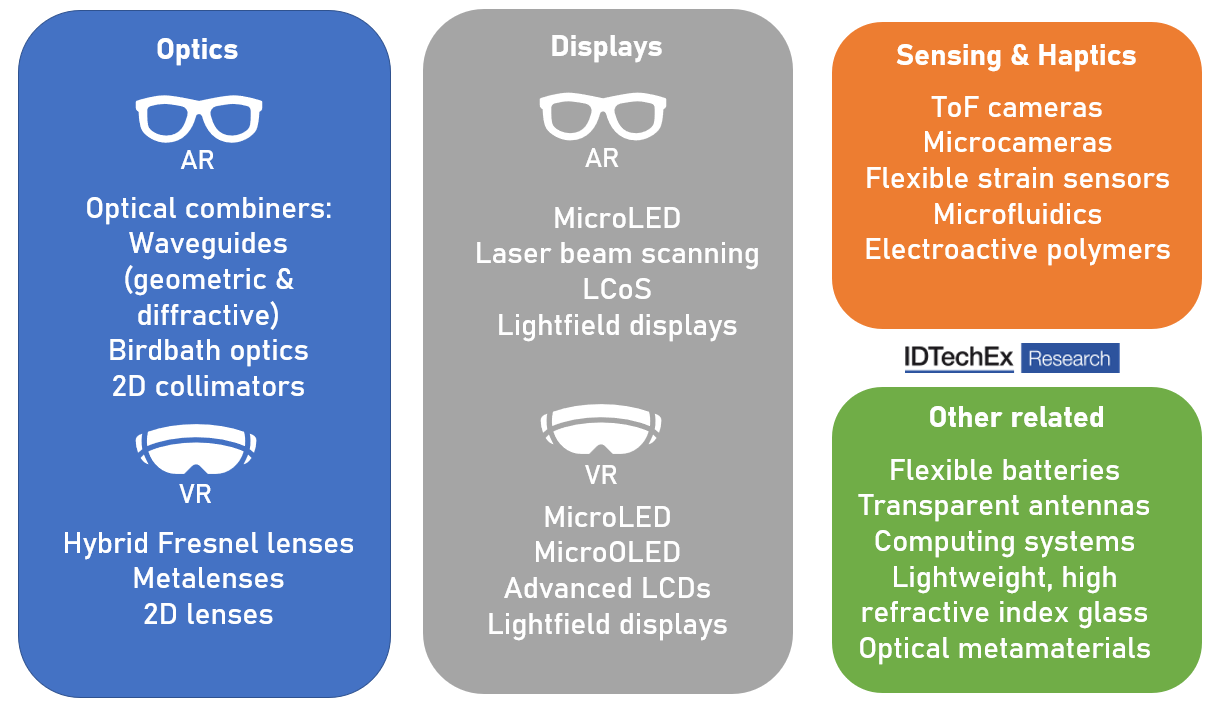
The primary battleground for AR optics is the combiner: a transparent lens that overlays projected imagery. Companies vie for superior color accuracy, the widest field of view, and the largest eye‑box to deliver convincing visual experiences for every user.
Industry leaders now see surface‑relief waveguides as the path forward. In May, Snap acquired WaveOptics, and in November, Samsung Electronics invested $500 million in Digilens, a fabless waveguide pioneer. Digilens’ TREX waveguide can effectively double display resolution, helping meet the 60 ppd benchmark. For a deeper dive into AR, VR, and MR optics, refer to our dedicated report.
Eye‑tracking: optimizing resolution where it matters
Covering a 135° horizontal field of view at 60 ppd would be prohibitive. Fortunately, visual acuity peaks at the center of the gaze; eye‑tracking allows us to allocate high resolution only where the user is looking, reducing demands elsewhere.
Future iterations may even project images directly onto the retina using laser‑beam scanning, bypassing combiners and accommodating glasses wearers—provided consumers accept the technology.
Emerging image‑sensor designs—such as event‑based vision—streamline processing by recording motion events instead of full frames. Printed sensors enable slimmer eye‑trackers; Meta Materials Inc. (unrelated to Meta) already embeds micro‑cameras into lens surfaces, a strategy that will integrate with combiner optics as the field matures.
Haptics: adding a tactile dimension
Even the most advanced visual hardware is incomplete without realistic touch feedback. In November 2021, Meta’s Reality Labs unveiled a haptics glove prototype, featuring microfluidic channels that deliver localized feedback across the hand. Although the design shares similarities with HaptX, Meta’s intellectual‑property position is solid and exemplifies the industry's push toward multisensory immersion, according to IDTechEx.
Time‑of‑flight cameras have emerged as a key sensor for hand tracking, eliminating the need for traditional controllers. Apple’s long‑standing interest in AR/VR has recently been confirmed when LG Innotek supplied such cameras for a 2022 headset, signalling the technology’s impending ubiquity.
In conclusion, the metaverse is already emerging in limited forms. While the hardware mountain remains steep, progress is steady, and the prospect of sleek, IMAX‑quality AR glasses replacing smartphones is increasingly realistic.
Sensor
- A Practical Taxonomy for Industrial Internet of Things (IIoT) Systems
- Why Ultra‑Low, High‑Accuracy Pressure Sensors Are Critical for Modern Applications
- Key Drivers Behind Successful Open‑Source Hardware Innovation
- SIGHT: Smart Glasses Empowering the Blind
- Certified Reliability Engineer (CRE): The Essential Credential for Plant Reliability Professionals
- Urban Bees Adopt Plastic: A New Insight into Sustainable Nesting
- Lunar Flashlight Mission: Scanning the Moon’s South Pole for Water Ice
- How 5G Will Revolutionize IoT and Industrial IoT
- Integrating the 5S Method into Industry 4.0: Overcoming Implementation Challenges
- A Heartfelt Farewell: My 40-Year Journey in Publishing