



Choosing the Right Thermoplastic Elastomer (TPE) for Injection Molding: A Practical Guide
We sometimes get questions about how thermoplastic elastomers (TPEs) differ from thermoset elastomers and which of the various TPEs would work best for a given part. One of the most fundamental differences between a part made with thermoplastics and one made with thermosets has to do with the chemistry that happens when the part is formed.
The Name is Bond…Chemical Bond
Thermoplastic elastomers (TPEs) differ from thermoset elastomers in the way their molecules attach to each other. Another difference is that TPEs can be processed on conventional injection molding machines. The resin is heated beyond its melting point, molded into shape, then cooled by the mold to solidify into its final form.
Meanwhile, thermoset elastomers such as liquid silicone rubber (LSR) are molded into shape at lower temperatures, then high heat from the mold chemically crosslinks the polymer. This strengthens bonds between molecules.
One big difference between the two is that because they don’t undergo crosslinking during molding, TPE parts can return to a molten state, permitting recycling.
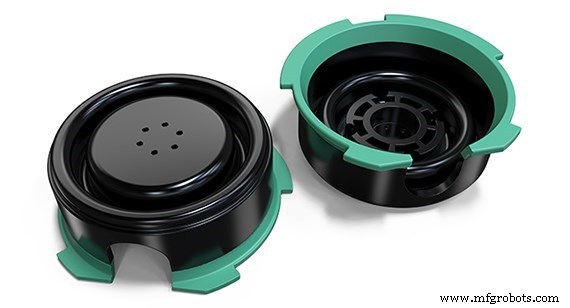
TPEs also provide the advantage of being able to be processed on the same equipment as standard thermoplastic resin, allowing for more optimized processes such as overmolding or multi-shot molding.
 Triax Technologies used TPE overmolding to chemically bond to the substrate material, creating a waterproof seal for its IoT-enabled wearable device.
Types of Thermoplastic Elastomers
You can break TPEs into six primary categories that differ based on their chemical composition and structure:
- TPV: Thermoplastic vulcanizates
- TPU: Thermoplastic urethanes
- TPO: Thermoplastic olefins
- SBC: Styrenic block copolymers
- COPE: Copolyester elastomer
- PEBA: Polyether block amide
There can be substantial differences between each type of TPE and even the formulation of each subtype, so it’s important to pick the right material when considering part longevity and cost.
| TPE Type | Trade Names | Chemical Resistance | Dimensional Stability | Density | High Tensile Strength? | Shore Hardness Range | Continuous Use Temp. Limit |
|---|---|---|---|---|---|---|---|
| TPV |
|
good | good | high | moderate | 40A to 50D | 135℃ |
| TPU |
|
excellent (for polyester-based formulations) | good (with additives) | high | yes | 65A to 80D | 120℃ |
| TPO |
|
good | good | low | yes | 75A to 80D | 120℃ |
| SBC |
|
limited | good | low | low-to-moderate | 15A to 50D | 110℃ |
| COPE |
|
good | good | high | yes | 90A to 80D | 140℃ |
| PEBA |
|
good | good | low | yes | 80A to 75D | 170℃ |
TPV – Thermoplastic Vulcanizates
This is a hard thermoplastic material with regions of softer cross-linked rubber dispersed throughout its polymer matrix. In general, it offers a “soft” feel, matte finish, and high compression set. Be aware that it is not available in clear.
Applications: Seals, boots and grommets, bumpers, under-hood applications
TPU – Thermoplastic Urethanes
This is a block copolymer with alternating hard and soft regions on its molecular backbone, containing urethane linkages. TPU is noted for its mid-to-high hardness, good clarity, moderate compression set, and good wear, abrasion, and tear resistance. It’s suitable for outdoor applications and must be dried prior to molding. It’s also rather expensive. TPU is also distinguished as the only TPE available for 3D printing.
Applications: Protective cases, sporting equipment, medical equipment, footwear, in-line skate wheels
TPO – Thermoplastic Olefins
This is a “hard” polyolefin (typically polypropylene) blended with “soft” non-crosslinked rubber regions. Its high hardness yields a tough product with high impact strength. Some grades are weather-resistant. It has a low compression set and, unlike TPU, is comparatively inexpensive.
Applications: Automotive interior: dash, bumpers, roofing
SBC – Styrenic Block Copolymers
These plastics are made up of hard styrene regions and “soft” elastomeric regions arranged in alternating blocks, typically mixed with a more rigid polymer such as polypropylene. There are many different SBCs, so properties are often dependent on specific formulation. SBC is the softest and most flexible of all TPEs. It has a glossy surface, high elongation, good transparency, and good abrasion resistance.
Applications: Soft touch handles, buttons, knobs, grips; gel inserts
COPE – Copolyester Elastomer
COPE is a copolymer consisting of hard crystalline polyester regions and soft amorphous segments. It’s noted for its high temperature resistance, tear strength, and impact strength. It also has good creep resistance and low moisture absorption.
Applications: Furniture, auto boots, bumpers, prosthetics
PEBA – Polyether Block Amide
This copolymer consists of hard polyamide blocks alternating with soft elastomeric blocks. PEBA is noted for its good flex fatigue, creep, and impact resistances. It also does well in high temperatures, has a low compression set.
Applications: Medical equipment, sports equipment, electronics
Composite material
- High‑Viscosity PEEK Compounds: Optimal for Injection Molding and Extrusion
- Bakelite FoamSet: Lightweight, Heat‑Stable, Flame‑Retardant Foams for Injection & Compression Molding
- Advanced Robotic Injection Molding for Functionalized Composite Components
- Choosing the Right Tooling: Soft vs. Hard Injection Molding Solutions
- 10 Essential Plastic Resins for Optimal Injection Molding Results
- Explore Mold Surface Textures for Superior Injection Molding Quality
- Design for Manufacturing: Essential to Optimize Cost and Quality in Injection Molding
- Choosing the Right Tooling Materials for Injection Molding Success
- Preventing Cosmetic Defects in Injection Molding: Expert Tips
- Mastering Living Hinges in Injection Molding: Design, Stress, and Durability