



Lockheed Martin Sends Advanced Aeroshell for NASA's Mars 2020 Rover to Kennedy Space Center
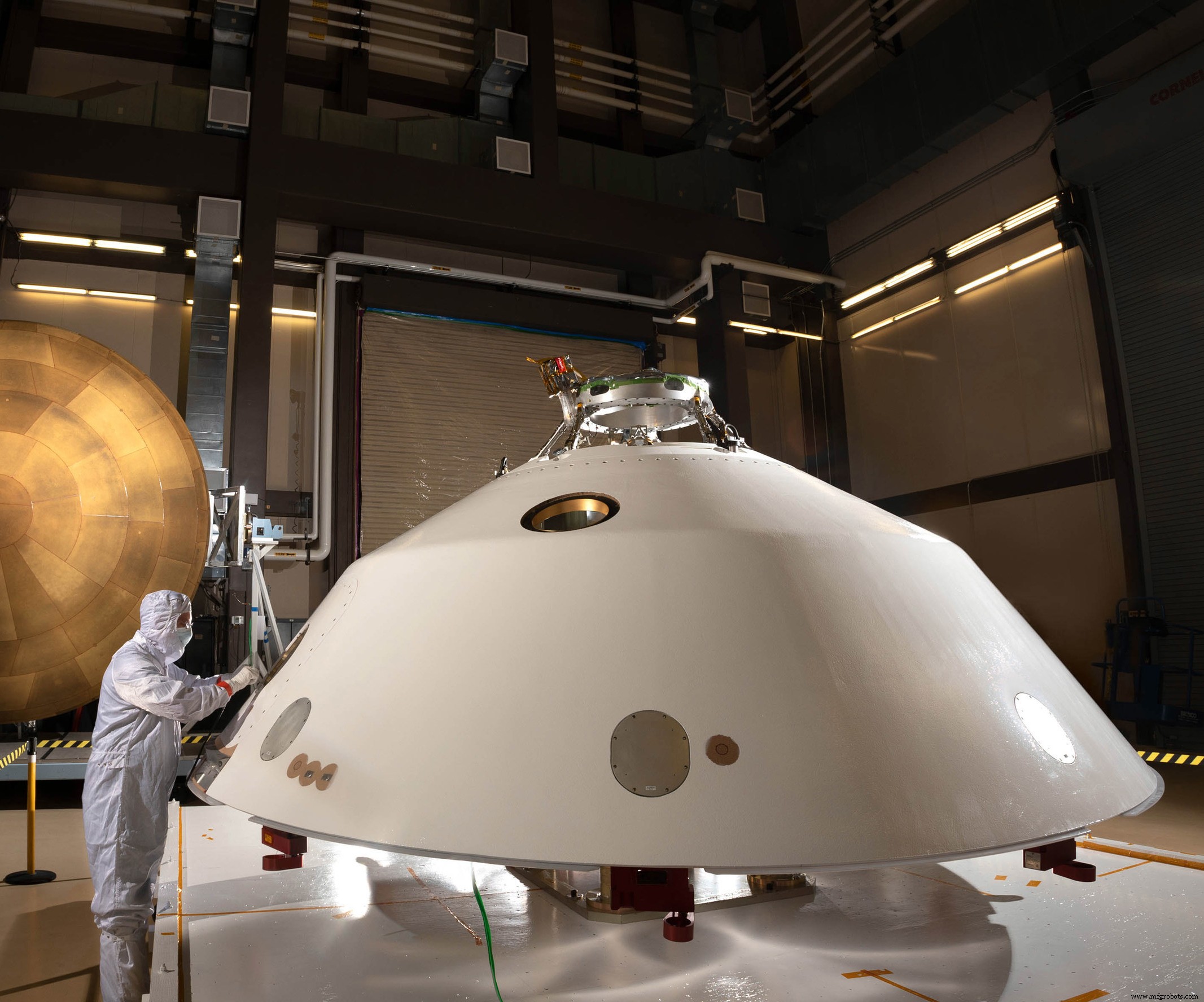
Source | Lockheed Martin
The capsule-shaped aeroshell that will protect NASA's Mars 2020 rover was delivered to NASA's Kennedy Space Center in Florida on Dec. 13. Built by Lockheed Martin (Littleton, Colo., U.S.), the aeroshell will encapsulate and protect the Mars 2020 rover during its deep space cruise to Mars, and from the intense heat as the entry system descends through the Martian atmosphere to the surface of Mars.
Because of the large mass and unique entry trajectory profile that could create external temperatures up to 3,800°F (2,093°C), the heat shield uses a tiled Phenolic Impregnated Carbon Ablator (PICA) thermal protection system instead of the Mars heritage Super Lightweight Ablator (SLA) 561V.
“Even though we have the experience of building the nearly identical aeroshell for the Curiosity rover, the almost 15-foot diameter composite structure was just as big a challenge to build and test 10 years later,” says Neil Tice, Mars 2020 aeroshell program manager at Lockheed Martin Space. “We've built every Mars aeroshell entry system for NASA of its 40 years of exploring Mars, so we pulled from that experience to build this important system.”
According to Lockheed Martin, along with the Curiosity mission, this is the largest aeroshell/heat shield ever built for a planetary mission at 4.5 meters (nearly 15 feet) in diameter. In contrast, the aeroshell/heat shield of the InSight lander measured 8.6 feet and Apollo capsule heat shields measured just less than 13 feet.
The backshell and heat shield were transported from Lockheed Martin's Waterton facility in Littleton, Colorado where they were built, to nearby Buckley Air Force Base. They were then loaded onto an Air Force transport plane and flown to NASA's Kennedy Space Center.
Recently, Lockheed Martin integrated the MSL Entry Descent and Landing Instrument (MEDLI2) onto the heat shield and backshell. Provided by NASA's Langley and Ames Research Centers, MEDLI2 will collect temperature and pressure data during the spacecraft's descent through the Martian atmosphere.
The Mars 2020 rover is in testing at NASA's Jet Propulsion Laboratory, Pasadena, Calif., U.S., which manages the Mars 2020 project for the NASA Science Mission Directorate. The mission will launch in July 2020 and land on Mars in February 2021 at the Jezero Crater.
As CW reported in June 2019, the Mars rover’s carbon fiber composite chassis is under development through a partnership between RUAG Space (Decatur, Ala., U.S.; Bern, Switzerland) and Scheurer Swiss GmbH (Volketswil, Switzerland).
fiber
- Lockheed Martin Boosts Competitiveness by Outsourcing Maintenance to MAG Technologies
- Lockheed Martin Secures $126M U.S. Army Contract for RF‑ITV Operations and Maintenance
- 7 Must‑Have Gifts for Nerds in 2024
- NASA’s Perseverance Rover Successfully Touches Down on Mars, Showcasing Advanced Composite Technology
- Michelman Showcases Hydrosize Fiber Sizing Solutions at JEC World 2020
- Toray Unites Five European Subsidiaries for First-Time Joint Showcase at JEC World 2020
- Chromaflo Technologies Welcomes Luc Driessen to Lead Global Innovation & Technology Team
- Continuous Composites Demonstrates CF3D Technology in Lockheed Martin’s AFRL WiSDM Wing Design Project
- Build Your Own Arduino‑Powered Mars Perseverance Rover Replica – Step‑by‑Step Guide
- Lockheed Martin Enhances F‑35 Production with Advanced Robot Painting Simulators