



ESI Group Accelerates Nissan’s Carbon Fiber Parts Production with C‑RTM Technology
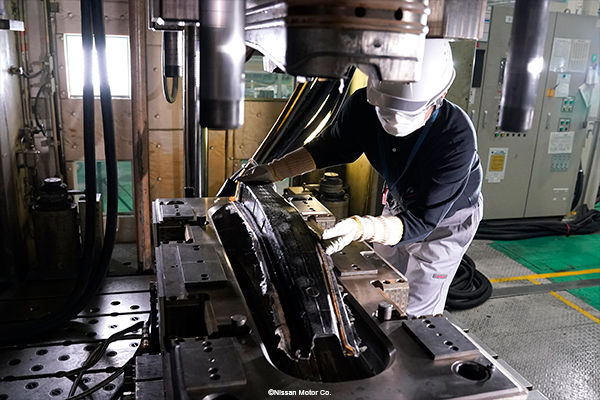
It was reported on Dec. 3 that ESI Group (France), a global company with a focus on virtual prototyping software and services, supported Nissan Motor Co. (Yokohama, Japan) in its use of the Compression Resin Transfer Molding (C-RTM) production process, which sped up the development of car parts made from carbon fiber reinforced plastics (CFRP), a material that is often considered too time-consuming and too expensive to industrialize for the automotive sector.
“We have always considered CFRP as a material for future generations of cars,” says Hideyuki Sakamoto, EVP of Nissan Motor Co. “But when it comes to reality, CFRP can only be used for limited models and appears to be more challenging for mass market production. Indeed, costs are high, and complex designs are required to shape the material. The challenge was to industrialize its production process in order to reduce costs and development time.”
ESI Group has been supporting Nissan’s CFRP challenge since 2015 through the evolution of its industrial product design and manufacturing methodologies for various vehicle models. The partnership was strengthened in 2018 with the CFRP mass production project.
To overcome the difficulty in shaping CFRP parts, Nissan’s engineers, aided by ESI’s solution, found a new approach: the C-RTM process. The existing method involves forming carbon fiber into the right shape and setting it in a die with a slight gap between the upper die and the carbon fibers. Resin is then injected into the fiber and left to harden.
Nissan’s engineers developed techniques to accurately simulate the permeability of the resin in carbon fiber, while visualizing resin flow behavior in a die using an in-die temperature sensor and a transparent die. The result of the simulation was a high-quality component with a development time reduced by 50% and reduced by 80% for single molding. Incorporation of virtual prototyping further validated the product’s design.
“We are proud of the support we have brought Nissan over the years and throughout this project,” adds Cristel de Rouvray, CEO of ESI Group. “Nissan’s success embodies our mission to enable industrial players to commit to outcomes.”
fiber
- Comparing Popular Manufacturing Methods for Carbon Fiber Parts
- Carbon Fiber Production and Custom Parts: Expert Guide to Materials, Processes, and Benefits
- Carbon Fiber Reinforced Plastic (CFRP): Strength, Weight Savings, and Emerging Applications
- Revolutionizing Automotive Design with Carbon Fiber Technology
- High‑Performance Carbon Fiber/Epoxy Composite for Automotive Mass Reduction and Mass Production
- Arevo 2018: Pioneering Continuous Fiber 3D Printing for Industrial Production
- Dymag Secures £5M Funding to Expand Carbon Fiber Wheel Production to 50,000 Units Annually
- Zoltek Pioneers Renewable-Powered Carbon Fiber Manufacturing
- 4M Demonstrates Breakthrough Large‑Diameter Carbon Fiber Production with Plasma Oxidation Technology
- Zoltek Expands Carbon Fiber Production Capacity to 13,000 Metric Tons Annually in Guadalajara