



Raise3D Unveils RMF500: High-Performance FFF 3D Printer for Small-Batch Production
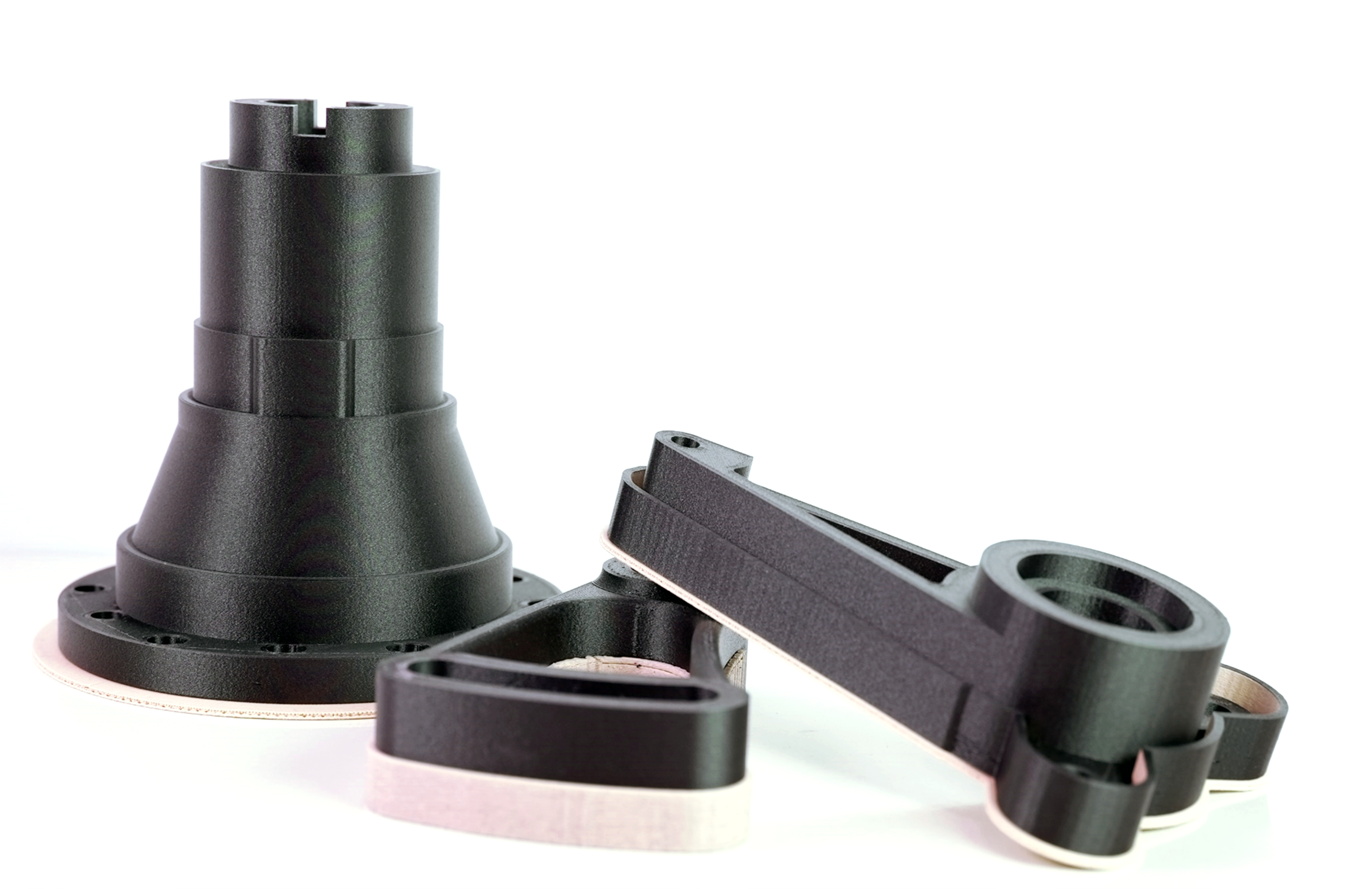
Raise3D (Rotterdam, Netherlands and Irvine, Calif., U.S.), a global provider of additive manufacturing (AM) solutions for small- and large-scale enterprises, launches the Raise3D RMF500, a large-format fused filament fabrication (FFF) 3D printer aimed at small-batch production in the industrial sector. The printer can fabricate carbon fiber-reinforced end-use parts with highly accurate production repeatability, high speed and large build volumes.
The RMF500 has a 500 x 500 x 500 mm build area. It can reach print speeds of up 300 mm/s along with an acceleration of up to 2G and movement of up to 1,000 mm/s. An independent dual extruder system (IDEX) also makes it possible to execute two print jobs simultaneously.
Linear motors help the RMF500 achieve an accuracy of 0.001 mm along the X and Y axes and 0.0009765 mm along the Z-axis. Its 1 μm closed-loop, synchronous control reduces speed variations with load changes of the motor, further enhancing precision.
Use of a carbon fiber-reinforced filament is said to ensure reliable printing of strong end-use parts and a good alternative to metal parts. The material offers high rigidity, a low shrinkage ratio and does not require a heated chamber to avoid warping, as is customary in 3D printing. According to Raise3D, this leads to a far more efficient printer that does not need to draw so much power; for example, 120 watts is used to power a single hotend.
Moreover, for trouble-free, uninterrupted printing, the RMF500 is equipped with four 2.5-kg cartridges (main and auxiliary) so the 3D printer can switch automatically between main/auxiliary cartridges, reducing the need for constant intervention. Positive pressure humidity control keeps chamber humidity under 5% relative humidity.
RMF500 offers additional benefits. The 3D printer’s load-bearing structural parts are made of high-grade hardened steel, with a Z-axis that can withstand a maximum load close to 100 kg and has a deflection error that is reported to be 50% lower than that of conventional offerings. The linear motor driven system also has low clearance and low maintenance requirements.
fiber
- 5 Key Facts About Fused Filament Fabrication (FFF)
- How Extrusion Drives Precision in Fused Filament Fabrication (FFF) 3D Printing
- Fused Filament Fabrication (FFF): The Complete Beginner’s Guide
- Anisoprint Launches ProM IS 500: Industrial 3D Printer for High-Temperature Thermoplastics with Fiber Reinforcement
- Roth Launches Advanced Filament Winding, Prepreg & Towpreg Automation Equipment
- Engineering Technology Unveils ST2: Precision Servo Tensioner for High-Speed Filament Winding
- CSP Refines Carbon Fiber RTM, Secures Production Role with Premium Automaker
- Quick Guide to Untangling Knotted 3D Printer Filament Spools
- Can You Safely Keep Filament Loaded in a 3D Printer?
- Can 3D Printer Filaments Safely Withstand Dishwasher Cycles? A Practical Guide