



New Study Offers Design Guidelines for Thermoplastic Composite Overmolding
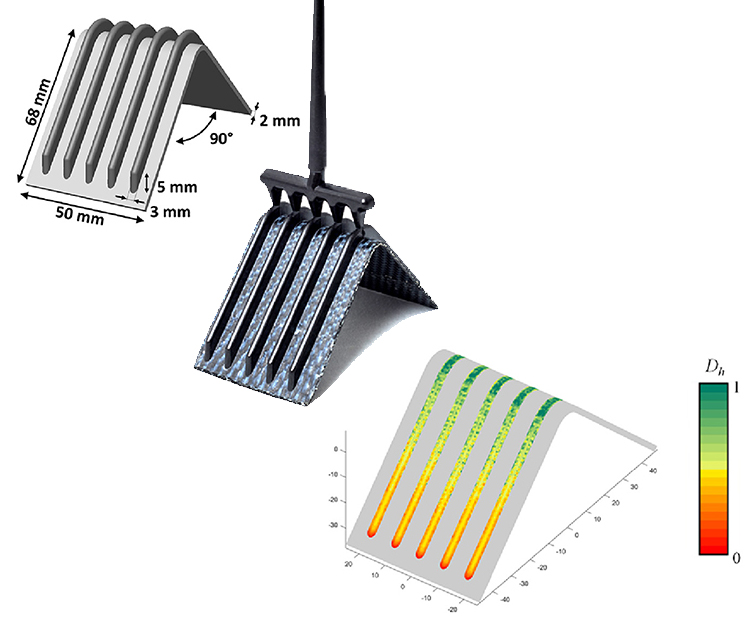
Overmolding is a technology in which a thermoplastic composite laminate is thermoformed and subsequently injection overmolded. This near-net-shape manufacturing process is well suited for automated large series production of complex 3D structures with excellent structural performance and a high level of function integration.
However, the industry lacks process design tools. Responding to this need, researchers at the ThermoPlastic composite Research Center (TPRC, Enschede, Netherlands) analyzed the overmolding process, focusing on the bond strength between the overmolded composite laminate and the injected polymer resin/reinforced composites. Using process modeling and mechanical testing, they evaluated both a single-step and a dual-step process. Results showed distinctly different process mechanisms and resulting material structure and mechanical performance in the overmolded composite parts.
Starting from De Gennes' classical reptation theory for reptation and healing of amorphous polymers, an alternative approach was developed to describe the strength development for semi-crystalline materials. A rudimentary description of the degree of melting was implemented to predict the bond strength as a function of the thermo-mechanical history at the interface during forming and subsequent resin injection for PA6 and PEEK, both semi-crystalline matrix materials.
The full article, “Analysis of the Thermoplastic Composite Overmolding Process: Interface Strength” can be found in Frontiers in Materials. Read more about TPRC’s overmolding research here.
Reptation
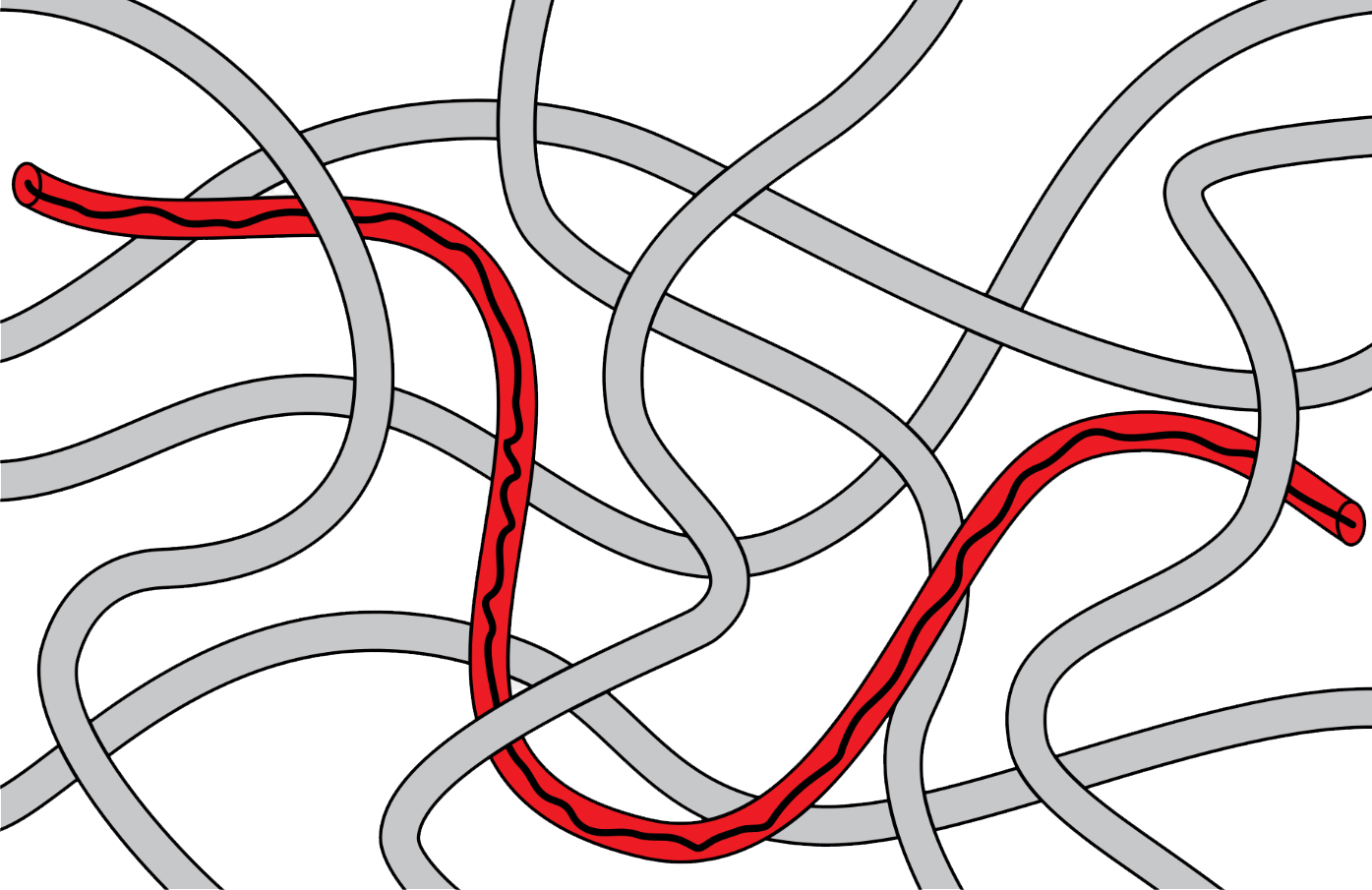
A theory proposed by Piere Gill deGennes in 1971 and later extended to the tube model by Maasai Doi and Sam Edwards. It describes the thermal motion of long polymer chains in concentrated solutions and melts, postulating that individual polymer chains, constrained by their neighbors, move primarily along their own contours in a snakelike fashion. Hence its name, derived from the Latin reptare, to creep. Reptation-based models have reportedly been successful in reconciling a wide range of experimental observations and are broadly in agreement with more recent computational results.
REFERENCES | “Activated reptation: Coupling of polymer dynamics to density fluctuations” and “Reptation and Tube Model” from polymerdatabase.com
Resin
- Momentive Launches Primerless Silopren LSR 27x9 for PC, PBT, and Copolyester Overmolding
- Fraunhofer Deploys Cutting‑Edge Engel Automation to Advance Thermoplastic Composite R&D
- Thermoplastic Tapes: Driving Innovation in Composite Aerostructures
- Solvay & Leonardo Launch Joint Lab to Pioneer Thermoplastic Composite Materials
- NREL & Arkema Advance Recyclable Thermoplastic Composite Wind Turbine Blades
- German Aviation Research Launches 3-Year Project for Continuous Thermoplastic Composite Profile Production
- Engel & Fill Introduce Automated Cell for Thermoplastic Composite Manufacturing
- PolyOne Launches Sustainable reSound OM Thermoplastic Elastomers for Overmolding
- Ensuring Quality of Thermoplastic Prepreg Tape for Superior Part Process Control
- INEOS Styrolution Expands Production with New Site for Advanced StyLight Thermoplastic Composite