



A Comprehensive Guide to FDM 3D Printing Materials: PLA, ABS, and Emerging Options
Introduction
Choosing the right type of material to print a given object is becoming increasingly difficult, as the 3D Printing market sees the regular emergence of radically new materials. In FDM 3D Printing
, PLA and ABS have historically been the two main polymers used, but their initial dominance was mostly fortuitous, so there should not be any major roadblocks for other polymers to play a key role in the future of FDM.
We are now seeing new products become more popular, both pure polymers and composites. In this study, we focus on the main pure polymers that exist in the market today: PLA, ABS, PET, Nylon, TPU (Flexible) and PC. We sum up the key differences between their properties in snapshot profiles so that users can make a quick decision about the best polymer to use for their application.
Methodology
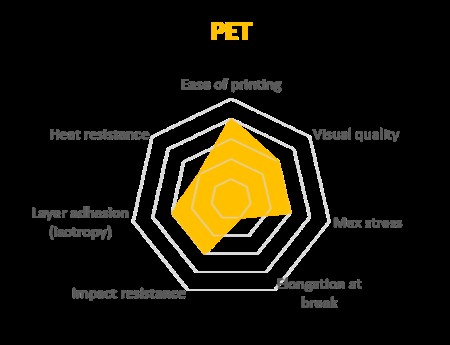
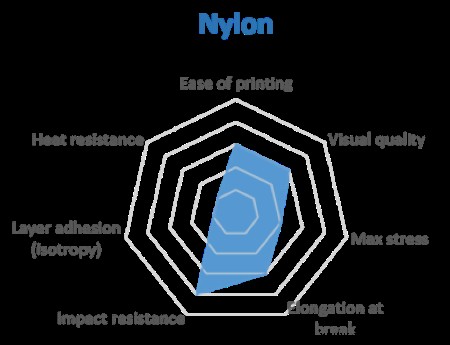
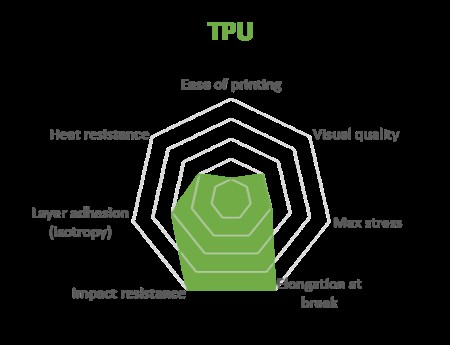
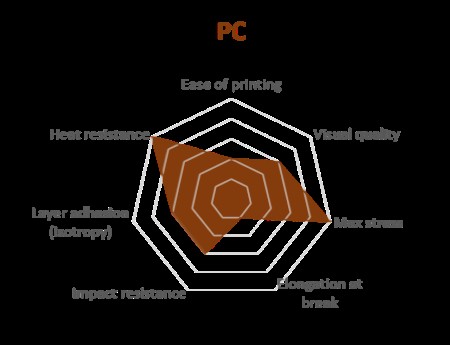
Materials are usually graded along 3 categories: mechanical performance, visual quality, and process. In this case, we further break down these categories to paint a clearer picture of the polymer’s properties. The choice of material really depends on what the user wants to print, so we listed the key decision criteria needed to choose a material (other than cost and speed):
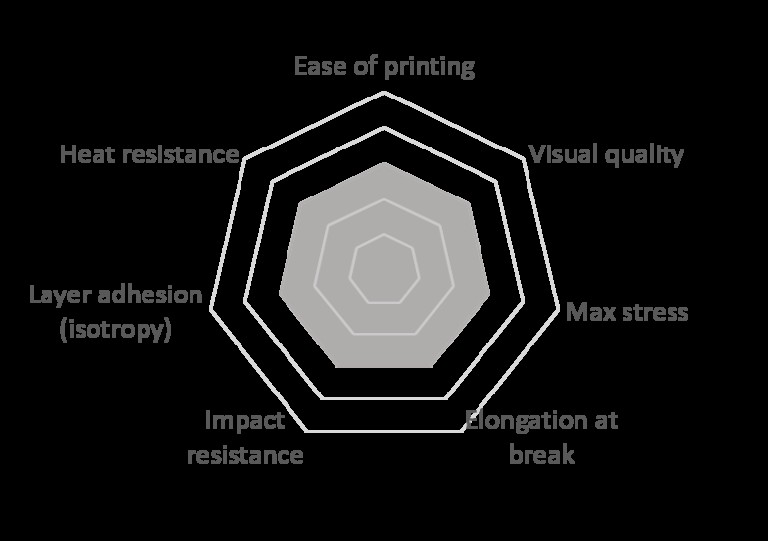
- Ease of printing: How easy it is to print a material: bed adhesion, max printing speed, frequency of failed prints, flow accuracy, ease to feed into the printer etc.
- Max stress: Maximum stress the object can undergo before breaking when slowly pulling on it.
- Elongation at break: Maximum length the object has been stretched before breaking.
- Impact resistance: Energy needed to break an object with a sudden impact.
- Layer adhesion (isotropy): How good the adhesion between layers of material is. It is linked to “isotropy” (=uniformity in all directions): the better the layer adhesion, the more isotropic the object will be.
- Heat resistance: Max temperature the object can sustain before softening and deforming.
We also provide additional information that is not captured in the diagram, for one of two reasons:
- They are neither “good” nor “bad” in essence; they are just properties that are suitable for some applications and not for others, such as rigidity.
- We don’t have a good quantitative assessment of it, but we know it is an important factor, such as humidity resistance or toxicity.
Results
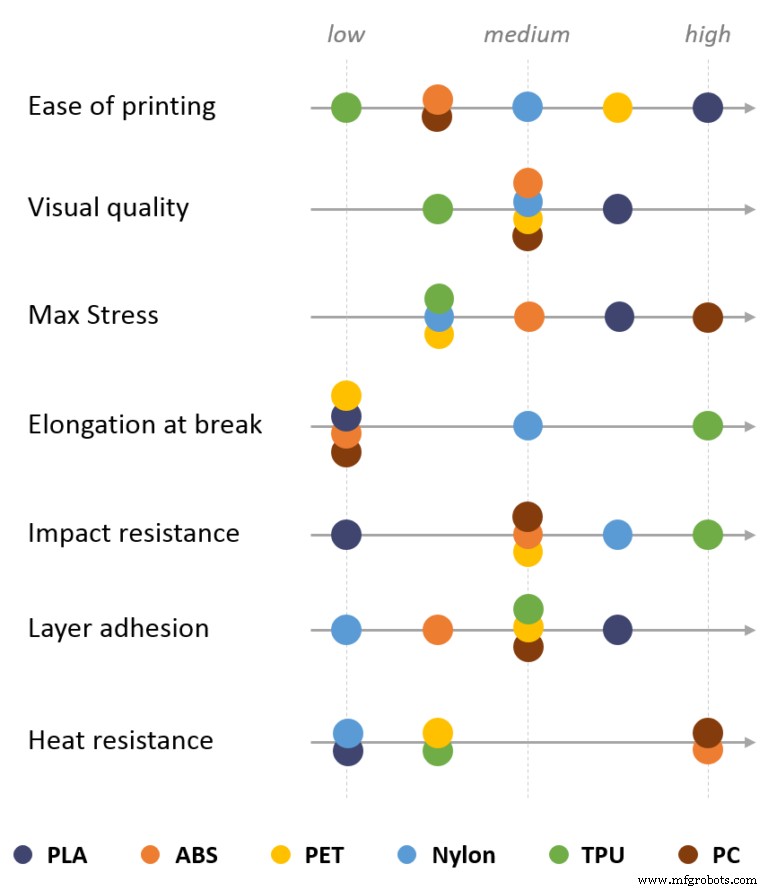
Each material has been ranked along the following criteria on a 1 (low) to 5 (high) scale. These are relative grades for the FDM process - they would look quite different if other manufacturing technologies were taken into account. Using the data from Optimatter, the polymers have been ranked along the different criteria considered:
Get your parts printed in these materials:
PLA ABS PET Nylon TPU
PLA
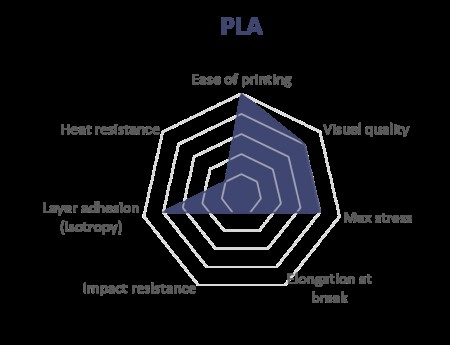
PLA is the easiest polymer to print and provides good visual quality. It is very rigid and actually quite strong, but is very brittle.
| Pros | Cons |
|---|---|
| Biosourced, biodegradable | Low humidity resistance |
| Odorless | Can't be glued easily |
| Can be post-processed with sanding paper and painted with acrylics | |
| Good UV resistance |
ABS
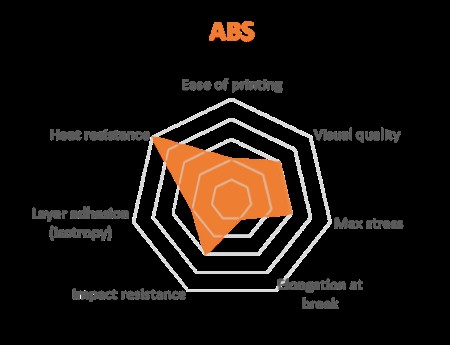
ABS is usually picked over PLA when higher temperature resistance and higher toughness is required.
| Pros | Cons |
|---|---|
| Can be post-processed with acetone vapors for a glossy finish | UV sensitive |
| Can be post-processed with sanding paper and painted with acrylics | Odor when printing |
| Acetone can also be used as strong glue | Potentially high fume emissions |
| Good abrasion resistance |
PET
PET is a slightly softer polymer that is well rounded and possesses interesting additional properties with few major drawbacks.
| Pros | Cons |
|---|---|
| Can come in contact with foods | Heavier than PLA and ABS |
| High humidity resistance | |
| High chemical resistance | |
| Recyclable | |
| Good abrasion resitance | |
| Can be post-processes with sanding paper and painted with acrylics |
Nylon
Nylon possesses great mechanical properties, and in particular, the best impact resistance for a non-flexible filament. Layer adhesion can be an issue, however.
| Pros | Cons |
|---|---|
| Good chemical resistance | Absorbs moisture |
| High strength | Potentially high fume emissions |
TPU
TPU is mostly used for flexible applications, but its very high impact resistance can open for other applications.
| Pros | Cons |
|---|---|
| Good abrasion resistance | Difficult to post process |
| Good resistance to oil and grease | Can't be glued easily |
PC
PC is the strongest material of all, and can be an interesting alternative to ABS as the properties are quite similar.
| Pros | Cons |
|---|---|
| Can be sterilized | UV sensitive |
| Easy to post-process (sanding) |
Conclusion
Choosing the right polymer is critical to get the right properties for a 3D printed part, especially if the part has a functional use. This article will help users find the right material depending on the properties they need. However, material suppliers also often provide blends or add additives to modify the properties of the pure polymer (e.g. adding carbon fiber to make the material stiffer). We are not addressing these more complex formulations in this article, but you can find data on some of these products in our optimization tool at OptiMatter.
Disclaimer
- The grades given in this article are for an average polymer representing the general chemistry, but the performance will vary depending on the actual product or supplier the user buys from.
- All the data underlying our grades in this study was measured by 3D Matter, with the exception of Heat Resistance, for which we used the glass temperature given by multiple filament suppliers.
- For the sections called “Additional considerations”, we are using a combination of third-party assessments and our own observations.
- The Nylon type we discuss in this article is Nylon 6, not Nylon 11 or 12.
- Visual quality is tested without any significant post-processing. There are ways to smoothen the prints and improve the visual quality of a given polymer significantly (e.g. using acetone vapor on ABS).
- The toxicity of 3D printing polymers is still not very well understood and is a factor that might play a bigger role in the future. We are basing our comments regarding toxicity on one study by Azimi et al. [1]
[1] Azimi et al, Emissions of Ultrafine Particles and Volatile Organic Compounds from Commercially Available Desktop Three-Dimensional Printers with Multiple Filaments, Environmental Science & Technology, 2016
A big thank you to 3D Matter for sharing this material research with our community.
3D printing
- 3D Printing: The Future of Manufacturing and Medicine
- Luvocom 3F PA – Flame‑Retardant, High‑Temperature Polyamide for 3D Printing
- Mastering Material Jetting 3D Printing: Fundamentals & Applications
- 3D Printed Injection Molds: Professional Material Comparison
- How 3D Printing Drives Sustainable Construction with Innovative Materials
- Understanding FDM 3D Printing: A Complete Guide
- Eco-Friendly Biodegradable Materials for 3D Printing: Sustainable Solutions
- Fused Deposition Modeling (FDM) 3D Printing: Comprehensive Technical Overview
- Comprehensive Guide to Selecting Plastic Materials for 3D Printing
- Top 5 Innovative Filaments Transforming FDM 3D Printing