



Is 3D Printing Entering the Productivity Plateau?
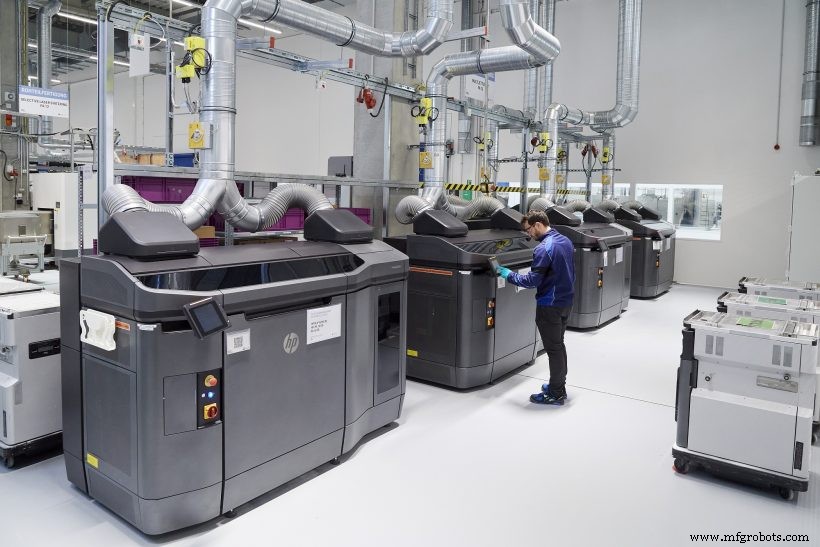
[Image credit: BMW Group]
Understanding the Gartner Hype Cycle and 3D Printing’s Position
The Gartner Hype Cycle visualises the life‑cycle of emerging technologies, with the “Plateau of Productivity” marking the point at which widespread, profitable adoption begins. Where does 3D printing sit on that graph? In other words, has the technology reached maturity?
The additive manufacturing (AM) landscape spans several segments, each at a different maturity level. Nonetheless, key indicators reveal that the industry is steadily advancing toward a mature state. Below we examine the most telling trends and highlight the three sectors that are already approaching mainstream adoption.
A Maturing 3D Printing Ecosystem
Multiple signals suggest the industry is progressing toward maturity. We analyse rising M&A activity, expanding use cases driven by technological breakthroughs, and the push for deeper integration and interoperability.
The Consolidation Wave
New industries typically fragment before consolidating. The Consolidation Curve framework outlines four stages—Opening, Scale, Focus, Balance & Alliance—that most sectors follow.
Tracing 3D printing’s journey: the technology debuted in the 1980s and remained in the Opening stage until the late 2000s, when pioneers such as Stratasys, 3D Systems, and Materialise established a global presence and erected significant entry barriers. The early 2010s ushered in the Scale phase, characterized by exponential growth, the emergence of players like MakerBot, 3DHubs, and Formlabs, and a surge in acquisitions led by Stratasys and 3D Systems.
Simultaneously, hype peaked and then subsided around 2015, dampening consumer enthusiasm. The decline in hype clarified that 3D printing is not a novelty but a robust manufacturing technology with vast industrial potential.
While consumer‑oriented 3D printing slowed, industrial AM accelerated. In the 2020s, we observe a shift from the second Scale stage toward Focus, evident in the last 12 months’ wave of large‑scale M&A deals. Notable transactions include:
- Stratasys acquiring Origin
- Stratasys acquiring RPS
- Desktop Metal acquiring EnvisionTEC
- DSM acquiring parts of Clariant’s 3D printing portfolio
- Covestro acquiring DSM Resins & Functional Materials, including DSM Additive Manufacturing
- Protolabs acquiring 3DHubs
- BEAMIT Group acquiring 3T Additive Manufacturing
- Nikon purchasing a majority stake in Morf3D
Key drivers behind this surge are:
- Manufacturers expanding their reach (e.g., Nikon & Morf3D)
- AM firms strengthening their value‑chain position (e.g., Desktop Metal & EnvisionTEC)
- Equipment makers integrating innovative technologies (e.g., Stratasys & Origin)
The industry remains a few years from the final Balance & Alliance phase, where a handful of giants dominate 70–90% of the market. The 2020s will be defined by megadeals reshaping the global 3D printing landscape.
From Prototyping to End‑Use Production
Initially celebrated for rapid prototyping, 3D printing is now increasingly used to produce functional end‑use parts. Surveys illustrate this shift: Ultimaker’s 3D Printing Sentiment Index 2021 noted a 7% drop in prototyping usage and a 5% rise in end‑use applications relative to 2019. Jabil’s 3D Printing Technology Trends 2021 echoed these findings, with 55% of surveyed firms deploying at least a quarter of their AM capacity for functional parts—a significant jump from 2019 figures.
These data confirm that AM is transitioning from a niche hobbyist tool to a mainstream industrial technology, signalling early maturity.
High‑Speed Printing and Expanded Materials
Functional applications demand faster processes and certified materials. Historically, most AM techniques were slow and lacked production‑grade materials. To compete with traditional manufacturing, industry players have introduced high‑speed binder jetting, multi‑laser powder bed fusion (PBF) for metals, and vat photopolymerisation for plastics. Concurrently, materials suppliers are focusing on high‑performance alloys and composites.
These advances drive adoption in sectors previously hesitant to use AM for production parts.
Read also: Composite 3D Printing: An Emerging Technology with a Bright Future
Building an Integrated Additive Ecosystem
True maturity for AM requires breaking down silos across design, production, and supply chain. While hardware and materials remain central, there is a growing emphasis on automation—from topology optimisation in design to post‑production streamlining. Additive manufacturing execution systems (MES) now automate order handling and scheduling, enhancing efficiency.
Further reading: Solving additive manufacturing challenges with MES
Hardware manufacturers are also opening their platforms for third‑party integration, enabling a connected ecosystem that supports interoperability and scalability.
Which 3D Printing Segments Have Reached the Plateau of Productivity?
While the industry as a whole is maturing, progress varies across segments. Some areas, such as 3D‑printed human tissues, remain embryonic, whereas polymer‑based printing is approaching maturity. Below we explore the segments that are moving toward the productivity plateau and the forces propelling them.
3D Printing Service Providers
Key industry metrics:
- The Wohlers Report 2021 reports $5 billion in revenue for service providers in 2020.
- EY’s 2019 report places service providers at 34% of the global AM market.
- Jabil’s 2021 trends indicate 45% of companies outsource 3D printing jobs.
Despite a 2020 downturn, the service sector grew. Many enterprises first encounter AM through service providers, especially amid supply‑chain disruptions that highlight AM’s resilience. Competition intensifies as hardware makers launch service lines and as the “Manufacturing‑as‑a‑Service” model consolidates on single‑platform marketplaces.
Success in this crowded arena hinges on continuous innovation, service diversification, process standardisation, and automation, coupled with expansion into new markets.
Dental 3D Printing
High‑speed polymer AM has accelerated growth in dental applications. SmarTech estimates the AM dental and medical market exceeds $3 billion. Digital dentistry—integrating intraoral scanning, CAD/CAM, and 3D printing—is now mainstream. Applications range from surgical guides to clear aligners, the latter being the highest‑volume use case globally.
3D printing enables rapid, patient‑specific aligner production from digital scans, outperforming traditional manufacturing in speed and cost. Over 70% of U.S. dental labs are expected to own 3D printing technology by the end of 2021, propelling the industry toward a $9.2 billion valuation in the next five to seven years.
Metal Powder Bed Fusion
Metal PBF remains the most mature AM technology. Over the past decade, manufacturers have refined automation and integration, producing modular, high‑automation systems that reduce manual labour.
Laser PBF now powers critical aerospace components, such as engine parts, showcasing the technology’s ability to produce complex geometries with minimal waste. While the process is capable of delivering functional parts reliably, final production often requires fine‑tuning and validation.
Future gains in ease of use and reliability will stem from software advances and streamlined workflows. For instance, VELO3D’s Intelligent Fusion system delivers parts with fewer supports, superior surface finish, and higher success rates, enhancing overall reliability.
Metal PBF holds the largest installed base among metal AM technologies and commands the biggest market share. Metal usage in 3D printing has grown 20% since 2019, outpacing the 12% growth in polymers—a clear indicator of mounting confidence in metal AM’s maturity.
Industrial 3D Printing: A Decade of Sustained Growth
The industry has entered a new growth phase, driven by companies responding to supply‑chain and manufacturing constraints. This momentum spans all AM segments, not just those highlighted earlier.
Accelerated technological progress is steadily moving us toward distributed digital manufacturing—a vision that has long been in development and is now materialising as the AM ecosystem coalesces.
How will manufacturing evolve once AM fully matures? The answer is emerging fast.
Discover how you can lay the foundation that will fast‑track the shift to distributed additive manufacturing in our free whitepaper.
3D printing
- 6 Proven Strategies to Cut 3D Printing Costs
- The Pandemic’s Impact on 3D Printing: From Decline to Resurgence
- Debunking 3D Printing Myths: What the Technology Truly Can Do
- The ABCs of 3D Printing: How Additive Manufacturing is Shaping Modern Industry
- How 3D Printing Revolutionized Manufacturing: A Journey Through Its Evolution
- COVID-19 Highlights 3D Printing’s Critical Role in Healthcare
- Unlocking Innovation: The Key Advantages of 3D Printing in Modern Manufacturing
- How 3D Printing Will Transform Manufacturing in the Next Decade
- How 3D Printing is Revolutionizing Modern Manufacturing
- 4D Printing: Revolutionizing Additive Manufacturing for Adaptive Solutions