



The Pandemic’s Impact on 3D Printing: From Decline to Resurgence

Industrial 3D printing is evolving to keep businesses resilient and agile amid new complexities and opportunities.
While the COVID‑19 pandemic introduced uncertainty into the industry, some companies suffered a downturn, whereas others adapted and grew. This article examines how the pandemic has reshaped the additive manufacturing landscape and what the future holds as the world recovers.
On the Verge of Mainstream Adoption
Over the past decade, the global additive manufacturing market has expanded steadily, reaching $10.4 billion in 2019—its first double‑digit‑billion milestone in almost 40 years. This growth reflects a shift in perception, positioning 3D printing as a mature manufacturing solution by 2020.
Investment surged, with hundreds of millions of dollars flowing into the sector. Companies began exploring diverse applications, from footwear to medical implants and aerospace components. 2020 promised a bright future for the industry, poised to become mainstream—until the pandemic struck.
The Fall
During the first half of 2020, hardware demand plunged. Global uncertainty forced many potential adopters to delay purchases and deployments. According to CONTEXT, shipments of industrial‑grade (≥$100K) and design‑grade ($20K–$100K) hardware fell by more than 30% in Q1 2020.
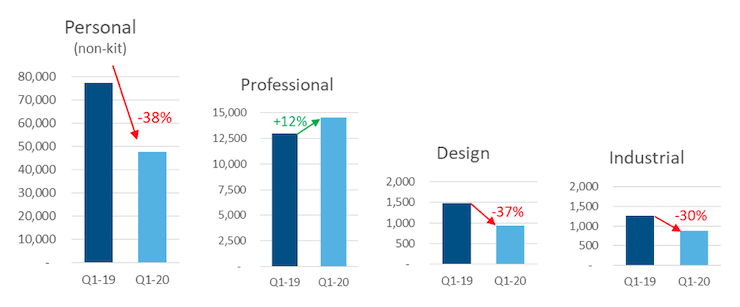
The metal additive manufacturing hardware market also slumped 33% year‑over‑year compared to 2019. The aerospace sector—historically the largest AM adopter—was hit hard, with airlines cutting capacity, idling fleets, and deferring new aircraft deliveries. Consequently, decisions to invest in AM were postponed, despite its long‑term benefits of part consolidation, reduced lead times, and lightweighting.
Major players reported revenue declines and announced workforce reductions. HP’s Commercial Hardware division, which includes 3D printer sales, saw a 37% drop. 3D Systems announced layoffs after reporting a 28% revenue decline in Q2 2020, and Stratasys experienced nearly a 30% drop in the same period. These headlines painted a grim picture, yet the sector is rallying to recover stronger and more consolidated.
The Rise
While some companies contracted, others capitalized on the crisis. German metal printer manufacturer SLM Solutions reported a 90% revenue increase in the first half of 2020, driven by order backlogs and a new three‑year contract with BEAMIT, which will supply at least 15 machines. The high average price of metal 3D printers—hundreds of thousands of dollars—has significantly boosted SLM’s revenue.
Professional printer brand Ultimaker announced double‑digit global growth in the first six months, attributing it to increased adoption as a supply‑chain stopgap. Hospitals and businesses worldwide struggled with medical‑supply shortages, and 3D printing proved its value by enabling rapid, on‑demand production of critical parts.
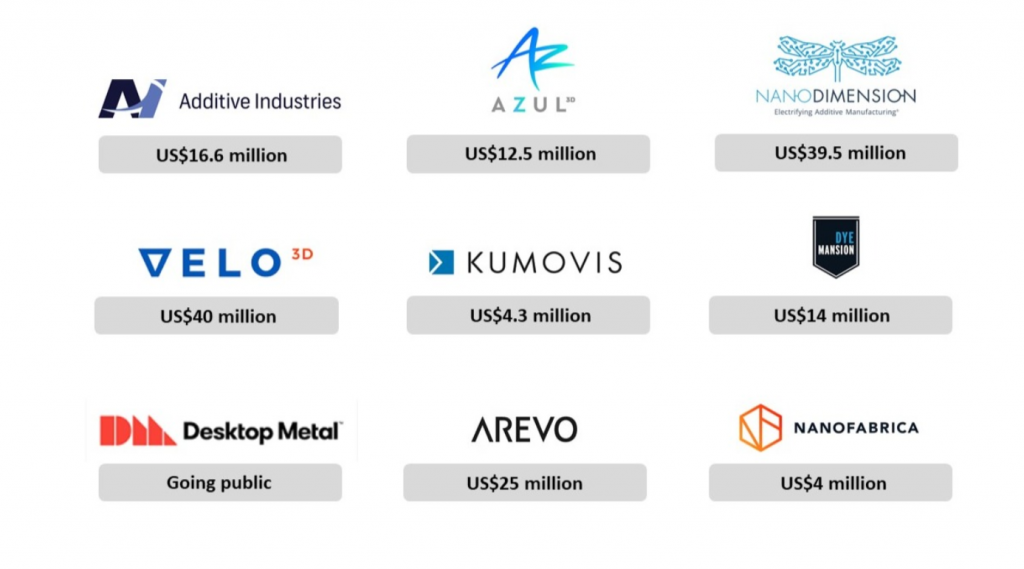
Capital remains flowing into the sector. Since early 2020, companies like VELO3D, Arevo, nTopology, and Additive Industries have closed successful funding rounds. Xometry, a leading on‑demand manufacturing marketplace, raised $75 million to expand distributed manufacturing and reduce reliance on traditional supply chains.
A recent survey found that 59% of companies believe geographic diversification of supply chains is essential for resilience—a trend that reinforces the move toward decentralized manufacturing.
3D Printing After the Pandemic: A Watershed Moment
As recovery unfolds, the question remains: what will 3D printing’s role be in the post‑pandemic landscape? We see the pandemic as a watershed moment that accelerated adoption of digital manufacturing, allowing companies to maintain operations and pivot to essential product creation.
Today, businesses are re‑examining legacy supply chains and exploring innovative solutions to stay competitive. 3D printing stands out as a key technology for localised, sustainable, and digital production—especially when paired with connectivity and automation tools that drive digital transformation.
The benefits of 3D printing—rapid prototyping, lightweighting, and on‑demand manufacturing—are poised to shape the future of manufacturing, fostering a more resilient and agile industrial ecosystem.
3D printing
- Terry Wohlers on the 2018 Wohlers Report: Metal AM Growth, Global Trends, and the Future of 3D Printing
- How 3D Printing Is Revolutionizing Defence – Benefits, Challenges, and Future Applications
- How 3D Printing is Revolutionizing Automotive Production – 2021 Insights
- How 3D Printing is Revolutionizing Spare Parts Management – 2021 Update
- How 3D Printing is Combatting COVID‑19 Supply Shortages
- Revolutionizing Food & Beverage: How 3D Printing Drives Innovation and Efficiency
- Revolutionizing Cars: How 3D Printing Is Transforming Automotive Design and Production
- How 3D Printing is Driving Innovation in the Automotive Industry
- Retail's Transformation: Adapting to COVID-19 and the E-Commerce Surge
- Mastering 3D Printer Flow: Definition, Significance, and Calibration Tips