



Terry Wohlers on the 2018 Wohlers Report: Metal AM Growth, Global Trends, and the Future of 3D Printing

The annual Wohlers Report has become the additive manufacturing industry’s most coveted reference since its first edition 23 years ago. With 76 co‑authors spanning 32 countries, the report aggregates insights from the world’s largest network of AM professionals. As new system makers, material suppliers, software vendors, and service providers enter the market, the 2018 edition remains the definitive guide for the latest data, trends, and forecasts in 3D printing.
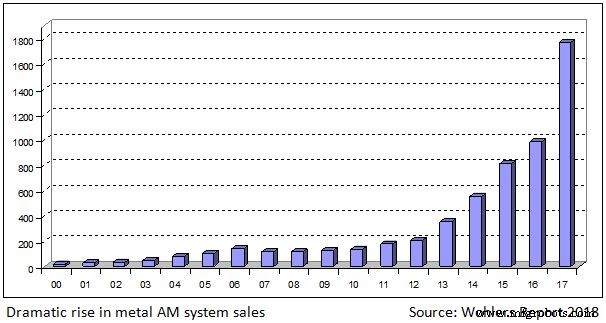
Key findings of the 2018 report include an 80% jump in metal AM system sales and a 21% overall growth of the additive manufacturing industry in the previous year.
Terry Wohlers, founder and president of Wohlers Associates, is one of the most respected voices in additive manufacturing and the mastermind behind the Wohlers Report. We spoke with him about the report’s most striking insights, the challenges companies face when adopting AM, and his outlook on the industry’s trajectory.
What were the most exciting findings from Wohlers Report 2018?
One of the most compelling discoveries was the dramatic 80% rise in metal AM machine sales in 2017—an unprecedented growth given that we have been tracking these sales for 18 years. The data clearly indicate that metal AM systems are gaining significant traction in the market.
Another noteworthy trend is the expanding number of manufacturers producing industrial AM systems. Historically, we have divided AM systems into desktop units selling for under $5,000—averaging about $1,000—versus industrial systems above that threshold. In 2016 there were 97 companies selling industrial systems; by 2017 that number had risen to 135, with 60 located in Europe.
What factors do you attribute the growth in metal AM systems to?
Companies are acquiring more metal AM systems to meet production demands. Initially, many firms purchased one or two units for testing and qualification, but they are now adding systems to scale up production capacity.
Desktop Metal’s first reported sales of 357 AM systems last year significantly boosted the overall metal AM market share. Additionally, we identified 12 Chinese firms manufacturing and selling metal AM systems, with an estimated 213 units sold in 2017.
How much growth in additive manufacturing are we seeing in overseas markets?
China is emerging as the most dynamic region, outpacing many other markets. Strong activity is also seen in Japan, Singapore, and several other countries, underscoring China’s ambition to become a major player in the global AM landscape.
As additive manufacturing is increasingly adopted by companies and manufacturers, what challenges will they have to face in implementing the technology?
Adopting AM is more complex than many realize. Key obstacles include data preparation and design optimization for production, as well as post‑processing workflows. For metal AM, post‑processing often involves powder removal, stress‑relief heat cycles to mitigate residual stresses, support removal (cutting and grinding), CNC machining, and sometimes hot isostatic pressing to eliminate porosity—all of which vary by application.
Understanding these steps is crucial because they demand substantial investment and commitment.
How much of a role will automation play in streamlining the processes you’ve outlined?
Automation, especially in post‑processing, will be transformative. Reducing or eliminating support structures during design can lower the cost and complexity of robotic handling. Automation will also enable efficient material handling and the movement of heavy build plates with attached parts.
Finally, what’s the next trend in AM that you’re most excited about?
The next frontier is the integration of AM‑specific design tools directly into mainstream CAD platforms. Designers increasingly want a single environment that eliminates data transfer between separate applications. Companies such as Autodesk, Dassault Systèmes, PTC, and Siemens are investing heavily in developing robust, seamlessly integrated design solutions that make additive manufacturing accessible and intuitive for all types of designers.
You can find out more about Wohlers Report 2018 and Wohlers Associates here.
3D printing
- Seven Key Trends That Shaped 3D Printing in 2018
- Expert Interview: Simon Fried, Co‑Founder of Nano Dimension, on 3D Printing’s Future in Electronics
- Dunlop Systems Accelerates Tooling Production with 3D Printing – Insights from Mark Statham
- The Pandemic’s Impact on 3D Printing: From Decline to Resurgence
- Revolutionizing Food & Beverage: How 3D Printing Drives Innovation and Efficiency
- Edge, Endpoint, and Cloud AI: A Unified Future for Intelligent IoT
- Open‑Source 3D Printing: Empowering Innovation Through Shared Designs
- How 3D Printing Is Transforming Toy Design, Safety, and Production
- IBEX 2018: Marine Industry Booms with 3D Printing & Thermoplastic Composites
- IMTS 2018: How Industry 4.0 is Revolutionizing Tool Holding