



Photocentric’s Daylight Polymer Printing: An In‑Depth Interview with Managing Director Paul Holt
Photocentric, established in 2002, is a UK‑based pioneer in 3D printing hardware and materials, renowned for its proprietary Daylight Polymer Printing technology.
Unlike traditional resin‑based systems such as Stereolithography (SLA) or Digital Light Processing (DLP), Photocentric’s Daylight Polymer Printing eliminates the need for UV lasers or projectors. Instead, it harnesses light from LCD panels to cure liquid photopolymer resin layer by layer. The resins, also developed in‑house, solidify when exposed to the printer’s LCD screen. By repurposing high‑resolution mobile, TV and tablet displays, Photocentric offers SLA/DLP‑quality prints at a fraction of the cost.
Could you tell me about Photocentric and your mission as a company?
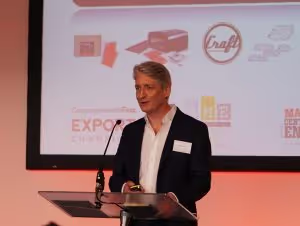
Paul Holt, Photocentric’s Managing Director
Photocentric began as a manufacturer of a patented photopolymer package. Since then we have expanded into multiple markets, applying our photopolymer innovations across industries—from jewellery design to dental manufacturing, and from engineering prototyping to full‑scale production. In 2005 we pioneered the concept of using LCD screens for 3D printing, and in 2014 launched our first LCD prototype. Today we offer our seventh LCD printer, with further models in development. Our mission is to transform global manufacturing by making 3D printing affordable, scalable, and functional, thereby enabling custom mass production worldwide.
How does your Daylight Polymer Printing technology work, and what sets it apart from other resin‑based machines available on the market?
Daylight Polymer Printing employs our own Daylight liquid photopolymer resin, cured incrementally by light from a high‑resolution LCD screen. Each layer hardens when illuminated, building a part layer by layer. Key differentiators include rigorous quality control at every stage, the use of inexpensive yet reliable consumer LCD panels, and a fully integrated chemistry pipeline—everything from resin formulation to printer engineering is done in‑house. Our Liquid Crystal Magna delivers the largest build volume for an LCD‑based printer (510 mm × 280 mm × 350 mm), while maintaining high accuracy thanks to a 23.4‑inch 4K Ultra‑HD screen and custom backlight.
Which industries could benefit the most from your technology?
Photocentric’s technology excels in both small‑scale, high‑precision fields such as dentistry and jewellery, and large‑scale prototyping for automotive and entertainment. The dental sector is particularly promising; after observing strong demand at the 2019 IDS show, we have dedicated R&D to dental‑specific solutions, including the upcoming Liquid Crystal Dental printer. Our LCD platform also scales effortlessly to produce large components for automotive and entertainment applications.
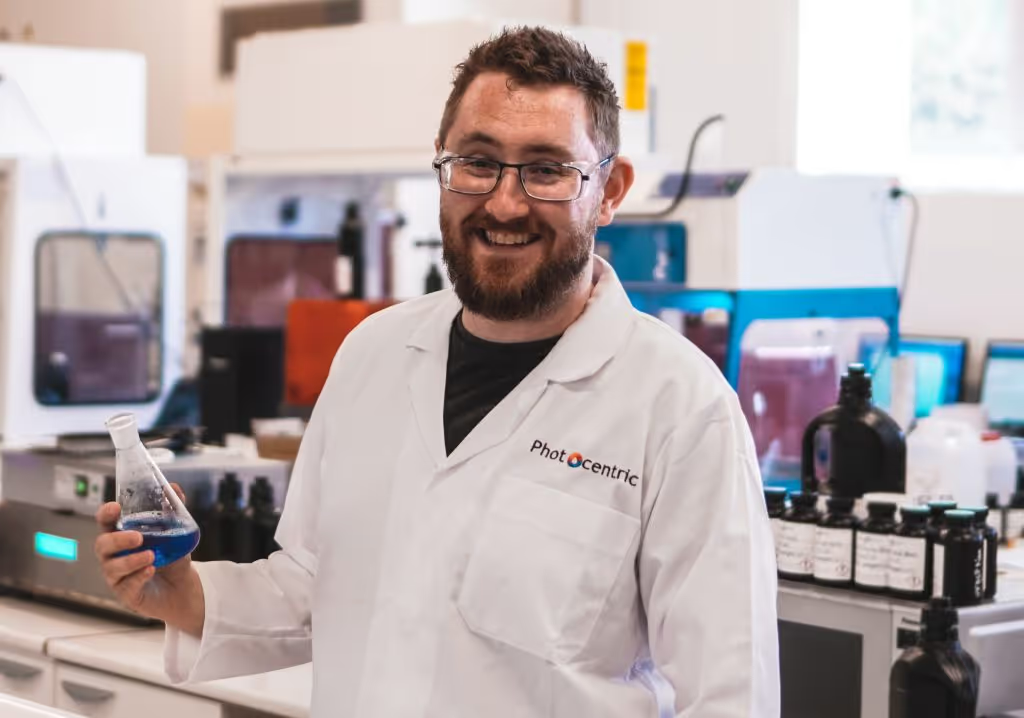
Image credit: Photocentric
Could you share one or two successful applications of how your technology has been used?
Quimbaya Orfebrería, an Argentine goldsmith, adopted our LC Precision 1.5 desktop printer to meet growing demand and overcome design limits. They achieved an 80% reduction in manufacturing time and a 400% increase in output, enabling more intricate designs.
In the UK, the Robert Jones and Agnes Hunt Orthopaedic Hospital leveraged the LC Pro to produce a pre‑shaped implant for a complex femoral osteotomy. The 3D model saved the NHS over £1,000 and cut operating time by one hour.
What are some of the challenges that need to be overcome to accelerate the adoption of additive manufacturing?
The main obstacles are high cost, limited scalability, and insufficient material properties. LCD screens have dramatically reduced cost and, with large‑format panels, addressed scale. However, functional material performance remains a bottleneck. We are collaborating with BASF to develop a broader range of durable resins suitable for industrial applications.
How do you see additive manufacturing technologies and the industry evolving?
LCD technology is a game‑changer, enabling custom mass production and rapid iteration. I anticipate fully automated machines becoming standard, eliminating manual intervention. Within two years, functional 3D‑printed plastics will enter production lines, leveraging the benefits of tooling elimination, bespoke designs, and geometric freedom. Additionally, the 3D‑printed green body approach—followed by sintering—will open low‑energy, cost‑effective pathways for ceramics and metals.
Photocentric recently announced its new Liquid Crystal Magna 3D printer. Could you take us through some of the specs and the benefits of this machine?
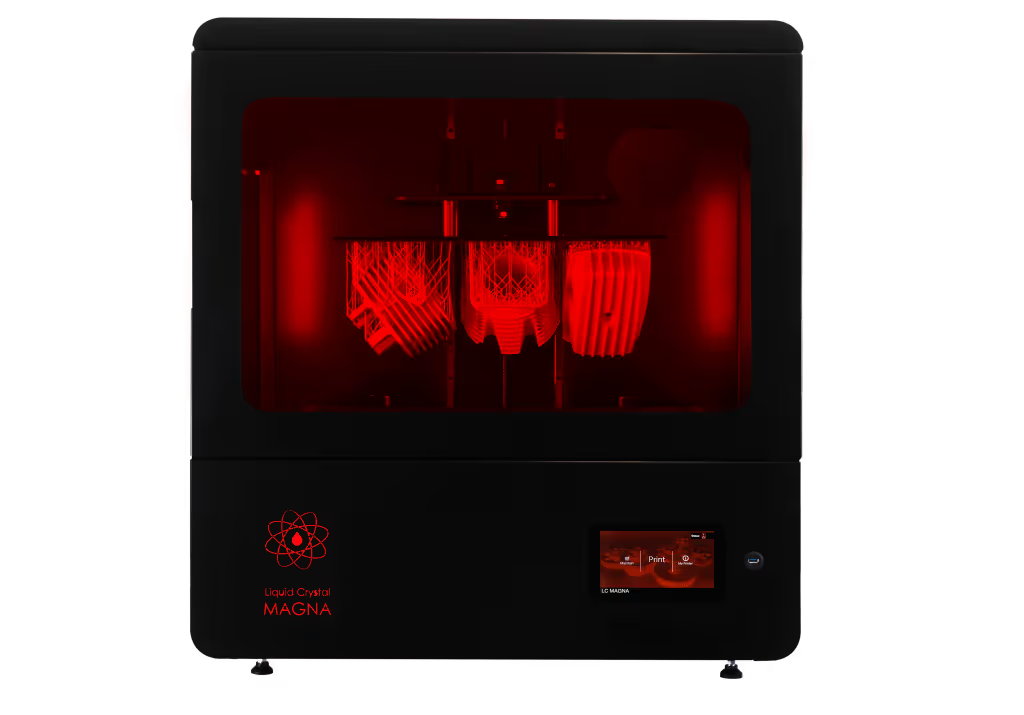
Photocentric's LC Magna 3D Printer [Image credit: Photocentric]
The LC Magna is engineered for custom mass manufacturing and large‑component prototyping at a competitive price. With a 510 mm × 280 mm × 350 mm build envelope, it’s the largest LCD‑based printer on the market. The 23.4‑inch 4K Ultra‑HD screen, paired with a custom backlight, delivers exceptional detail and precision. Backlight brightness allows 100‑µm layers to cure in 3–8 seconds. Target users include dental technicians, product designers, engineers, and manufacturers looking to boost throughput and reduce lead times. For example, a glasses maker can produce 36 optical frames in 12 hours (under 20 minutes each), while a dental technician can print 46 flat arches in just over an hour at a cost of less than £1.06 per arch using our Daylight dental resin.
What do the next 12 months hold for Photocentric?
We’re actively pursuing new printers for plastics, ceramics, and metals, and expanding our R&D team to deepen expertise in metal and ceramic 3D printing. These developments will broaden our material portfolio and enhance manufacturing capabilities across industries.
To learn more about Photocentric, visit: https://photocentricgroup.com/
3D printing
- Ultimate Guide to Ender 3 (Pro & V2) Support Settings – Optimize Print Quality
- 5 Key Benefits of Markforged’s Eiger Slicer Software for 3D Printing
- Top Heat‑Resistant Filaments for 3D Printing – Expert Rankings & Insights
- Collaboration: The Path to the Factory of the Future
- Choosing Ceramic-Filled SLA Materials for Superior 3D Printing Results
- Top 3D Printer Build Surfaces for Superior Print Quality
- Young's Modulus Explained: Key Definitions, Typical Values, and Practical Examples
- Solid Edge vs. SolidWorks: A Comprehensive CAD Software Showdown
- Why an Additive Manufacturing Execution System Is Essential for Spare Parts Production
- From Hobby to Income: How I Secured My First 3D Print Sale on Etsy