



Aconity3D MD Yves Hagedorn: Empowering Innovation with Flexible Metal 3D Printing
Metal 3D printing adoption often stalls at the crossroads of application development, material qualification, and process optimization. Aconity3D, a German leader in additive manufacturing, delivers modular laboratory systems that let customers fine‑tune every process parameter and explore new applications with confidence.
Could you tell me about Aconity3D?
[caption id="attachment_10527" align="aligncenter" width="700"]
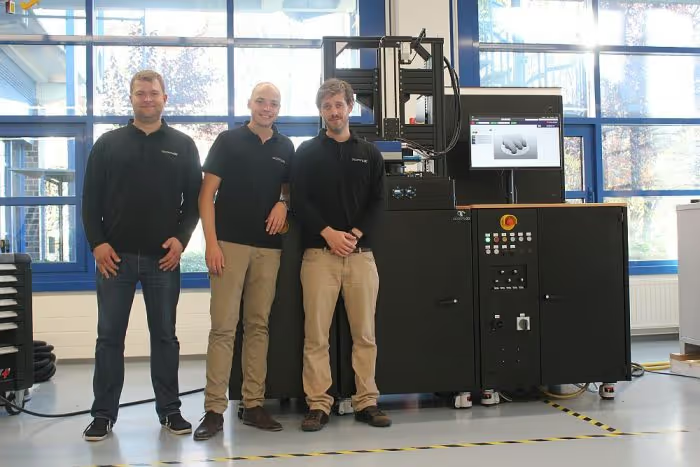
Co‑founders of Aconity3D, left to right: Hendrik Blom, Yves Hagedorn, Andreas Goerres [Image credit Aconity3D]
At Aconity3D we offer a complete ecosystem for metal additive manufacturing. Our platform blends bespoke machine components and modular kits, allowing us to tailor equipment for any specialized application. We start with expert consulting—whether a customer asks about 3D‑printing magnesium or another niche alloy, we identify the material, test its suitability, and provide a fully qualified process. Once validated, we manufacture the part for the customer or, in the long run, supply the dedicated equipment that fits their exact needs. This end‑to‑end approach makes us a true one‑stop shop while keeping equipment sales at the core of our business.
What was the motivation behind founding the company?

Expanding the reach of additive manufacturing—whether by adding new materials, boosting productivity, or enhancing dimensional accuracy—requires full access to hardware and process parameters. We saw a gap: no commercial system offered that level of control. That insight sparked Aconity3D’s founding, and we quickly realized we could deliver a genuine customer need: complete access to both hardware and software.
Are there specific industries that would benefit the most from the technology and services that Aconity3D provides?
Our solutions are versatile across all sectors. In medical engineering, we enable titanium and bio‑absorbable magnesium implants and advanced sensor components. Aerospace clients exploit our ability to qualify high‑temperature alloys and broaden plating options. Automotive manufacturers value our cost‑effective, highly flexible systems that eliminate unnecessary tooling, keeping them competitive with traditional methods.
When it comes to metal 3D printing, which applications are best suited for the technology, and how can companies begin to identify the right types of applications?
Additive manufacturing shines with small, complex parts, or when integrating new materials—such as copper‑chromium blends—into a single build. While most applications still carry higher unit costs than milling, exceptions exist: dental restorations and eyewear frames are now more economical with powder‑laser technology. The key is rigorous part screening and a clear business case that accounts for life‑cycle costs. When companies can demonstrate functional integration—like built‑in cooling channels—they unlock the true value of additive processes.
What are the key challenges of metal 3D printing, and how have you addressed them?
Design and data preparation remain the most significant bottlenecks. The industry still lacks standardized CAD formats and guidelines, which forces engineers to spend weeks preparing a part that prints in days. At Aconity3D we mitigate this by offering open‑architecture hardware that works with any software stack, combined with an in‑house expertise team that can quickly validate designs and optimize parameters. This synergy reduces lead time and ensures that the final part meets stringent quality standards.
Could you share any of your customer success stories?
Our clients include medical firms producing FDA‑approved titanium implants, automotive manufacturers deploying a high‑productivity four‑laser system for 400‑mm plates, and researchers fabricating magnesium components for biomedicine. We also support high‑temperature pre‑heating to expand the material palette to tool steels, titanium aluminides, and nickel‑based superalloys—opening new industrial possibilities.
How do you see the AM industry evolving over the next few years?
The additive manufacturing landscape has matured from hype to tangible value. While desktop printers are affordable, industrial systems still demand deep expertise. The next wave will focus on workforce development, standardized workflows, and reliable, turnkey solutions that lower the barrier to entry. Companies that invest in training and process integration will lead the shift toward mainstream adoption.
Are there any developments in the AM industry that you're excited about?
We’re particularly excited about in‑process monitoring and closed‑loop control. By integrating optical sensors and high‑speed cameras, we capture real‑time melt‑pool data and translate it into actionable feedback—regulating laser power or scanning speed to correct defects instantly. This level of intelligence moves us closer to fully autonomous, defect‑free builds.
Could you talk a bit more about in‑process monitoring and control, and what Aconity3D is doing in that space?
[caption id="attachment_10529" align="aligncenter" width="700"]
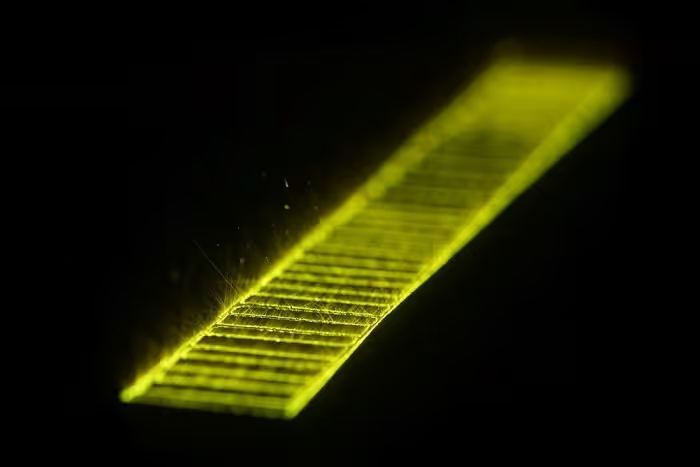
In‑process monitoring [Image credit: Aconity3D]
Our roots at the Fraunhofer Institute for Laser Technology gave us early access to advanced optical diagnostics. We now pair these sensors with machine learning models that sift through terabytes of data to isolate the truly critical parameters. This approach eliminates noise, speeds up data interpretation, and delivers a closed‑loop system that can adjust the process in real time—ensuring consistent part quality.
Aconity3D has recently announced a partnership with Aerosint. What does this partnership mean for your company going forward?
Multi‑material metal parts have long been a sought‑after capability. Aerosint’s powder‑deposition device can lay down two distinct materials in both X and Y axes on a single powder bed. By integrating their system with our process‑control platform, we can now adapt parameters for each material in situ, unlocking true multi‑material builds that were previously impossible.
What new applications could be opened up with the possibility of multi‑material metal 3D printing?
The jewellery sector stands to benefit from graded materials, transitioning smoothly from copper to chromium. Tooling industries can use copper cooling channels paired with steel outer surfaces, while the medical field can reduce stress shielding by tailoring implant stiffness. These applications hinge on robust multi‑material technology that matches the performance of conventional manufacturing.
What does the future hold for Aconity3D?
We will continue expanding our material catalogue, including multi‑material options, to deliver new industrial solutions. Our focus will shift toward specialized series production, ensuring even niche applications can be qualified and scaled efficiently. Ultimately, we aim to remain the enabler of innovation for every customer who relies on metal additive manufacturing.
To learn more about Aconity3D, visit: aconity3d.com
3D printing
- PETG vs PLA: Which 3D Printing Material Wins in Strength and Ease of Use?
- CADimensions Additive Manufacturing Podcast: Metal 3D Printing, Military Uses & DLP Technology
- Anisoprint CEO Fedor Antonov Explains Why Composite 3D Printing Is a Game‑Changing Trend in Additive Manufacturing
- Why a Filament Runout Sensor is Crucial for Reliable 3D Printing
- How 3D Printing Enhances Lean Manufacturing: Reducing Waste & Boosting Efficiency
- Choosing Between 3D Printing and Injection Molding: Which Method Delivers Best Value?
- Pad Printing Explained: Process, Materials, and Applications
- Introducing the PreForm Insider Program: Shape the Future of 3D Printing
- Expert Answers: Your Metal 3D Printing Questions Explained
- Food‑Safe 3D Printing: The Comprehensive Guide for Safe, Custom Food Containers