



Anisoprint CEO Fedor Antonov Explains Why Composite 3D Printing Is a Game‑Changing Trend in Additive Manufacturing
Composite 3D printing is a fast‑growing technology that delivers robust yet lightweight parts, and its impact is already felt across aerospace, automotive, and medical sectors.
Russian start‑up Anisoprint is at the forefront, having pioneered the Composite Fiber Co‑extrusion (CFC) process.

Fedor Antonov, CEO of Anisoprint
With CFC, continuous composite fibres are embedded directly into the plastic matrix during printing, producing parts that combine the strength of carbon or glass with the versatility of thermoplastics.
What is Anisoprint’s mission?
Founded five years ago by experts in composite design, Anisoprint aims to democratise lightweight manufacturing. “By enabling the production of lighter, stronger structures, we help reduce fuel use, lower emissions, and drive sustainability,” says Anton Antonov.
How does CFC deliver value?
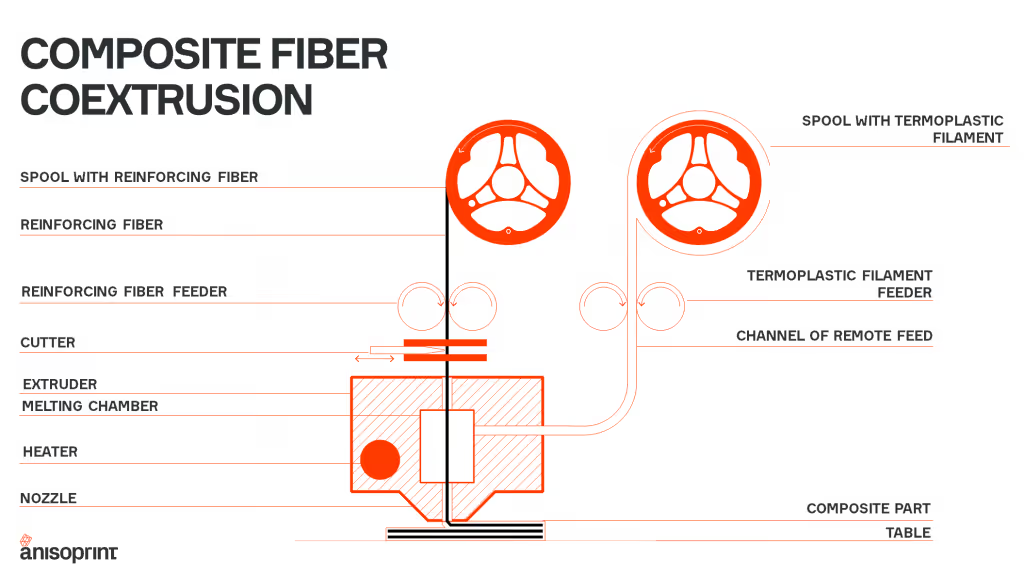
Anisoprint’s CFC technology [Image credit: Anisoprint]
Co‑extrusion grants unprecedented freedom: you can select any thermoplastic matrix, vary the fibre volume fraction, and lay fibres along arbitrary paths. This flexibility lets manufacturers tailor properties such as thermal resistance, impact toughness, or wear resistance while keeping weight low.
Unlike traditional laminates, CFC enables lattice‑style infill that delivers superior strength‑to‑weight ratios. “Our technology turns any complex shape into a high‑performance composite part,” Antonov explains.
Key sectors that benefit from CFC
Lightweighting is critical wherever performance and energy efficiency matter: aerospace, high‑performance automotive, sports equipment, and medical devices. CFC also accelerates prototyping, allowing rapid design iterations and the production of tooling or jigs that shorten manufacturing cycles.
Success stories
Anisoprint’s clients have achieved breakthroughs. Brightlands Materials Center has produced self‑sensing composite parts that monitor structural health in real time—a process that traditionally required multi‑step, specialist fabrication.
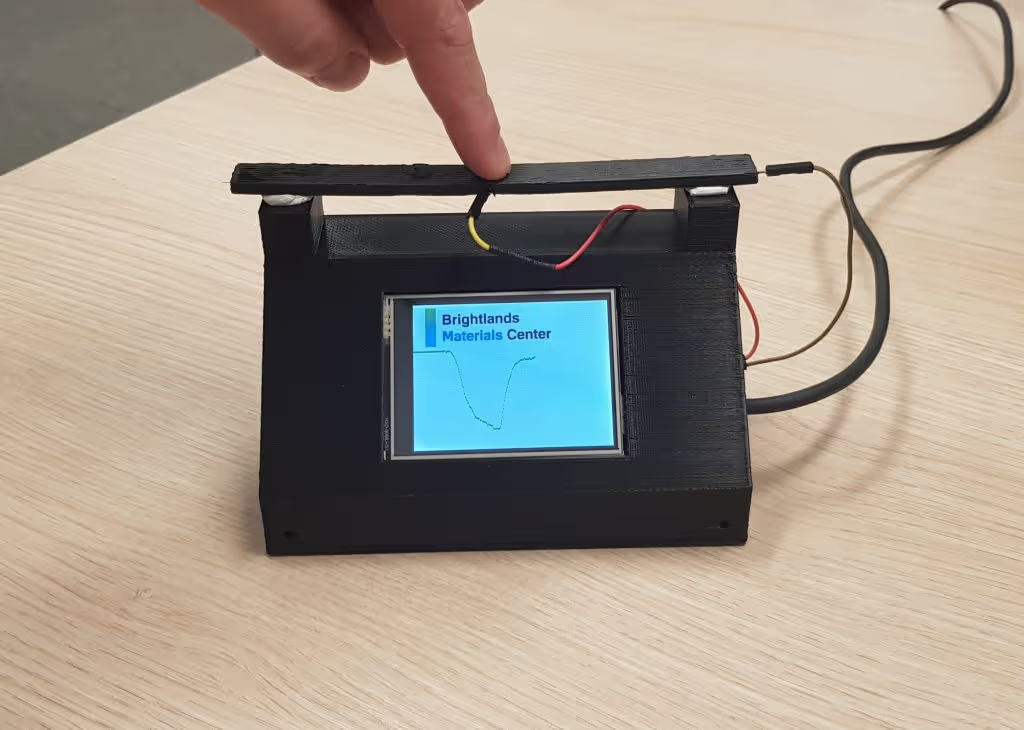
Monitoring deformation in a 3‑D‑printed composite structure [Image credit: Anisoprint]
In sheet‑metal forming, a CFC‑printed tool cut costs by a factor of four and doubled tool life compared to conventional tooling.
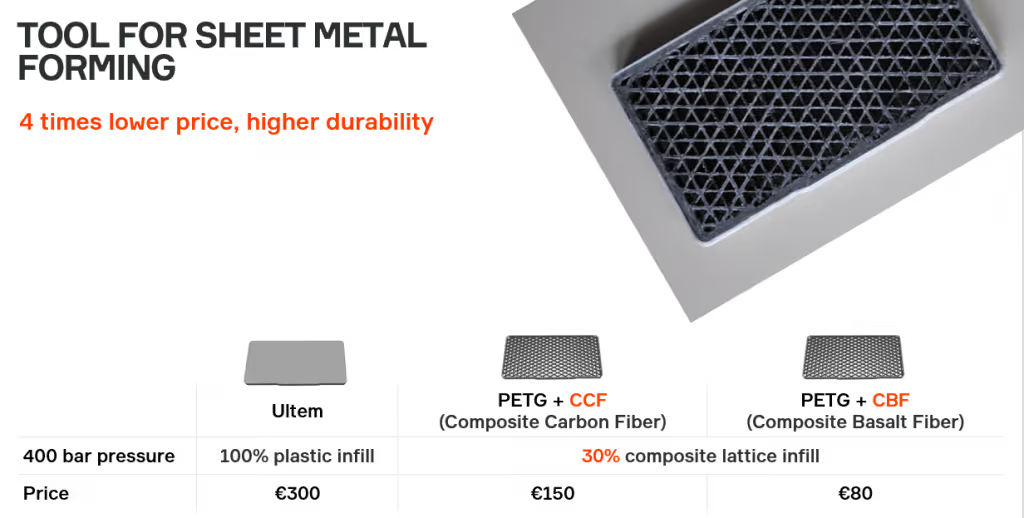
Cost savings with a CFC‑printed sheet‑metal forming tool [Image credit: Anisoprint]
The PROM IS 500: Anisoprint’s industrial 3‑D printer
To realise autonomous, single‑stage manufacturing of large, complex composites, Anisoprint introduced the PROM IS 500. It meets rigorous industrial standards, operates continuously in factory environments, and prints high‑performance polymers such as PEEK, PEKK, and PEI.
With a build volume of 600 × 420 × 300 mm, it delivers high productivity and reliability for production‑grade parts.
Composite 3‑D printing today and tomorrow
“Composite 3‑D printing has moved from a niche curiosity to a mainstream growth engine,” Antonov notes. “Market studies now treat it as a distinct technology group with one of the highest growth rates.”
As the century of composites unfolds, additive manufacturing will be the key to unlocking their full potential.
Looking ahead
In 2021, Anisoprint will ship the first PROM IS 500 units and launch the product officially. Upcoming desktop‑segment releases will introduce new materials, software, and services—details to be revealed at the official release.
To learn more, visit anisoprint.com.
3D printing
- Digital Light Processing (DLP) 3D Printing: How It Works and Why It Matters
- Mastering Post‑Processing for SLA Prints: From Cleaning to a Professional Finish
- Bulk Modulus Explained: Definition, Formula, Applications, and Key Benefits
- Fixing Infill-Wall Separation in 3D Printing: Quick, Reliable Solutions
- FDM 3D Printing: ASA, PETG, and PC Filaments Compared – Expert Guide to Performance & Applications
- Master PLA 3D Printing: Expert Tips for Perfect Prints
- Insightful Interview with Lithoz CEO Dr. Johannes Homa on the Future of Ceramic 3D Printing
- How a 3D Pen Works: From Filament to Finished Model
- Fortify CEO Josh Martin Discusses Revolutionary Fluxprint™ Digital Composite Manufacturing
- Can You 3D Print on Glass? Expert Guide to Glass Print Beds