



nTopology CEO Reveals How Generative Design Drives Additive Manufacturing Innovation
Engineers today wield a suite of sophisticated software tools that unlock complex solutions in additive manufacturing.
When paired with additive manufacturing, generative design reduces costs and enables the creation of highly intricate, lightweight structures that would be unachievable with conventional methods. In this interview, Bradley Rothenberg, CEO of New York‑based nTopology, explains how its nTop Platform empowers engineers across AM and traditional manufacturing, and shares insights on the future of generative design.
Can you tell me a bit about nTopology?

Bradley Rothenberg, CEO of nTopology
nTopology is an engineering software company founded in 2015, headquartered in Manhattan. In 2019 we launched the nTop Platform, now used by hundreds of engineering firms and thousands of engineers on cutting‑edge projects in aerospace, automotive, medical, and consumer markets.
What sets the nTop Platform apart from conventional 3‑D design tools?
Unlike traditional CAD that stores geometry as B‑Reps or meshes, nTop Platform treats geometry as a mathematical equation. This design‑first approach lets engineers craft and iterate complex shapes rapidly; any change to the equation propagates instantly through the model, eliminating rebuild errors.
Why are topology optimisation and generative design indispensable for additive manufacturing?
Generative design lets engineers explore the design space beyond manual trial and error. nTopology’s system exposes every parameter of the design equation, giving users full visibility and control—far from a black‑box one‑click solution.
What advice would you give designers new to DfAM?
Engage with experienced practitioners early on. The industry has evolved from prototyping to replacing existing parts, and now to true design for AM. Understanding the specific process constraints—whether laser powder‑bed fusion, binder jetting, or directed energy deposition—is essential. Jennifer Bracken at Penn State has developed the GAPS worksheet for laser powder‑bed fusion, a practical guide that evaluates whether a design is suitable for that process. Pairing this technical insight with business‑case analysis ensures a robust transition.
Which product categories gain the most from marrying generative design with AM?
[Image credit: nTopology]
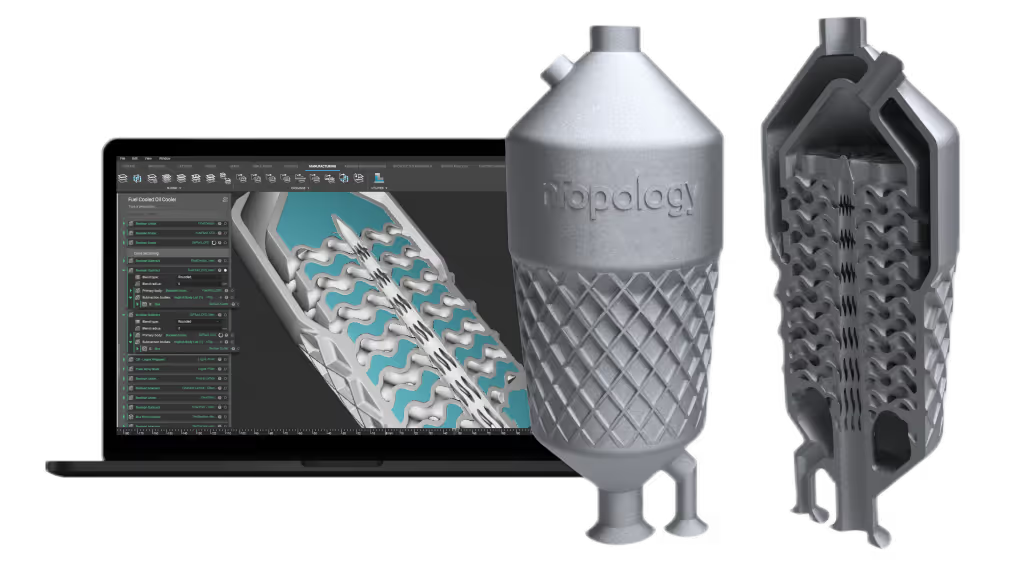
Our customers employ generative design in three main ways. First, they generate thousands of design variants through scripts and then evaluate them via simulation or physical testing. Second, topology optimisation shapes surface geometry to balance weight, strength, or stiffness. Third, they engineer material properties by designing mesostructures—mimicking bone density in medical implants or tailoring thermal conductivity for heat dissipation. Additive manufacturing’s ability to control geometry and material at the same time makes these applications particularly powerful.
How does nTopology address interoperability challenges in the 3‑D printing ecosystem?
We have built the nTop Platform to work seamlessly with a wide range of vendors. While no single file format fits every need, we actively support 3MF for efficient data exchange, export slice formats such as CLI and CLF, bitmap stacks, and CSV files that can carry laser speed and power information. We also ingest native CAD files, meshes, simulation data from tools like ANSYS and Abaqus, and even custom formats such as voxel grids. Command‑line integration with ModeFRONTIER, Python, and Excel further streamlines the workflow. In short, data interchange is at the heart of what we do.
What additive‑manufacturing trends excite you most?
We are most thrilled when designs move from lab prototypes into critical end‑use parts. nTopology’s geometry‑first capabilities unlock performance gains that traditional CAD systems struggle to achieve. Moreover, the growing adoption of design approaches that respect each AM process’s unique freedoms and constraints signals a maturation of the field.
What’s next for nTopology?
Recent funding will accelerate the evolution of the nTop Platform and expand our international footprint in the AM market and beyond. While early adopters used us primarily for design for AM, our biggest customers now apply nTop across the manufacturing spectrum—from injection‑mold design and composite lay‑up to punching millions of holes in metal plates.
Final thoughts from Bradley Rothenberg
We’re grateful for the community’s support and the invaluable feedback that shapes our roadmap. If you’d like to see what’s new, visit our website for weekly demos, in‑depth webinars with partners, and a regular DfAM series featuring experts worldwide. Thank you to AMFG for the opportunity to discuss these exciting topics.
3D printing
- Delta vs Cartesian 3D Printers: A Comprehensive Comparison
- The Ultimate Guide to 3D Printing: Benefits, Drawbacks, and Key Technologies
- 3D Printing vs. Traditional Manufacturing: A Professional Comparison of Methods and Benefits
- SLS vs SLA 3D Printing: Key Differences and How to Choose
- Unlocking Innovation: The Key Advantages of 3D Printing in Modern Manufacturing
- Accurate Injection Molding Cost Estimation Guide
- Understanding and Managing Odors from 3D Printing: Health and Safety Tips
- Understanding 3D Printer Nozzles: Types, Uses, and Expert Recommendations
- Additive vs Subtractive Manufacturing: Key Differences & Applications
- Additive Manufacturing Explained: From Design to Finished Part