



Fortify CEO Josh Martin Explains How Fluxprint™ Transforms Composite 3D Printing
[Image credit: Fortify]

Joshua Martin, Fortify CEO
Fortify, headquartered in Boston, is pioneering a groundbreaking composite 3‑D printing approach that combines magnetic fiber alignment with Digital Light Processing (DLP). This synergy produces high‑resolution, high‑performance composite parts that were previously impossible to manufacture.
The core of this innovation is Fluxprint™, which powers Fortify’s Digital Composite Manufacturing (DCM) platform. DCM is designed to help companies create durable tooling—such as injection‑mold inserts—and end‑use production parts with unprecedented speed and precision.
Could you tell me a bit about Fortify?
Fortify is a Boston‑based additive‑manufacturing company delivering the next‑generation platform for composite printing. We merge the strength of fiber‑reinforced materials with the surface finish and accuracy of SLA/DLP technologies.
Our founding principle was clear: eliminate the trade‑off between form and function. Traditional prototyping offers either realistic appearance or functional performance, but rarely both. In contrast, Fortify’s technology allows us to add reinforcing fibers to high‑resolution photopolymers while controlling their orientation with magnetic fields.
Photopolymer chemistry has largely stagnated for the past 25–30 years, with only incremental improvements in recent years. By integrating reinforcing additives into these chemistries, we unlock a broader property space—strength, stiffness, thermal conductivity—across all three dimensions of each voxel.
Is this what comprises your Digital Composite Manufacturing (DCM) platform?
Yes. The DCM platform encompasses hardware, software, and materials that tune fiber architecture for optimal performance. Fluxprint™ applies magnetic fields within the build chamber to orient magnetically responsive composites precisely.
Which industries and applications would be best suited for your technology?
We target tooling first, leveraging our ability to produce parts with the resolution of photopolymers while withstanding temperatures up to 300 °C and maintaining industry‑leading strength and stiffness.
This positions Fortify to disrupt the injection‑molding market, where tooling investments are substantial and lead times can span weeks. Our prints are ready in about an hour—compared to the ten‑week cycle of conventional tooling—while delivering higher cycle life and lower volume production capabilities for high‑value applications.
We also pursue end‑use part production, enabling parts that meet stringent certifications such as FST (flammability, smoke, toxicity). Expanding the material palette is essential for broader adoption in additive manufacturing, and our platform excels in that area.
What is your view on the current state of composite 3D printing, and how is the technology developing?
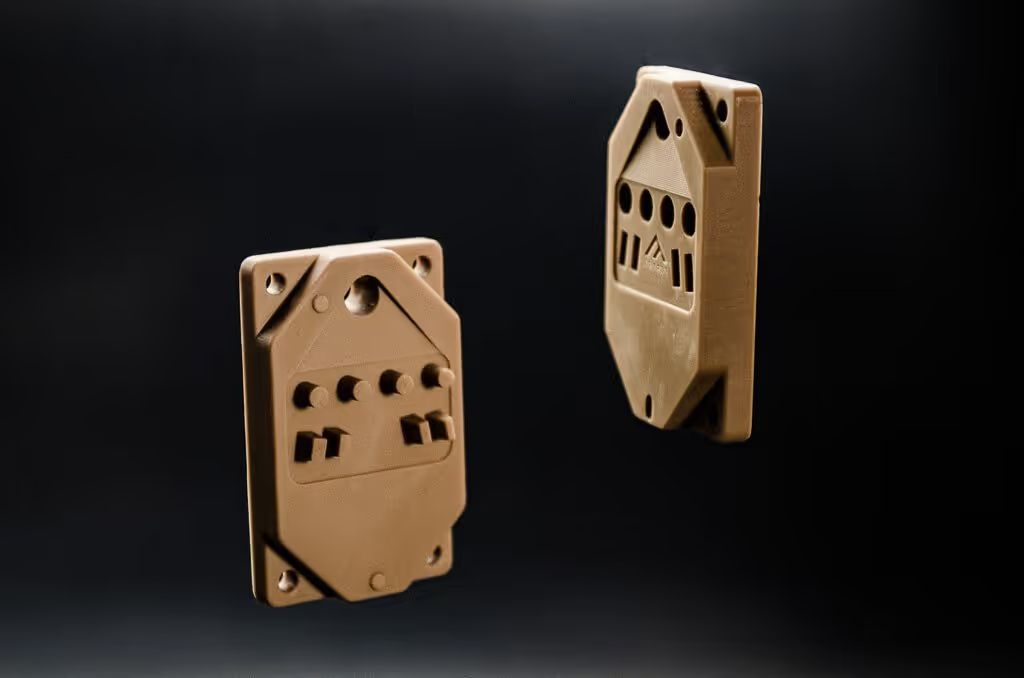
Composite 3‑D printing remains a nascent segment relative to polymer and metal 3‑D printing, which have attracted billions in investment. Companies like Carbon, Markforged, and Arevo are leading the way, yet composite printers still lag in terms of surface finish, isotropy, and material versatility.
Most existing composite systems rely on extrusion‑based FDM, which suffers from poor surface quality and directional anisotropy. Fortify’s approach addresses these gaps by delivering isotropic, high‑resolution composites with precise control over fiber orientation and mechanical properties.
Our mission is to enable high‑throughput production of materials traditionally requiring machining or hand lay‑up. By embedding these materials directly into the build process, we unlock new design freedoms and reduce manufacturing complexity.
Why has it taken this long for the industry to recognize composites as a great opportunity for 3D printing?
The maturity of the buying market has been a key factor. Early 3‑D printing efforts focused on consumer and prototyping markets, while composites were reserved for high‑performance aerospace and sporting goods. As the technology matures, industrial applications are now gaining traction, and the industry is shifting from generic to specialized solutions.
We are now at a stage where composites can deliver not only structural performance but also properties like thermal conductivity and specific heat resistance—attributes critical for many engineering applications.
Thinking about the AM industry more generally, how do you see it evolving over the next five years?
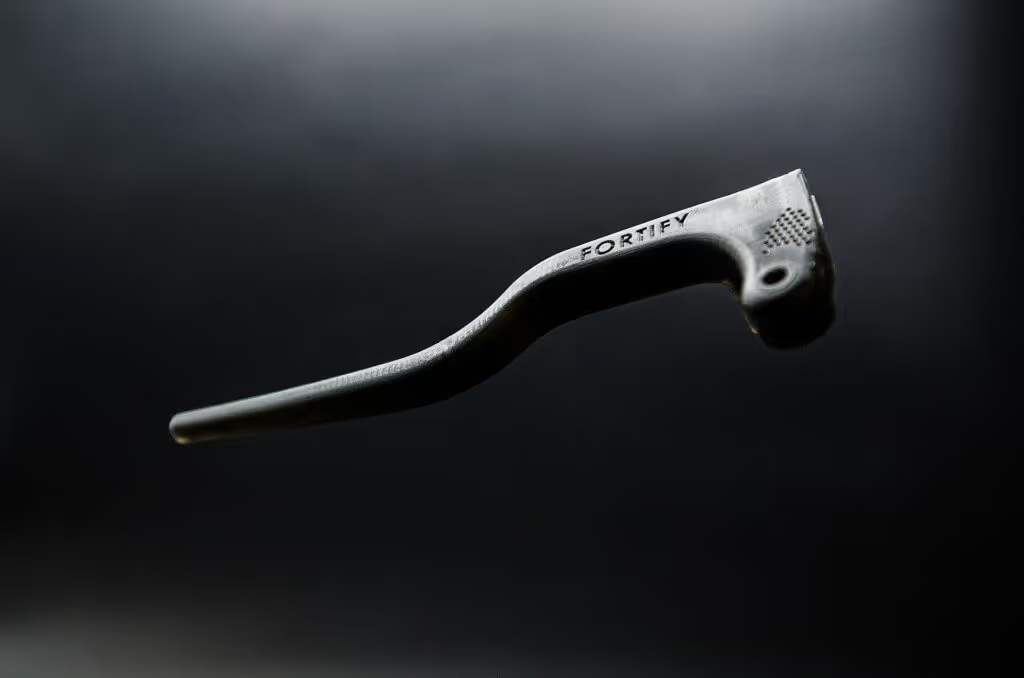
The next five years will see a decisive shift toward industrial‑grade, “lights‑out” manufacturing. Companies like Carbon have laid the groundwork, but the focus will intensify on hardware, software, and materials innovation.
Key developments include digital thread tracking—from raw material batch numbers to post‑print validation—enabled by machine learning. This will reduce variability, enhance repeatability, and build the trust necessary for large‑scale adoption.
What are some of the challenges the industry will need to overcome?
Current barriers include achieving the high throughput, repeatability, and cost efficiency required for Industry 4.0. To reach these goals, additive‑manufacturing equipment must evolve from hobbyist printers into fully integrated manufacturing units, complete with the quality controls and process standards of CNC machining.
Events like IMTS reveal that the majority of participants still come from traditional manufacturing, underscoring the need for AM to mature into a mainstream production technology.
How long will it take the industry to become a larger portion of overall manufacturing?
While additive manufacturing will never fully replace conventional manufacturing, its value lies in unique geometries, material properties, and rapid prototyping. Fortify is focused on enabling these advantages to create new markets rather than merely substituting existing processes.
Fortify announced a $2.5 million funding round this year. What does this investment mean for the company?
The round, announced in January, was a recap of prior funding and aimed to accelerate beta testing of our platform. We also closed a $10 million Series A led by Accel Partners, which will fund hardware production and expansion of our material library.
With the next two material systems already validated, we are now prioritizing tooling solutions and scaling toward end‑use part production across diverse engineering domains.
Could you tell us more about your collaboration with DSM?

DSM is our first partner on the open‑material platform. This collaboration allows us to focus on additives, hardware, and software while giving customers multiple material suppliers.
DSM’s high‑temperature photopolymers—capable of maintaining strength at ~100 °C—combine with Fortify’s magnetic alignment to produce parts that perform at even higher temperatures, extending the applicability of both partners’ solutions.
Is an open‑materials model the future of 3D printing?
Historically, the printing industry was vertically integrated. Today, specialization has become the norm—software, processors, memory, and materials are developed by distinct players. An open‑materials ecosystem offers customers flexibility and encourages innovation, though industry‑wide standardization will take time.
What does the next 12 months hold for Fortify?
We are scaling our team to meet product milestones, targeting early‑to‑mid 2020 for beta deployments and general availability in 2021. Additional capital will be sought at the end of 2021 to manufacture production‑grade systems for early 2022.
We are actively engaging high‑touch customers and inviting early adopters to join our journey. For more information, visit https://3dfortify.com.
3D printing
- Fiberglass vs. Carbon Fiber: Choosing the Right Reinforcement for 3D Printing
- Expert Insight: Dominic Parsonson on the Future of Additive Manufacturing at Fuji Xerox Australia
- Markforged Elevates Drone Performance with Carbon‑Fiber 3D Printed Parts – Part 1
- Master PLA 3D Printing: Expert Tips for Perfect Prints
- Mastering 3D Printing Surface Finish: Essential Techniques for Superior Part Quality
- 9 Myths About 3D Printing Debunked: What You Need to Know
- Interview with Professor Ian Campbell: Pioneering Design for Additive Manufacturing at Loughborough University
- Glassboard: Leveraging 3D Printing for Rapid, Reliable Product Development
- AMendate’s CEO Thomas Reiher on Revolutionizing 3D Printing with Automated Topology Optimization
- Interview with Eckhart Additive Manufacturing Engineer Robert Heath: 3D Printing, Automation & Industry 4.0