



Inside Arevo’s 3D‑Printed Carbon‑Fiber Bike Frames: Interview with Co‑Founder Wiener Mondesir

Wiener Mondesir, Arevo Co‑Founder and CEO
Silicon Valley‑based Arevo captured global attention in 2018 when it unveiled the world’s first 3D‑printed carbon‑fiber bike frame. The showcase highlighted Arevo’s proprietary composite 3D‑printing platform—a blend of robotics, materials science, and advanced software that produces lightweight, custom‑made composite parts.
Since that milestone, Arevo has partnered with Franco Bicycles to deliver 3D‑printed carbon‑fiber unibody frames for a new e‑bike brand. We spoke with Arevo’s Co‑Founder and Chief Technology Officer, Wiener Mondesir, about the technology’s foundation, the advantages of composite 3D printing, and the future of scalable composite manufacturing.
Could you tell us a bit about Arevo?
At Arevo, we aim to democratize large‑scale composite manufacturing. By integrating robotics, advanced materials, and intelligent software, we address a massive opportunity: carbon fiber is stronger than many metals yet dramatically lighter, making it attractive across aerospace, automotive, and consumer sectors. However, traditional composite production is labor‑intensive, capital‑heavy, and suffers from long design cycles due to limited simulation tools and a knowledge gap among non‑experts. Our solution—what we call the digitalization of composites—fills that gap. Designers start with a 3D model; our software automatically analyses, optimises fiber orientation, material usage, and generates precise build instructions. Think of a spider’s web, which uses just enough silk in the right places; we emulate that efficiency in every print.
What are the benefits of composite 3D printing?
Carbon‑fiber composites boast an exceptional strength‑to‑weight ratio, enabling robust yet lightweight parts. While metal lattice structures can reduce weight, they still start with a dense material. Beginning with carbon fiber eliminates that inefficiency from the outset. The anisotropic nature of carbon—strong along the fiber direction—has historically limited its use, but our toolset abstracts that complexity. Designers no longer need a PhD; our software handles the directional nuances, allowing anyone to produce structurally sound composites.
Your carbon‑fiber 3‑D‑printed bike frame was widely publicised when it was unveiled. What was the process of creating the bike frame, from design to production?
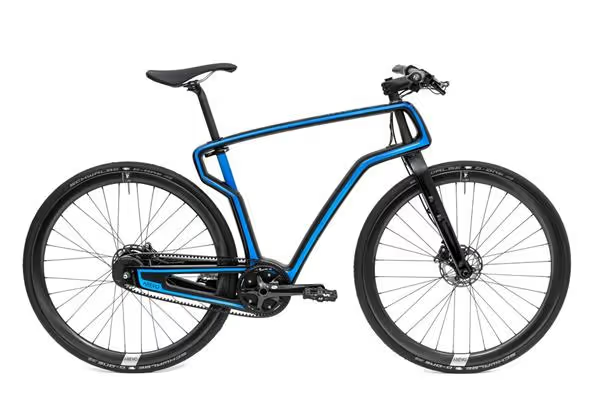
Arevo’s 3‑D‑printed carbon‑fiber bike frame [Image source: Arevo]
We chose the bike frame as a proof‑of‑concept because it’s a complex, high‑load structure that demands precision. Traditional composite bikes undergo a year‑long cycle—design, prototyping, then production—requiring 20‑30 parts and up to 40 workers per frame. In contrast, our software turns a CAD model into an isotropic, generative design in minutes, optimising fiber orientation and material distribution. At our California facility, a six‑axis robot deposits the fibers in X, Y, and Z directions, producing a fully integrated unibody frame in days. The result is a lightweight, strong structure that can be tuned for stiffness and ride quality via software, opening a new business model for rapid, on‑demand customization.
With around a million composite frames produced annually worldwide, Arevo’s technology enables the market to shift from mass‑produced, nearly identical frames to truly personalized, high‑performance options.
Is the customised approach to production a scalable business model?
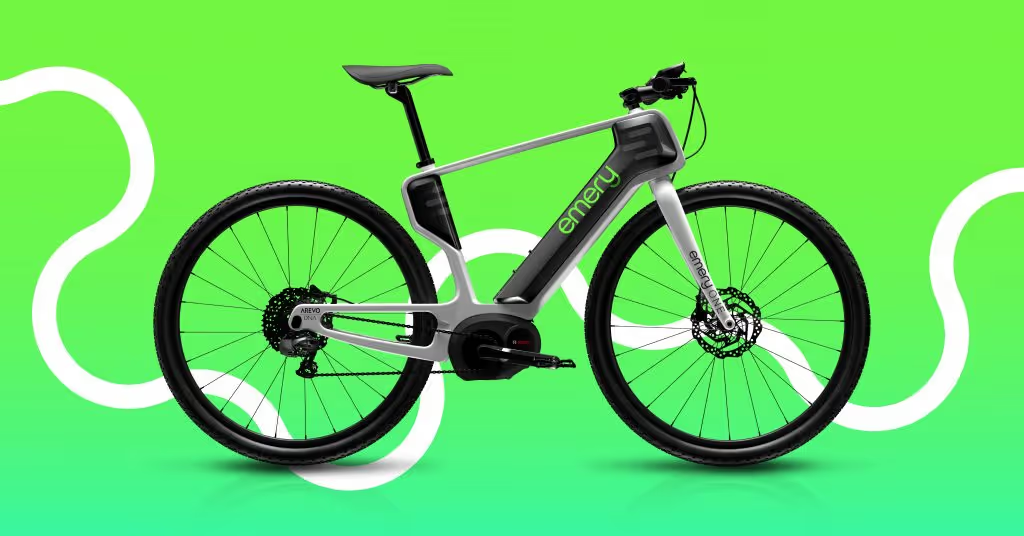
The Emery ONE: Arevo has announced its partnership with Franco Bicycles to release a new line of e‑Bikes [Image source: Arevo]
Customisation is a key differentiator for bicycles, as riders benefit from frames tailored to their body and riding style. Mass‑market production cannot easily accommodate such personalization. Our platform lets customers design a frame, while our software verifies structural integrity. The design is then printed on demand, streamlining the journey from concept to finished product.
What other applications do you envision with your technology?
While we’re currently focused on mobility, the core benefits—ultra‑lightweight, high strength, and custom‑fit—extend to sports equipment, automotive components, energy solutions, and aerospace parts. We’re actively developing applications where performance and bespoke design are critical.
How does robotics fit into your technology?
Traditional layer‑based 3D printing deposits material only in the X and Y planes, leaving the Z direction weaker. Arevo’s fully articulated six‑axis robot can deposit carbon fiber in all three dimensions, eliminating the typical Z‑direction weakness. Additionally, the robot’s reach of up to four metres allows us to print large parts—such as aerospace components—without splitting them into sub‑assemblies. The same robotic system can print a bicycle frame, demonstrating the versatility of our build envelope.
How would you describe the current state of the composite 3‑D printing market? How advanced is the technology?
[Image credit: Arevo]
Composite additive manufacturing has existed for years, but progress was limited by manual fiber placement and small, flat geometries. Today, automated robotics and advanced resin systems unlock complex shapes and higher resolution. While several companies pursue different approaches—ranging from resin chemistry to placement strategies—Arevo leads with an integrated platform that couples robotics, laser‑based deposition, and AI‑driven quality control.
What are some of the challenges the industry is facing, either 3‑D printing in general or composite 3‑D printing specifically?
One major barrier is the lack of accessible software that truly explores additive manufacturing’s capabilities. Designers often start from traditional, pre‑existing parts and attempt to retrofit them for 3‑D printing, which can compromise performance. We need tools that guide users from the outset, helping them exploit the unique possibilities of additive processes.
How do you see the industry evolving over the next five years?
We’re already shifting the narrative from novelty to production. In the coming years, the focus will move toward quality and scalability. Industries that adopt large‑volume, repeatable production will differentiate themselves, and we anticipate that standards and best practices will crystallize.
Ensuring the quality of parts and processes is a big talking point for additive manufacturing at the moment. What is Arevo’s approach to this?
Arevo’s laser‑based deposition system, coupled with machine‑learning algorithms, performs in‑situ inspection throughout the build. Sensors capture real‑time data, and a closed‑loop control system adjusts parameters on the fly, resulting in parts with less than 1% void content. Microscopic cross‑sections confirm the homogeneity of the material, ensuring that our components meet the rigorous demands of aerospace and other high‑performance sectors.
What does the next 12 months hold for Arevo?
Following the launch of our bike frame, demand has outpaced our current capacity. Over the next year, we’ll focus on scaling production while launching new applications across mobility and beyond. Our goal is to bring the benefits of on‑demand, high‑quality composite manufacturing to a broader market.
To learn more about Arevo, visit: https://arevo.com/
3D printing
- SLS vs. DMLS: Key Differences & Performance Comparison
- Inside 3D Printing: Professor Neil Hopkinson on Innovation, Scale, and the Future
- Stratasys Revives MakerBot: The Method Brings Industrial‑Grade Reliability
- Building Customer Confidence with World‑Class Data Protection in Additive Manufacturing
- Carbon DLS 3D Printing: Advanced Digital Light Synthesis Technology
- The Three Pillars of 3D Printing Success: Hardware, Materials, and Software
- Why 3D Printers Create a Skirt Outline: The Key to a Smooth Print
- Creality Unveils K2 Plus Multi‑Color 3D Printer at RAPID+TCT 2024, Showcases New Models, and Hosts LA User Meetup
- Understanding Jerk and Acceleration in 3D Printing: A Practical Guide
- Advanced 3D Printing Techniques for Electrostatic Discharge (ESD) Safe Products