



MELD Manufacturing CEO Nanci Hardwick on Revolutionizing Metal Additive Manufacturing
MELD Manufacturing Corporation is pioneering a radical new technology that enables the 3D printing of metals without melting. After a decade of development with Aeroprobe, MELD spun out as a subsidiary in spring 2018 and introduced its large‑scale B8 machine in April 2018. The B8 challenges conventional powder‑bed metal 3D printing by using a solid‑state fabrication process based on friction stir welding. By bonding metal with friction and pressure—rather than heat—MELD unlocks a host of unique advantages.
Vision Behind MELD Manufacturing
MELD is a woman‑owned small business founded last year in Virginia. It received the prestigious R&D 100 Award in 2018—an international competition that recognizes the 100 most innovative products worldwide. Our mission is to revolutionize manufacturing and enable the repair of the unrepairable. Unlike many AM companies that focus solely on part creation, MELD’s approach spans material selection, additive manufacturing, and post‑manufacturing repair, allowing designers to build parts from the ground up for optimal performance.
How MELD Technology Works
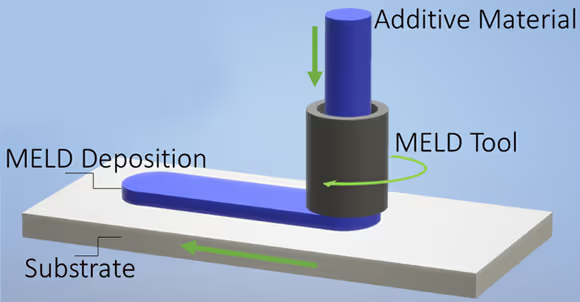
MELD’s core innovation is its solid‑state process. Unlike traditional AM methods that melt metal, MELD uses a rotating hollow tool to apply extreme pressure and friction to both the feed material and the base material. This plastically deforms the materials, allowing them to be “stirred” together—an additive friction‑stir process. The grain structure is refined, yielding superior strength, corrosion resistance, and impact fatigue performance. Because the process occurs below the melting temperature, MELD can handle powders, flakes, chips, and solid bars without stringent material specifications—unlike many AM systems that require proprietary raw materials.
MELD operates in an open atmosphere, eliminating the need for vacuum or inert gas shielding. This reduces cost, enhances safety, and makes the process environmentally friendly. It also allows for seamless scaling to large parts—critical for applications such as ship, spacecraft, and bridge repairs—without the limitations imposed by closed‑chamber systems.
Power consumption is low because lasers are not used, and deposition rates are high. Finished parts are fully dense, eliminating post‑processing steps like hot isostatic pressing (HIP) or sintering.
Comparing MELD to Other Metal AM Methods
Each metal AM technology has its niche. MELD’s distinguishing features are its solid‑state nature, open‑air operation, and unparalleled material versatility. It can build or repair very large parts, add wear‑resistant or ballistic coatings, and modify existing components. The low‑heat process results in minimal residual stress, which is especially valuable for aerospace and automotive parts that require precise geometry and structural integrity.
MELD also enables in‑situ alloy creation and metal‑matrix composite fabrication—an advantage for rapid prototyping of new material compositions. Moreover, the technology has proven the ability to recycle machine chips into finished parts, reinforcing its green credentials.
Industry Impact of Metal 3D Printing
Metal additive manufacturing offers cost savings, performance gains, reduced logistics, and the ability to repair components on‑site. These benefits apply across virtually every industry that uses metal in production. MELD’s flexibility—handling a broad spectrum of materials and part sizes—makes it especially attractive for sectors ranging from aerospace to power generation.
Current State and Future Outlook of Additive Manufacturing
We are at the dawn of a new era, moving from Industry 4.0 toward Industry 5.0. The next five years will see a shift from rapid prototyping to integrated material‑design and performance optimization at the design stage. By evaluating and tailoring material properties—such as localized ductility or strength—right from the concept phase, we can unlock the full potential of AM.
Key Challenges for Wider Adoption
The biggest barrier is the lack of in‑house expertise. Many companies entrust AM strategy to individuals whose primary responsibilities lie elsewhere. Accelerating adoption requires dedicated internal champions and strategic resource allocation.
Company Size vs. AM Expertise
Size does not dictate capability. Small firms can move quickly and make bold decisions, while larger organizations may struggle with inertia. The critical factor is the ability to embrace change and deploy AM solutions rapidly.
Getting Started with Metal 3D Printing
Begin by assessing product size, material requirements, and performance criteria. Match these to the capabilities of available AM processes. Once the fundamentals are mastered, the possibilities for cost, time, and weight reductions expand exponentially. Education and hands‑on experience are the best drivers of interest.
What Lies Ahead for MELD Manufacturing
MELD is targeting Industry 5.0 by merging material science, mechanical and electrical engineering, and design customization. Upcoming initiatives include a larger‑build‑space machine platform, a certified operator training program, and a research consortium to accelerate innovation.
Women in 3D Printing
At a recent Women in Manufacturing event hosted by Volvo Trucks, I highlighted that women bring courage, collaboration, and resilience to the field. MELD’s inclusive culture encourages anyone willing to take a chance to join this transformative technology.
To learn more about MELD Manufacturing, visit meldmanufacturing.com.
3D printing
- Eiger: The Industry‑Standard Slicer Driving Markforged’s Precision 3D Printing
- Step‑by‑Step Guide to Replacing Nozzle Tips on Your Stratasys 3D Printer
- Instant Quote & Price Estimating Software: The Competitive Edge for 3D Printing Service Providers
- Introducing Onyx – Markforged’s New High‑Performance Carbon‑Fiber‑Filled Nylon
- How 3D‑Printed Fixtures Save Shop Time: Harnessing Tough Nylon and Fiber‑Reinforced Parts
- Choosing Between 3D Printing and Injection Molding: Which Method Delivers Best Value?
- Metal 3D Printing: 5 Cutting‑Edge Applications Transforming Industry
- The IZOD Impact Test Explained: Definition, Significance, and Calculation
- Mastering Metal Binder Jetting: Innovation, Applications, and Industry Opportunities
- Calculating ROI for the Metal X 3D Metal Printer – A Practical Guide