



How 3D‑Printed Fixtures Save Shop Time: Harnessing Tough Nylon and Fiber‑Reinforced Parts
In many manufacturing workflows, the real challenge isn’t building the component— it’s creating the fixtures that hold it. Take pipe‑bending, for instance, a staple in everything from Formula SAE chassis to custom furniture. Standard rectangular clamps compress the pipe and provide only two contact points, making bends imprecise and potentially damaging the workpiece.
When a dedicated bending rig isn’t available, the alternative is to fabricate a custom fixture on a mill. While feasible, this approach is often expensive and time‑consuming, and the fixture must be engineered to avoid marring the pipe.
Markforged’s Tough Nylon, reinforced with carbon or other fibers, offers a solution. These parts are strong, non‑marring, and inexpensive to produce in‑house. Dr. Keith Durand, Senior Mechanical Engineer at Markforged, leveraged this material to design and build his own French horn.
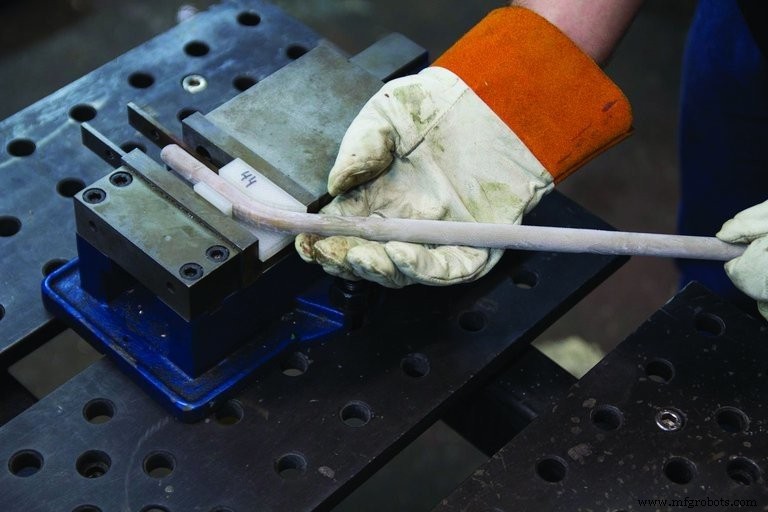
Durand’s custom fixtures—ranging from fiber‑reinforced cheater bars to bespoke clamping profiles—cut costs dramatically. Machining the same components out of nylon would have cost $521.71; 3D printing them in‑house yielded a final price of just $42.12, an order of magnitude savings.
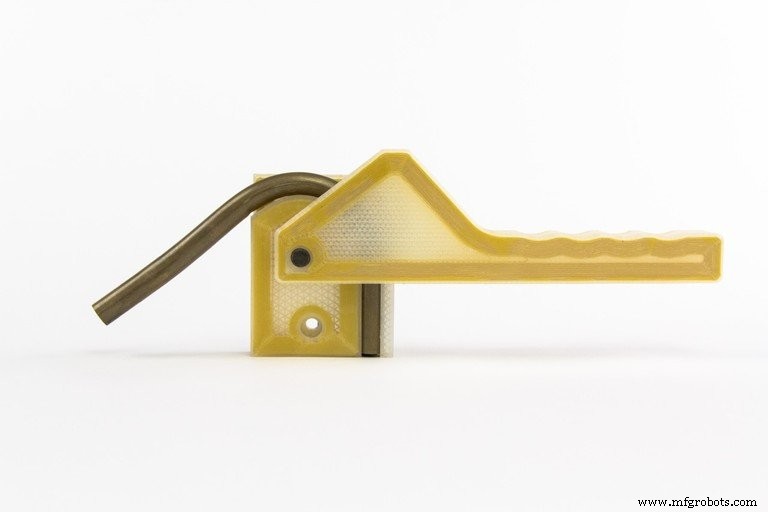
Fixtures, jigs, and soft jaws are often overlooked until the design phase is complete, yet they can be the most time‑intensive tools to produce. A complex soft jaw that must hold a delicate part for drilling can take hours of CNC or manual machining—time that could be better spent on the primary operation.
Here’s where the Mark Two 3D printer shines. By adding a reliable, non‑marring tool kit to the shop floor, machinists can replace cumbersome or costly custom fixtures with lightweight, durable 3D‑printed alternatives. The result? Faster setup, reduced machine downtime, and significant cost savings.
For more on Keith’s French horn fabrication, read here!
3D printing
- How 3D Printing Transforms Jigs & Fixtures: 6 Proven Ways to Boost Production Efficiency
- Synthesis and Characterization of Monodisperse ZnO Nano‑Clips via a Simple Polyol Process
- Eliminate Production Bottlenecks: 5 Proven Tools for Manufacturing Efficiency
- Jig vs. Fixture: Key Differences for Manufacturing Excellence
- 7 Key Challenges in Multilayer PCB Fabrication: Expert Insights
- Jigs vs Fixtures: Clarifying Their Distinct Roles in Manufacturing
- Jigs vs. Fixtures: Key Differences and Impact on Manufacturing Efficiency
- Design Jigs & Fixtures Using CNC Machining & 3D Printing
- How Automation Is Transforming the Fabrication & Welding Industry
- PPprint: Expert FDM 3D Printing of Polypropylene Parts