



Inside Additive Manufacturing: Scott Dunham, VP of Research at SmarTech Analysis, Discusses Key Industry Trends (Part 1)
Read the second part of our interview with Scott Dunham here.

Scott Dunham, Vice President of Research, SmarTech Analysis
With the additive manufacturing (AM) industry evolving rapidly, the most up‑to‑date data and insights are essential. SmarTech Analysis is a leading market‑research firm dedicated to AM, providing analysis and forecasts for hardware, materials, software, and services. In this interview, Scott Dunham shares his expertise on emerging verticals, the future of service providers, and the global outlook for AM.
Could you tell me a bit about your background and how you became involved in additive manufacturing?
I’ve been professionally engaged with AM for seven and a half years. My journey began at a market‑analysis firm focused on two‑dimensional printing technologies. As that sector matured, my team sought new opportunities and I began exploring 3D printing. This led me to SmarTech Analysis, where the founding president envisioned a dedicated AM research firm. We officially launched in late 2013 and have witnessed the industry’s remarkable growth ever since.
Could you tell me a bit more specifically about the work you do at SmarTech?

As Vice President of Research, I lead all research initiatives. While our syndicated market‑research reports are widely recognized, we also collaborate closely with industry leaders on consulting projects. These engagements involve designing research methodologies, conducting opportunity analyses, and advising on market strategy. We provide quarterly growth tracking for large enterprises and author flagship reports that quantify market segments and forecast revenue streams across the AM ecosystem.
What are some of the ways you’ve seen the additive manufacturing industry change over the years?
Key technical processes—such as metal powder‑bed fusion—remain largely unchanged, but the supporting infrastructure has evolved dramatically. Workflow automation and post‑processing software have advanced, reducing cost and effort in volume production. Machine architecture now often includes dedicated material and laser stations, enabling a near‑continuous printing cycle. These enhancements transform the economics of AM, moving it from prototyping to mass production.
We often hear about 3D printing being used in key industries like medical and aerospace. Are there other industries where you’re seeing an increasing adoption of the technology?
While aerospace and medical have historically led adoption, growth rates have slowed as these markets mature. Emerging fast‑growing verticals include automotive, consumer goods, and energy (nuclear, oil & gas). Companies such as Carbon, Desktop Metal, EOS, and 3D Systems are demonstrating how AM can enhance product design and manufacturing beyond prototyping. For example, Carbon’s collaboration with Vitamix shows how reengineering a single component can unlock significant cost savings and performance gains in high‑volume consumer products.
Are there any examples of very niche verticals where 3D printing can still play a transformative role?
Oil & gas and electronics are prime examples. Additive manufacturing is already used for precision parts, especially in electronics where deposition of minute material layers is critical. Some printer manufacturers, like HP and Renishaw, produce metal parts for their own hardware—illustrating confidence in the technology’s reliability. These use cases signal broader industrial acceptance and provide compelling proof points for other sectors.
Recently, SmarTech issued a report on the dental market. Could you share some of the top findings from that report for our readers?
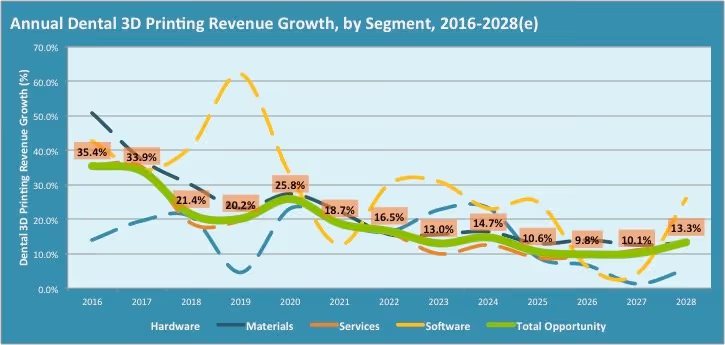
Image source: SmarTech Analysis
Marketing for 3D printing in dentistry has surged, driven by the industry’s potential to transition from manual, labor‑intensive workflows to digital, repeatable processes. Unlike the hearing‑aid market—where non‑customized products now dominate—dental offers an opportunity to convert over 80% of production to additive methods. Photopolymerization (SLA) systems from 3D Systems, Carbon, and EnvisionTech enable rapid, high‑quality production of dental devices, reducing material waste and shortening turnaround times. These capabilities are positioning AM as the next standard for dental manufacturing worldwide.
What does the AM market look like in non‑European and non‑US territories? Is the rate of adoption very different?
Asia remains a key growth region, with substantial opportunities across China, Japan, and Southeast Asia. Adoption is already significant, though much untapped potential remains. In contrast, the Middle East, Africa, and South America lag behind, largely due to limited access to lower‑cost machines. Service‑provider ecosystems are expanding globally, with North American and European firms establishing partnerships in Asia to capitalize on outsourced manufacturing and rapid prototyping demands.
To learn more about SmarTech Analysis, visit: https://www.smartechanalysis.com/
3D printing
- Meet the Onyx Series: Markforged’s New High‑Performance 3D Printers
- Introducing Holistic Build Analysis: Instant Machine Capacity Estimation for Automated Additive Manufacturing Scheduling
- Cutting 3D Printing Costs: Proven Strategies from Design to Post-Processing
- Blacksmith Launches 2,000‑sqft Kendall Square Office to Accelerate AI‑Driven Adaptive Manufacturing
- Stratasys Launches SAF™: Revolutionizing Powder Bed Fusion with High‑Speed Production
- Leading Global Companies Driving Investment in 3D Printing Research
- Why BLTouch and Auto Bed Leveling Are Worth the Investment for 3D Printing Success
- Choosing Between In‑House and Outsourced 3D Printing: A Practical Guide
- AXIS Boosts Aftermarket Auto Part Production Sixfold Using Fuse Series
- Step‑by‑Step Guide to Replacing Nozzle Tips on Your Stratasys 3D Printer