



Solvay’s Brian Alexander on Building High‑Performance Polymers for Additive Manufacturing

As demand for high‑performance polymers in additive manufacturing surges, leading materials companies such as Solvay, BASF and SABIC are expanding their portfolios to meet the needs of production‑grade applications across automotive, medical, aerospace and more.
Solvay, a €10 billion company with a 150‑year legacy in materials science, has become a key player in specialty polymers used worldwide. In this interview, Brian Alexander—founder of Solvay’s Business Incubation Platform for Additive Manufacturing—shares the company’s strategic shift toward AM, the opportunities it unlocks, and why engineering‑grade materials are essential for the next wave of manufacturing.
Recognising the AM Opportunity

Brian Alexander, Solvay Speciality Polymers, Business Incubation Platform for Additive Manufacturing
By early 2016, additive manufacturing had moved from niche to mainstream. Solvay’s leadership responded by creating a dedicated business unit within its Speciality Polymers division to focus exclusively on AM.
“Additive manufacturing aligns perfectly with Solvay’s core markets—high‑value, low‑volume production and mass customisation,” Alexander explains. “Industries like aerospace and healthcare demand thousands of parts per year, not millions, which makes AM an ideal fit.”
With the expiration of key patents in SLS and FFF by 2016, the market opened to new entrants. Solvay seized the opportunity, choosing to view AM as a growth lever rather than a threat.
“In our first year we spoke with leading customers to gauge their AM maturity,” Alexander recalls. “Back then, many believed AM was a prototype‑only technology. Today, that perception has shifted dramatically.”
Shifting the Mindset for AM Success
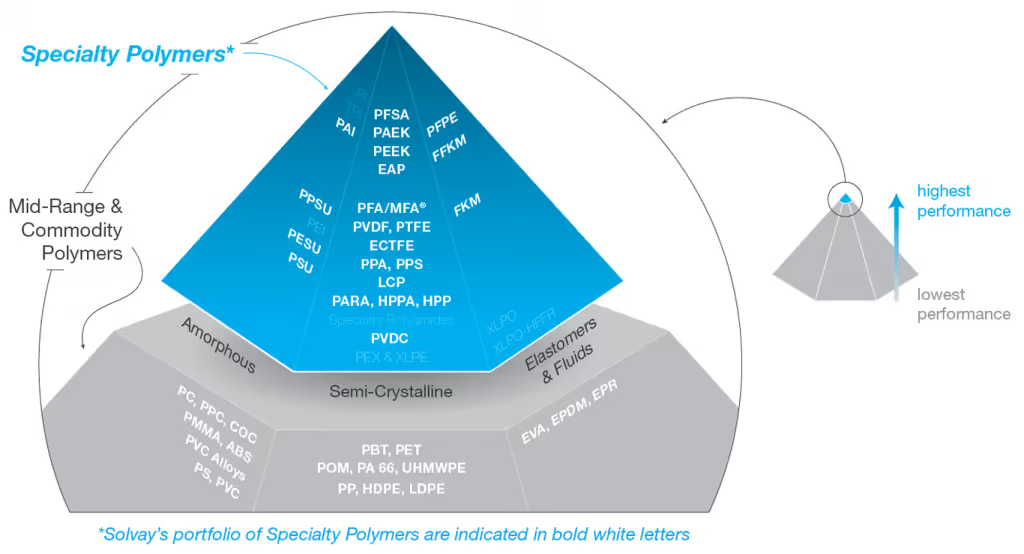
Solvay’s Speciality Polymers unit employs around 3,500 professionals and boasts one of the industry’s most extensive portfolios of high‑performance materials—over 35 distinct polymers, each with unique mechanical, thermal and chemical properties. These high‑value materials are sold in smaller volumes, making them a natural fit for the precision and complexity demanded by AM.
“Traditional manufacturing processes don’t translate directly to AM,” Alexander says. “You must redesign the entire value chain—from raw material formulation to part design and process optimisation—to achieve consistent, high‑quality results.”
Solvay’s goal is to become the premier supplier of customised, AM‑ready solutions. “If we simply marketed our legacy resins in the AM space, we would fall short,” Alexander notes. “Our focus is on materials engineered specifically for the AM process, with clear specifications for feedstock, printing parameters and post‑processing.”
Solvay’s portfolio features more than 35 high‑performance polymers [Image credit: Solvay]
Developing High‑Performance Polymers for AM
While early AM relied on consumer‑grade materials like PLA and ABS, industry leaders now demand industrial‑grade polymers such as PEEK and PPSU.
“Prototyping alone doesn’t unlock the full benefits of AM,” Alexander explains. “For serial production, designers need a broad spectrum of temperature tolerance, mechanical strength, and qualification data. Only then can they exploit lattice structures, lightweighting and part consolidation.”
To meet these needs, Solvay began its AM‑focused research with Fused Filament Fabrication (FFF), the most accessible AM technology, targeting healthcare (mass customisation) and aerospace (small‑batch production).
Key materials—PEEK, known for its exceptional thermal stability and strength‑to‑weight ratio, and PPSU, prized for heat resistance and chemical durability—were selected as launch‑pad polymers.
“Understanding shrinkage, warpage and cohesion is critical,” Alexander says. “Predictive material knowledge allows us to provide reliable print profiles.”
In 2017, Solvay launched its Additive Manufacturing Cup, inviting university students worldwide to print complex parts using PEEK filament. The competition’s success demonstrated the untapped potential of AM and reinforced Solvay’s confidence in its material platform.
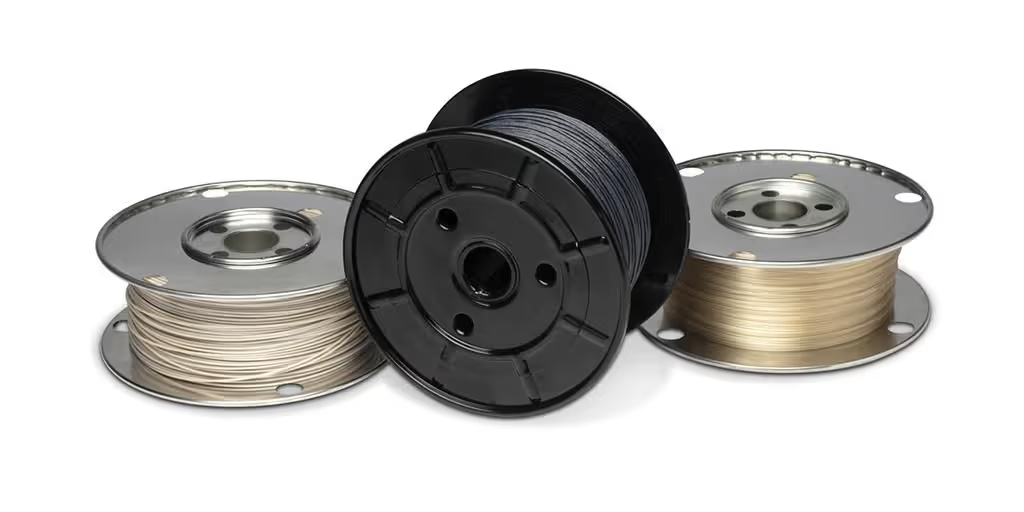
Solvay’s high‑performance polymers include KetaSpire® PEEK and Radel® PPSU [Image credit: Solvay]
A New Business Model: Direct‑to‑Customer E‑Commerce
Building on the Additive Manufacturing Cup, Solvay introduced a groundbreaking e‑commerce platform that makes its polymers available at fair prices to anyone with a credit card.
“We moved away from a closed, distributor‑centric model,” Alexander says. “Our platform offers fast, transparent purchasing and serves as an educational tool for the next generation of designers.”
Data transparency is a cornerstone of Solvay’s approach. “Traditional chemical datasheets focus on injection‑moulded parts,” Alexander notes. “We provide AM‑specific data sheets, giving industrial clients confidence in material performance.”
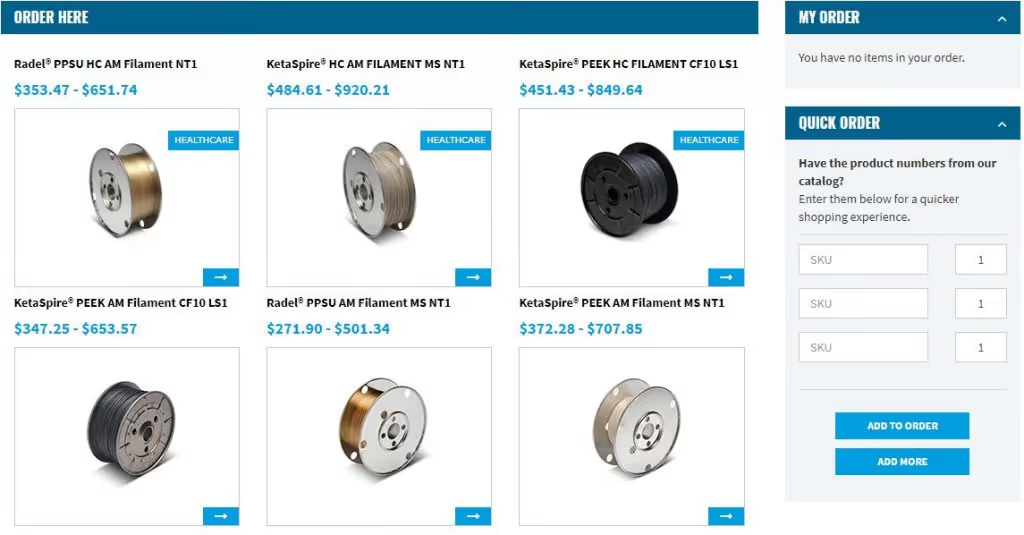
Solvay’s e‑commerce platform for AM materials [Image credit: Solvay]
Process Control: The Key to Consistency
Alexander emphasizes the necessity of robust process control. “A poorly managed AM process leads to porous parts with inconsistent mechanical properties.”
To deliver plug‑and‑play reliability, Solvay partners with printer manufacturers to fine‑tune print profiles tailored to its polymers. “We aim for a material that, once loaded, produces repeatable parts with every print.”
Materials Simulation: Predicting Performance Before Printing
In 2018, Solvay partnered with e‑Xstream Engineering to integrate its high‑performance polymers into the Digimat‑AM simulation platform.
“Simulation lets designers predict thermomechanical behavior during the design phase,” Alexander explains. “This reduces costly trial‑and‑error and accelerates time‑to‑market.”
By adding Solvay’s PEEK and PPSU to Digimat‑AM, users can now create digital twins of their parts, evaluating design iterations virtually before printing.

In 2019, Solvay added carbon‑fiber‑filled KetaSpire PEEK and neat Radel PPSU to e‑Xstream Engineering’s Digimat‑AM release [Image credit: e‑Xstream Engineering]
Looking Ahead: The Future of AM Polymers
Alexander envisions a future where additive manufacturing complements rather than replaces traditional methods. “Success hinges on process qualification—if the process doesn’t work, the part fails.”
While material costs remain high, Solvay expects prices to fall as production volumes grow and applications expand. The company aims to qualify its polymers across 10–15 commercial printers, extend partnerships into powder‑based technologies such as SLS and Multi‑Jet Fusion, and collaborate with OEMs committed to disruptive innovation.
For more information about Solvay’s material solutions, visit Solvay.com.
Expert Interviews
AMFG’s Expert Interviews series showcases innovative companies and individuals shaping the future of additive manufacturing. For more information about participating in the series, please contact marketing@amfg.ai.
3D printing
- PLA vs. ABS Filaments: Key Differences in Strength, Usability, and Heat Resistance
- Why a Filament Runout Sensor is Crucial for Reliable 3D Printing
- 10 Proven Techniques to Eliminate Heat Creep in FDM 3D Printing
- Silencing the Ender 3 Series: Proven Tips for a Quieter 3D Printing Experience
- High-Performance Conductive PLA Filament for 3D Printing
- Home 3D Printing Cost Breakdown: Power, Materials, and Savings
- Wax 3D Printing: Feasibility, Applications, and Future Outlook
- Additive Manufacturing & 3D Printing Explained: Key Insights & Applications
- Robotic Arms for 3D Printing: Leading Manufacturers, Benefits & Drawbacks
- Altair’s Ravi Kunju Discusses Simulation-Driven Design & the New Inspire Print3D for 3D Printing