



John Kawola, President of Ultimaker, Discusses 3D Printing’s Future and Enterprise Growth

Since 2011, Ultimaker has become a household name in desktop 3‑D printing. Founded on the belief that additive manufacturing should be accessible, the company offers open‑source printers, materials, and software. 2018 marked a pivotal year: the launch of the S5 and new partnerships with major material suppliers. We spoke with John Kawola, President of Ultimaker North America, to explore the company’s shift toward enterprise, the growing role of desktop printers in manufacturing, and the future of the technology.
How did you first get involved in additive manufacturing?

John Kawola, President of Ultimaker North America
I’ve been working in additive manufacturing for over two decades. I began at Z Corporation in the early 2000s and joined Ultimaker in 2016. Over the years I’ve watched 3‑D printing evolve through three distinct waves: the 1990s’ large, expensive machines; the 2000s’ price drop into the tens of thousands; and the last decade’s explosion of low‑cost desktop printers, metal options, and corporate adoption.
Ultimaker was founded around the time of the consumer hype surrounding 3D printing, with lots of desktop players entering the market. Now that the bubble has burst, where did Ultimaker succeed where others didn’t?
We never fully bought into the 2012‑2013 hype. Early on, our focus was on enthusiasts and hobbyists—people who already had the technical know‑how and the motivation to experiment. The broader consumer narrative that everyone would own a printer proved overoptimistic. Instead, we concentrated on the maker, education, and—by 2018—enterprise markets. Today, the majority of our revenue comes from large companies that rely on our reliable, open‑source solutions.
Was it an active decision to move toward the enterprise sector, or did it happen organically?
Both. Technological advancements—improved print quality, robust software, and a broader material palette—made desktop printers viable for industrial use. As early adopters in manufacturing began integrating the technology, we seized the opportunity to serve their growing needs.
What role do you see desktop systems having in the industrial space? Is it an either‑or choice between desktop and larger industrial machines?
Desktop printers are increasingly displacing older, more expensive machines in prototyping, tooling, and short‑run production. Engineers now install printers on their desks or in small clusters, replacing centralized “print rooms.” While large industrial printers still dominate high‑volume production, the gap is narrowing as desktop machines handle more demanding materials—glass‑filled composites, for example—and deliver comparable quality.
Do you see that trend progressing further in terms of desktop 3D printers getting better and being used for even more applications?
Absolutely. Improvements are coming from two fronts: user‑friendly workflows and material performance. Our open platform allows material developers worldwide to create high‑quality filaments, enabling faster, more accurate, and more durable parts. This collaborative ecosystem is accelerating progress.
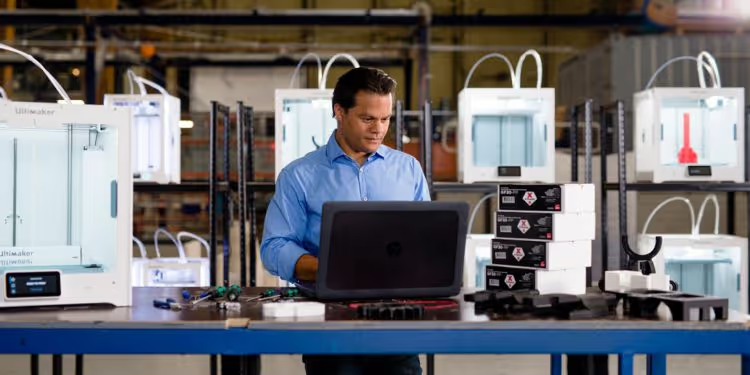
Ultimaker recently announced its global alliance with materials companies to bring more professional materials to market for plastic extrusion‑based processes.
Ultimaker has recently announced collaborations with several chemical companies. What was the strategic reasoning behind this, and how do you see this developing in future?
Large manufacturers—automotive, toy, equipment—purchase massive quantities of plastic each year. They want prototyping materials that match production grades. By partnering with leading plastics suppliers, we align filament chemistry with injection‑molded parts, enabling a seamless transition from prototype to production. As 3‑D printing’s share of total manufacturing grows, these partnerships become essential.
So materials innovation is an important area for 3D printing.
Yes. For production‑ready parts, material consistency is paramount. The influx of established plastics research teams—beyond the limited R&D at traditional 3‑D printer makers—means more robust, certified, and cost‑effective materials are entering the market.
Let’s move from materials to hardware: what was the vision behind Ultimaker’s S5 machine and how does it differ from other machines on the market?
Our product roadmap has been built to match the enterprise trajectory. Starting with the 2+, we moved to the dual‑extrusion 3, and now the S5. The S5 offers a larger build volume, advanced automation, and the ability to print with high‑performance composites. It bridges the gap between prototyping and industrial use, providing reliability and material versatility that earlier models lacked.
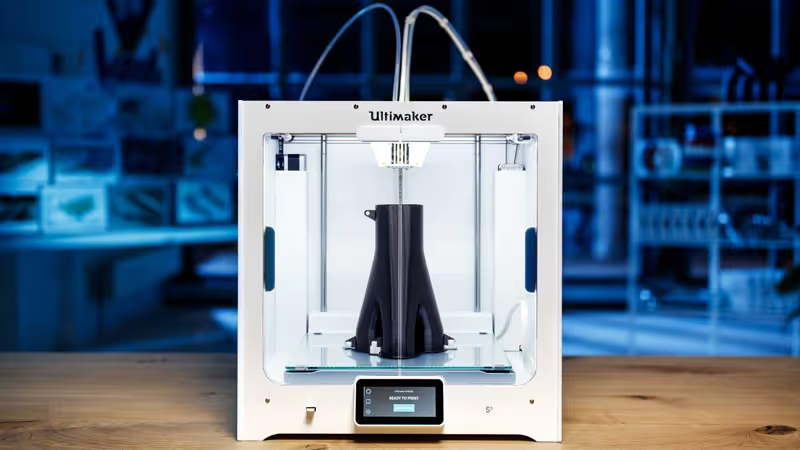
Ultimaker’s S5 3D printer.
Are you planning more product launches in the future?
Yes. We’re investing heavily in the S5 this year and next. Our roadmap splits into two tracks: one focuses on optimized, user‑friendly prototyping tools, and the other on fully industrial machines with enhanced repeatability and a wider material suite. We aim to bring these solutions to market over the next few years.
What do you see as the core challenges still facing the industry?
There’s an ongoing education gap—particularly in production applications. Engineers need to understand that additive manufacturing is distinct from subtractive methods. We must improve ease of use to match everyday office printers, while also meeting the stringent performance requirements of production parts.
How do you see additive manufacturing evolving over the next five years?
We anticipate a shift from prototyping‑centric to production‑centric technology. Companies like HP and Carbon are already building solutions for high‑volume output. Material prices will drop as competition rises, narrowing the cost gap between filament and injection‑molded plastic. The industry will continue to move toward production‑grade parts across more sectors.
What’s next on the horizon for Ultimaker?
Our next steps are twofold: further streamlining the office experience—from design to post‑processing—and developing a new line of printers with higher repeatability, broader material ranges, and short‑run production capabilities.
To learn more about Ultimaker, visit https://ultimaker.com/
3D printing
- Additive Manufacturing Workflow Survey: Share Your Insights
- Elegoo Saturn 3 Review: Is This 12K Resin Printer Worth Your Investment?
- Top CAD Software for 3D Printing: A Professional Guide
- Mastering PETG Bridging: Common Issues, Optimal Settings, and Quick Fixes
- Delta vs Cartesian 3D Printers: A Comprehensive Comparison
- Revolutionizing Bone Implants: How 3D Printing Enhances Fit, Longevity, and Performance
- Markforged Sets New Standards in Antweight Combat Robotics
- Quick Guide: Clean and Unclog Your 3D Pen in 3 Simple Steps
- Understanding 3D Filament Glass Transition Temperatures & How to Optimize Them
- Revolutionizing Fashion: How 3D Printing Transforms Design & Production