



Introducing Holistic Build Analysis: Instant Machine Capacity Estimation for Automated Additive Manufacturing Scheduling
Accurate capacity forecasting is essential to additive manufacturing production planning, yet it remains a complex challenge. How can manufacturers prioritize and schedule jobs while assessing cost‑efficiency?
Introducing Holistic Build Analysis
At AMFG, we’ve spent significant time developing a tool that empowers production teams to optimize scheduling and eliminate inefficiencies early in the additive manufacturing workflow. Traditional nesting software forces users to run iterative simulations, often taking hours or even days to complete. That delay hampers decision‑making and inflates costs.
We’ve responded with Holistic Build Analysis, an AI‑powered solution that estimates build fill rates instantly—no nesting required. By leveraging machine learning, the tool delivers rapid, accurate predictions of how full a machine build will be, enabling teams to make informed decisions in real time.
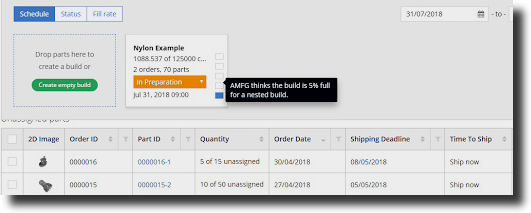
Although nesting remains a valuable part of the additive process, it is not the most efficient way to gauge build capacity or generate cost estimates. Holistic Build Analysis integrates seamlessly into our production management suite, allowing users to assign parts to a build and receive immediate fill‑rate estimates so they know exactly how much space remains.
Benefits of Holistic Build Analysis
1. Save Time and Prioritize Jobs
Predicting fill rates in seconds, rather than hours, dramatically speeds up planning. The machine‑learning engine considers machine availability, production deadlines, and other critical variables, helping teams prioritize the next parts to produce and maintain a streamlined workflow.
2. Reduce Production Costs
Optimizing at the planning stage not only saves time but also cuts costs by aligning resources with demand. By factoring in deadlines and optimal part arrangement, teams can fine‑tune schedules, choose the most cost‑effective jobs, and pack builds more efficiently.
3. Grow and Scale
AMFG’s goal is to deliver a scalable, end‑to‑end additive manufacturing solution. As 3D‑printing adoption grows across industries, Holistic Build Analysis grows with you—supporting larger operations and more complex production chains without compromising performance.
A New Way to Automate Production Scheduling
Holistic Build Analysis marks a significant step toward fully automated additive manufacturing planning. As our machine‑learning models mature, auto‑scheduling will become a cornerstone of maximum efficiency.
Initially, users can override the tool’s estimates with manual inputs. These inputs feed back into the system, refining predictions over time. In the future, the tool will even recommend which parts to produce next, bringing manufacturers closer to a fully automated production cycle.
Learn more about our workflow automation solution for end‑part production
3D printing
- 3D Printing: From Rapid Prototyping to Full‑Scale End‑Part Production
- Stratasys Origin One: Precision 3D Printing for Production-Grade Parts
- 3D Printing for Production: The Missing Standard That Holds Back Mass Adoption
- Fraunhofer Deploys Cutting‑Edge Engel Automation to Advance Thermoplastic Composite R&D
- INEOS Styrolution Expands Production with New Site for Advanced StyLight Thermoplastic Composite
- Mastering Automated Warehousing: A Proven AI Playbook for Your Operation
- Revolutionizing Mass Production: The Key Advantages of 3D Printing
- Instant Design Validation for Additive & Traditional Manufacturing
- Revolutionizing Furniture Production Through Advanced Automation
- Revolutionizing Vehicle Assembly: The Rise of Automated Production