



3D Printing for Production: The Missing Standard That Holds Back Mass Adoption
Since attending the Additive Manufacturing Users’ Group (AMUG) conference last month, I’ve been reflecting on the state of 3D printing in production. While the event highlighted bold visions for mass‑scale additive manufacturing, the reality remains that we are still several years away from widespread adoption.
In certain high‑value sectors—most notably aerospace—3D printing has already proven its worth. Companies such as Pratt & Whitney and Boeing use printed components, like titanium turbine blades and fuel‑efficient structural parts, to reduce weight, cut manufacturing steps, and save millions of dollars annually. Standards are already in place for these applications, with certified materials such as Ultem 9085 meeting strict ISO and ASTM requirements.

Despite these successes, 3D printing’s path to mass production is hindered by several critical challenges. Manufacturers tend to focus on speed and headline‑making technology, but the real hurdle lies in establishing robust engineering standards that ensure consistency, safety, and interoperability across the industry.
Engineering standards serve as a common language, guaranteeing that parts produced by one company meet the expectations of another. They define tolerances, surface finish, material integrity, and more—essentially creating a safety net for the end user. For 3D‑printed parts, crafting these standards is inherently complex.
Three Key Challenges to Mass Production with 3D Printing
1. Anisotropy
By design, additive manufacturing builds objects layer‑by‑layer, resulting in anisotropic properties. Unlike isotropic metals or plastics that exhibit uniform strength in all directions, 3D‑printed parts often display directional strength variations. This makes predictive modeling and fatigue analysis more difficult and can lead to unexpected failures if not properly accounted for.
2. Technology and Material Variability
There is a wide spectrum of 3D‑printing technologies—FDM/FFF, SLA, SLS, PolyJet, and more—each with its own material library and process nuances. Standardizing across this diversity requires extensive testing of dozens of material–process combinations, a task far more daunting than standardizing conventional subtractive manufacturing.
3. Process Inconsistency
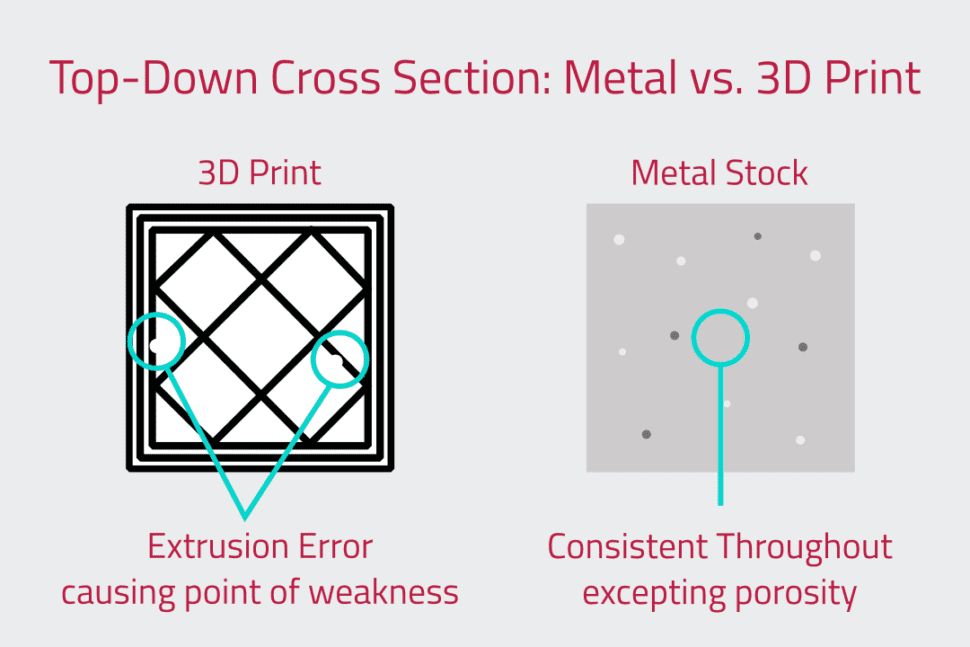
While off‑the‑shelf materials provide predictable bulk properties, additive processes can produce internal variations in infill density, inter‑layer bonding, and surface roughness. Detecting hidden defects is non‑trivial, and a failure inside a critical component—such as a structural bracket in an automotive chassis—could have catastrophic consequences. Engineering standards that mandate comprehensive quality control and non‑destructive testing are essential to mitigate these risks.
Is Additive Manufacturing Ready for Mass Production?
While the trajectory of 3D printing points toward eventual dominance over traditional subtractive methods, the journey is long. The biggest barrier remains the development of comprehensive quality standards by bodies such as ISO and ASTM. Once these frameworks are in place, the industry can unlock the full potential of additive manufacturing for end‑use production parts worldwide.
3D printing
- 3D Printing: From Rapid Prototyping to Full‑Scale End‑Part Production
- Why Origin One Is a Game‑Changer for Production‑Ready 3D Printed Parts
- Stratasys Origin One: Precision 3D Printing for Production-Grade Parts
- Onyx: The Next Leap in Production‑Ready 3D Printing
- Harnessing 3D Printing in Higher Education: Benefits, Case Studies, and Resources
- Revolutionizing Mass Production: The Key Advantages of 3D Printing
- PLA vs ABS: Which Filament Is Best for Miniature 3D Printing
- Top 3D Printing Infill Patterns: Which One Offers the Most Strength?
- Tinkercad for 3D Printing: A Comprehensive Review for Beginners
- Is SketchUp Ideal for 3D Printing? A Comprehensive Review