



What Is SLA 3D Printing? A Comprehensive Guide to Stereolithography
by Mike Brooks | Last Updated: June 25, 2022
Stereolithography, commonly known as SLA, is one of the three leading 3D printing technologies. It uses a focused UV laser to cure liquid photopolymer resin layer by layer, producing parts with exceptional detail and surface finish.
What Does SLA Stand For?
SLA stands for Stereolithography Apparatus, a process that relies on photopolymerization to create solid objects from liquid resin. The technique dates back to the 1970s and was patented by Chuck Hull in 1984.
How SLA 3D Printing Works
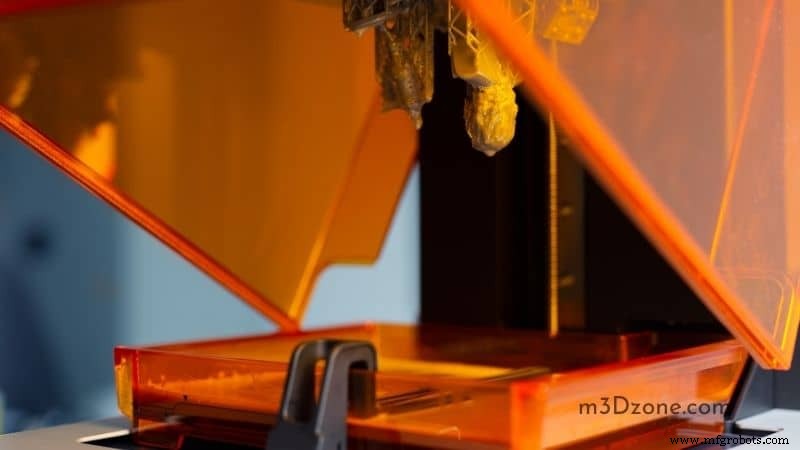
The process begins with a build platform submerged just above a tank of liquid, photosensitive resin. A UV laser, steered by galvanometer mirrors (galvos), traces the cross‑section of each layer, selectively hardening the resin. After each layer, a sweeper blade clears the surface, and the platform lowers to repeat the cycle until the model is complete.
Once the print is finished, the part is still partially cured. A post‑cure step under UV light fully polymerizes the resin, ensuring maximum mechanical and thermal performance.
Why Choose SLA?
- Isotropy: Layers bond with covalent links, giving parts uniform strength in all directions—ideal for functional prototypes and jigs.
- Watertightness: SLA prints are fully continuous, making them perfect for components that must hold liquids or gases.
- Precision & Accuracy: The laser’s point‑by‑point curing yields tolerances in the micrometer range, outpacing most other methods.
- Surface Finish: Minimal post‑processing is required, and the result is a smooth, high‑resolution finish suitable for dental, jewelry, and engineering applications.
What Is an SLA 3D Printer?
An SLA printer is a machine that uses a high‑power UV laser to harden liquid resin into a solid object, layer by layer. It is one of the three major additive manufacturing categories, alongside FDM and Selective Laser Sintering (SLS). A related technology, Digital Light Processing (DLP), uses a projector instead of a laser, offering faster build times but slightly lower resolution.
SLA vs. DLP
The key difference lies in the light source: SLA employs a moving laser beam for point‑wise curing, while DLP projects a full layer at once. SLA typically delivers higher accuracy, whereas DLP is faster and more cost‑effective for large, less detailed parts.
SLA vs. FDM
When choosing between SLA and FDM, consider these factors:
- Print Quality: SLA provides smoother surfaces and finer details due to laser precision; FDM relies on extruded filament lines.
- Materials: SLA can use a broad range of photopolymer resins, including high‑strength, high‑temperature, and biocompatible variants. FDM typically supports thermoplastics like PETG, TPU, and even high‑performance polymers such as PEEK.
- Build Volume: FDM printers usually offer larger build envelopes, making them better for sizeable parts.
- Speed: For identical layer heights, SLA can print faster and with higher surface finish, but FDM may be quicker for large, coarse parts.
Are SLA Parts Strong?
The strength of SLA prints depends largely on the resin used. While standard resins yield fragile parts, specialized engineering resins deliver high mechanical and thermal performance. Common applications include:
- Prototyping with standard or high‑strength resins
- Dental and medical devices requiring biocompatibility
- Castable resins for metal casting (no ash residue)
- High‑temperature resins for components exposed to heat
Conclusion
Understanding the fundamentals of SLA technology—its precise laser‑based curing, material versatility, and superior finish—helps you make informed choices for prototyping and production. Selecting the right resin and post‑processing steps ensures durable, high‑quality parts that meet your engineering requirements.

Recommended Reading
3D printing
- Preventing and Fixing Adhesion Issues in FDM 3D Printing
- Tensile Strength Explained: Key Definitions, Importance, Types, and Real-World Examples
- Printing with Multiple Infill Patterns & Densities: A Step-by-Step Guide
- TCT Show 2018: 10 Must‑See Additive‑Manufacturing Innovations
- Does PLA Dissolve or Decompose in Water? Conditions & Waterproofing Tips
- Mastering Volume Packing and Part Orientation for Faster, Cost‑Effective Additive Manufacturing
- V650 Flex: Stratasys’ Reliable SLA Solution for Precise 3D Printing
- Metal 3D Printing Explained: A Three‑Step Process From Design to Finished Part
- 3D Printing Accelerates EV Body Design and Production
- Understanding Resin 3D Printing: Process, Applications, and Benefits