



Face First: Protecting Your Nose with Markforged Kevlar® Reinforced Masks
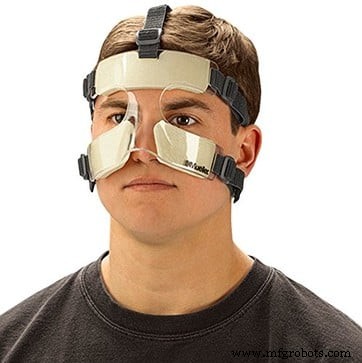
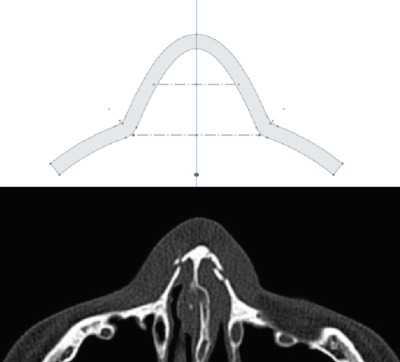
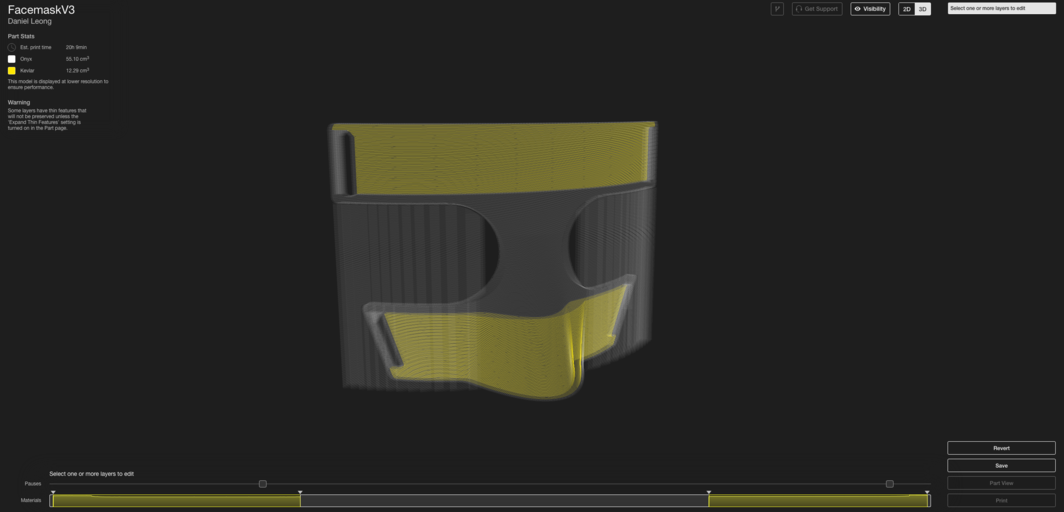
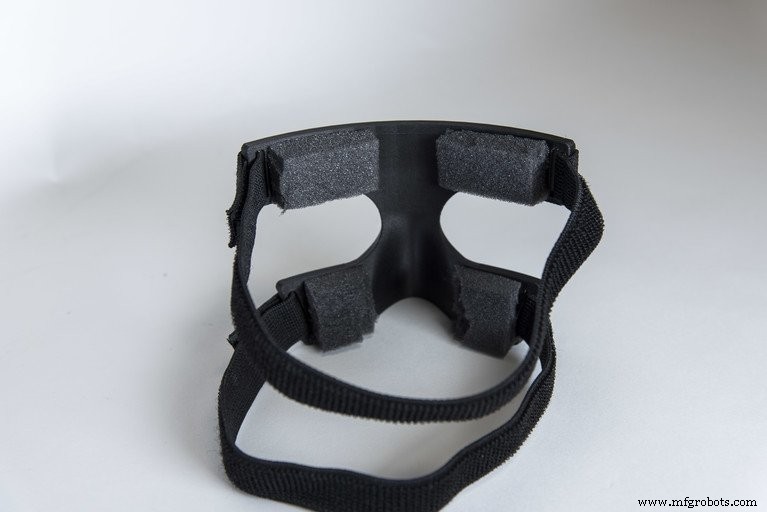
Interested in learning more about how Markforged’s Kevlar®‑based Aramid fiber works? Check this page out! A month ago I suffered a broken nose during a skiing trip in Vermont. While the injury healed quickly, the bone required up to six weeks of rest before it was fully structurally sound. During that time I was fit to move but could not tolerate any impact to the nose. Traditional face‑guards made of polycarbonate are expensive, and I wanted a custom solution that would keep my nose safe without compromising performance on the field. My mask needed two core functions: 1) completely prevent any contact with the nose, and 2) remain as unobtrusive as possible. Impact forces must be redirected to the cheekbones and forehead, so the mask’s shell must be stiff and impact‑resistant while the contact pads keep the load off the nasal bones. The shell also has to be lightweight, fit snugly, and allow full peripheral vision—critical for sports like soccer. With no ready‑made facial templates, I measured key facial dimensions with calipers and used my own CAT‑scan cross‑sections to shape the mask. After several iterations, I achieved a contour that sat comfortably on the face with a 5 mm clearance from the nose. I adjusted the top and bottom radii to ensure the support material adhered to the print bed rather than the part itself, and I cut generous eye openings that still covered the nasal bridge internally. For the build, I chose Markforged Onyx as the matrix material and incorporated Kevlar® reinforcement. Kevlar offers excellent impact resistance with a low risk of catastrophic failure, whereas continuous carbon fiber would be stiffer but more prone to catastrophic breakage. I deliberately omitted fiber along the nasal bridge to enhance layer adhesion and reduce the chance of a layer‑line crack. To secure the mask, I installed inexpensive elastic Velcro straps and bonded foam pads to the corners with Loctite 401. The straps hold the mask firmly yet comfortably, and the foam cushions the contact points. I have worn the mask in two full soccer sessions. It has successfully absorbed impacts around the face without any damage to my nose. The only trade‑offs are a slight restriction of downward peripheral vision and minor muscle fatigue that affects focus—issues that are acceptable until I receive clearance for full contact play. Dupont™ and Kevlar® are trademarks and registered trademarks of E. I. du Pont de Nemours and CompanyIntroduction
Mask Requirements
Design Process
Field Testing
3D printing
- Interview with Markforged’s Ibraheem Khadar on 3D Printing Innovation at formnext
- Markforged 3‑D‑Printed Part Revives Lost Kayak Rudder: A Real‑World Success Story
- Revolutionize Assembly Fixtures with Markforged Composite 3D Printing
- Markforged’s Mark Two Accelerates Innovation at MIT’s 2016 Hardware Hackathon
- Demonstrating Embedded Hardware with Dan Topjian’s Kevlar®‑Reinforced Letter Opener
- Optimizing Robot Traction: Custom 3‑D‑Printed Wheels with Markforged Casting
- Dunlop Systems Accelerates Tool Production with Markforged 3D Printing
- Saint‑Gobain Boosts Production Efficiency with Markforged 3D Printing
- Smart Door Access System with Facial Recognition Unlocking
- Fast Radius Reusable 3D‑Printed Face Mask – DIY Design