



Boost Strength‑to‑Weight in 3D‑Printed Parts with Automatic Composite Sandwich Panels
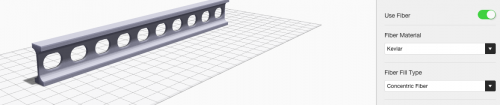
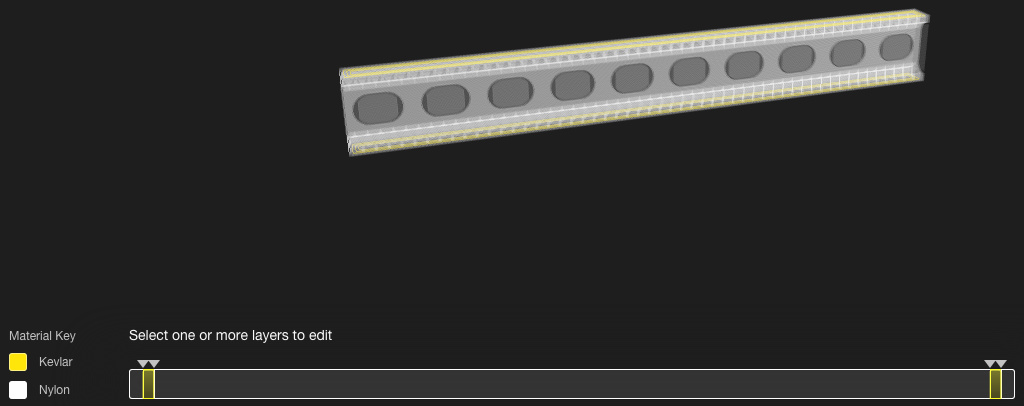
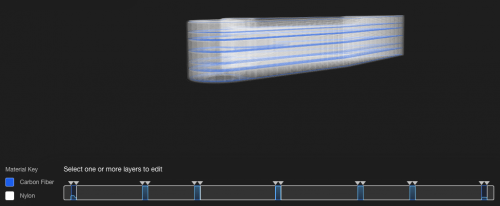
I‑beams are a staple in construction, efficiently resisting bending and shear with a flange that bears the load and a web that transfers shear stress. In large‑scale steel structures, this geometry is standard, but at smaller scales we can replicate the same mechanical advantage using composite sandwich panels. As shown below, a typical composite sandwich consists of a lightweight honeycomb core sandwiched between two layers of high‑strength carbon fiber. The carbon layers carry the majority of the load, while the honeycomb core transfers shear between the faces, keeping the structure thin yet stiff. The conventional epoxy lay‑up method yields excellent strength but can be restrictive in geometry and scale. It also demands hazardous chemicals, PPE, and dedicated workspace—challenges that limit rapid prototyping and on‑site fabrication. 1. Import your CAD model into Eiger. 2. Click the “Add Fiber” button. Eiger automatically deposits fiber sections on the top and bottom surfaces of your part. In the internal view you’ll see the new sandwich structure instantly. In the example above, the software added Kevlar layers to an I‑beam model, producing a lightweight, high‑strength sandwich that dramatically improves the strength‑to‑weight ratio. Need more strength? Adjust the sliders to increase the thickness of the top or bottom layers, or add additional fiber layers in the middle of the part. For parts with complex geometries—such as the jaw below—manual placement allows you to align reinforcement precisely with critical load paths. This jaw features two layers of fiberglass, strategically positioned to reinforce the knuckle joint, demonstrating how targeted reinforcement can further optimize performance.What is a Composite Sandwich?
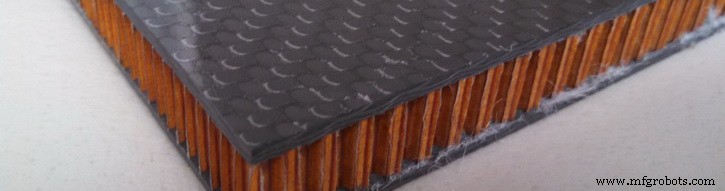
Quickly Build Sandwich Panels with Eiger
3D printing
- Top 5 Carbon Fiber Applications Revolutionizing Modern Sports
- Composite Engineering & Carbon Fiber: How Advanced Materials Shape Modern Infrastructure
- Top 3 Manufacturing Applications of Carbon Fiber 3D Printing
- Lean Machine: 3D‑Printed Composite Vises Boost Fabrication Efficiency
- Introducing the Composite Cable Clamp by MechEngineerMike: A Durable, Kevlar‑Reinforced Solution
- Unlocking the Power of Composite Materials in 3D Printing
- Industries Leading the Robotics Revolution
- CW’s Top 10 News Stories of the 2010s
- Industrializing Continuous Fiber Composite 3D Printing in Delft: Advancements & Production Success
- Understanding Composite Panels: Lightweight, Strong Building Materials