



Unlocking the Power of Composite Materials in 3D Printing
In our previous blog, we examined the trade‑offs of popular 3D‑printing thermoplastics. While their low melting point and ease of use make them ideal for rapid prototyping, they often fall short in mechanical performance—strength, stiffness, and heat resistance. Markforged’s 3D‑printed composites, built on a process similar to Fused Filament Fabrication, overcome these limitations and deliver properties that routinely surpass conventional thermoplastics.
Read our Composites Design Guide
What Are Composites?
Composite materials combine two or more constituents to create a final product with characteristics that differ from each component alone. A typical fiber composite consists of a matrix that binds the structure and a reinforcement—such as carbon or glass fibers—driving its mechanical behavior. The synergy between matrix and reinforcement allows composites to outperform thermoplastics while remaining lightweight. For instance, many carbon‑fiber layups are stronger than steel yet weigh only a tenth of it.

Markforged’s 3D‑printed composites combine a nylon‑based thermoplastic called Onyx (the matrix) with one of four continuous‑fiber reinforcements: carbon, fiberglass, high‑strength high‑temperature fiberglass (HSHT), or Kevlar®.
Request a demo
3D‑Printed Composites
Like all composites, these parts feature a matrix and a reinforcement. Onyx provides toughness and flexibility, while the chosen fiber delivers stiffness, strength, or temperature resilience.
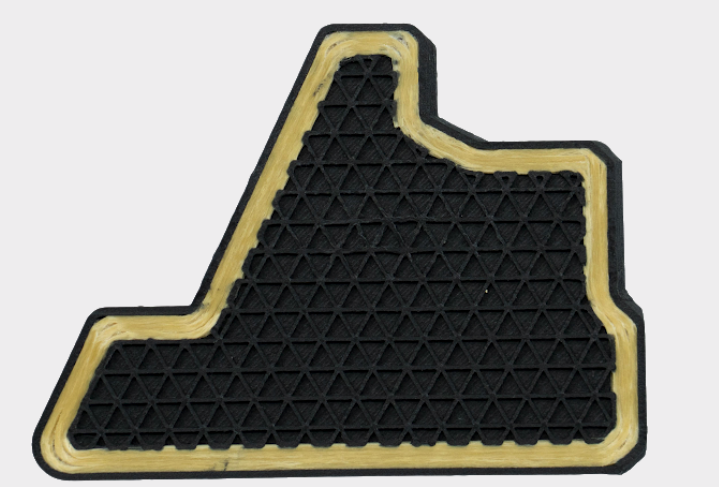

Fiberglass
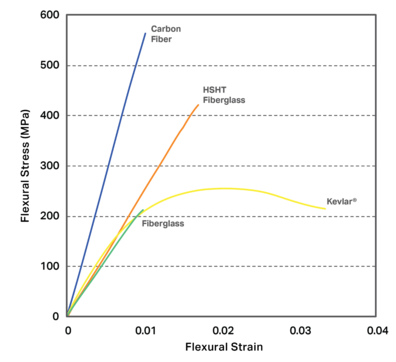
Fiberglass is our entry‑level reinforcement. Composed of glass filaments, it delivers impressive performance at a low cost. In flexural testing, fiberglass is four times stronger and eleven times stiffer than ABS, making it ideal for industrial fixtures, workholding, and other applications that demand more strength than a pure thermoplastic can provide.
Carbon Fiber
Carbon fiber is the strongest and stiffest of Markforged’s fibers. Its strength‑to‑weight ratio is nearly twice that of 6061 aluminum, enabling 3D‑printed parts to outclass machined metal in both performance and weight. Because it deflects only minimally under load, carbon‑fiber parts excel in applications where precision and durability are critical. Many customers use it to produce soft jaws, end‑use components, and production‑tooling that would otherwise be machined from metal.
Kevlar®
Kevlar® offers unique durability and a lower density—15–20 % lighter than other fibers. It can plastically deform without losing strength, providing a more gradual, predictable failure mode compared to the brittle nature of carbon fiber. Kevlar‑reinforced parts are ideal for high‑motion or high‑contact environments such as end effectors, crash‑test dummies, and mechanical stops.
Request a free sample part
High‑Strength High‑Temperature Fiberglass (HSHT)
HSHT combines heat resistance with exceptional impact performance: 30× that of ABS and over 100× that of PLA. It retains rigidity up to 300 °F and is highly elastic—deflecting under load and returning to shape when the load is removed. These properties make HSHT perfect for components that undergo repeated clamping, thermal shock, or high‑impact forces, such as welding fixtures, thermoforms, and mold inserts.
Composite 3D Printing
Composite 3D printing unlocks a new spectrum of material properties for the entire manufacturing cycle. By choosing the right fiber—fiberglass for cost‑effective strength, carbon for ultra‑high performance, Kevlar for durability, or HSHT for heat‑resistant impact—engineers can create parts that were previously impossible or prohibitively expensive to manufacture.
Want to discover how 3D printing can transform your business? Talk to one of our product specialists.
3D printing
- 10 Unexpected Examples of Composite Materials You Didn't Know Existed
- Why Carbon Fiber Leads the Composite Materials Market
- Composite Manufacturing: Advancing Materials for Aerospace, Energy, and Healthcare
- Composite Engineering & Carbon Fiber: How Advanced Materials Shape Modern Infrastructure
- Composite Materials: The Modern Solution for Lightweight, Durable, and Cost‑Effective Engineering
- Broad Applications of Glass Fiber Fabric in Advanced Composite Materials
- Discover the Latest Composite Materials at NPE2018 – Find Key Suppliers & Innovations
- Exploring 3D Printing Composite Materials: A Practical Guide for Engineers
- SIGRATHERM® ePCM Composite Materials: High-Density Thermal Energy Storage
- Understanding Brittleness in Materials: Causes, Consequences, and Testing